
Abu al-Hawl, the lion-bodied guardian of Gizeh
Published on 08/18/2026 at 13:55 | Editorial responsibility: Rafael Müller, Editor-in-Chief AD HOC NEWS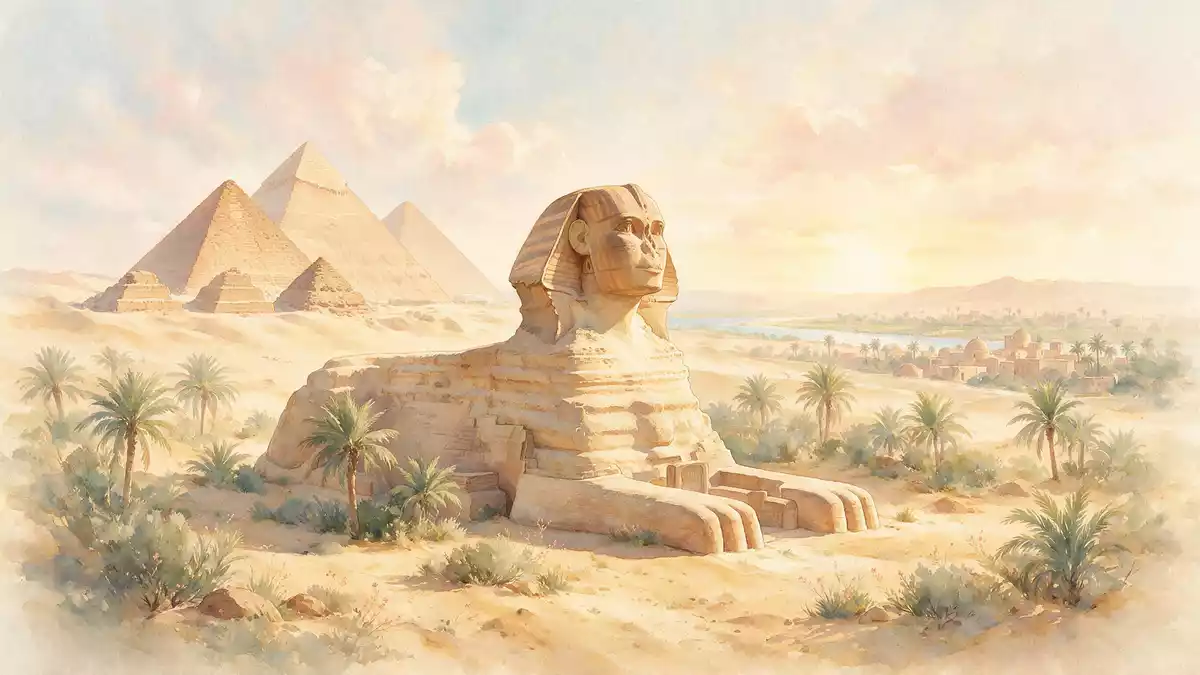
Abu al-Hawl, better known in English as the Great Sphinx of Giza, crouches on the Giza Plateau with the body of a lion and the head of a human ruler. Carved from the natural limestone bedrock during Egypt’s Old Kingdom, it stands beside the pyramid complex traditionally linked to Pharaoh Khafre in the twenty-fifth century BC and forms one of the defining monuments of ancient Gizeh.
A lion body and a human face in limestone
The most striking feature of Abu al-Hawl is its hybrid form, combining an elongated lion’s body with an upright human head carved from the same mass of limestone. The statue is hewn directly from the Eocene limestone of the Giza Plateau rather than assembled from blocks, which gives the whole figure a continuous, sculpted outline in the rock.Limestone statue of a reclining sphinx The creature reclines with its forepaws stretched out towards the eastern desert edge, while the bulk of the body extends back towards the west.
From paw to tail the Great Sphinx reaches about 73 m (240 ft) in length, and from the base to the top of the head it rises to roughly 20 m (66 ft).Colossal limestone statue in Giza The width across the hindquarters is around 19 m (62 ft), so the sculpture fills a shallow, quarried hollow in the plateau with a mass of pale stone shaped into sinews, chest and flanks. The head wears a royal headdress, and traces of a ceremonial beard and uraeus cobra are documented in museum collections, even though those elements are no longer complete on the monument itself.Dimensions and form of the Great Sphinx
Old Kingdom origins on the Giza Plateau
Abu al-Hawl stands on the west bank of the Nile at Gizeh, on a stretch of desert plateau that carries the pyramids of Khufu, Khafre and Menkaure. Archaeologists place the carving of the Sphinx in Egypt’s Fourth Dynasty, during the reign of Pharaoh Khafre in the twenty-fifth century BC, when the surrounding pyramid complex was being developed.Fourth Dynasty dating under Khafre In this setting the reclining lion figure marks the edge of the funerary landscape overlooking the cultivated valley.
The Arabic name Abu al-Hawl, meaning “father of terror” or “father of dread”, appears in medieval and later sources as the standard local name for the Sphinx.Arabic name Abu al-Haul for the Sphinx Earlier Egyptian texts use different designations, but the modern Arabic name has become closely tied to the monument’s role as a monumental guardian on the plateau. The Giza Plateau itself forms part of the wider Memphis and its Necropolis UNESCO World Heritage Site, which links Abu al-Hawl to the surrounding pyramids and tombs as one archaeological complex.Sphinx within the Giza World Heritage landscape
Weathered guardian beside the pyramids
For visitors approaching across the plateau, Abu al-Hawl appears set slightly below the surrounding ground level in a rectangular hollow cut into the bedrock. The statue faces east towards the rising sun and towards the low ground of the Nile floodplain, with the pyramids of Gizeh positioned behind it on higher desert ground.Location on the Giza Plateau west of the Nile The contrast between the compact, elongated body of the Sphinx and the clean geometric forms of the neighbouring pyramids defines the main panorama at this end of the necropolis.
Centuries of wind and sand have left their marks on the limestone surface, softening details of the paws and chest and exposing different layers of rock in the flanks. The face has lost its nose and parts of the headdress, so the features that survive are framed by rougher surfaces and restoration blocks in places.Ancient colossal statue cut from bedrock Even in this weathered state, carved eyes, ears and the line of the mouth remain visible enough for visitors to recognise the human figure emerging from the lion’s body when viewed from the surrounding walkways and viewing terraces.
Visiting Abu al-Hawl: what travellers from Western Europe should know
- Abu al-Hawl stands on the Giza Plateau on the western side of the Nile, near the city of Gizeh and within sight of the pyramids of Khufu, Khafre and Menkaure.
- The ground around the Sphinx consists of uneven limestone ledges and man-made steps, and reaching the main viewpoints involves walking on stone paths with some gradients.
- The site lies on the edge of the Sahara, where summer temperatures can be high and the open plateau offers little natural shade around the monument.
- Gizeh is part of Egypt, where the official language is Arabic and the currency is the Egyptian pound.
- Entry requirements depend on your nationality; UK travellers can check the FCDO travel advice at gov.uk/foreign-travel-advice, Irish travellers the Department of Foreign Affairs at ireland.ie.
Searching for Abu al-Hawl on social platforms
These links open searches for Abu al-Hawl on each platform.
Frequently asked questions about Abu al-Hawl
Where is Abu al-Hawl located?
Abu al-Hawl stands on the Giza Plateau in Egypt, on the west bank of the Nile near Gizeh and close to Cairo.
What can visitors expect when seeing the Sphinx?
Visitors see a colossal limestone statue of a reclining lion with a human head, set in a hollow below the surrounding desert and framed by the pyramids.
What makes Abu al-Hawl distinctive among ancient monuments?
The combination of lion body and royal head carved from a single mass of bedrock, together with its association with Pharaoh Khafre’s Fourth Dynasty pyramid complex, makes Abu al-Hawl distinctive.


