Gold Rallies on a Double Dose of Support Despite a 'Death Cross' Warning
Published on 07/05/2026 at 17:22 | Redaktion boerse-global.de
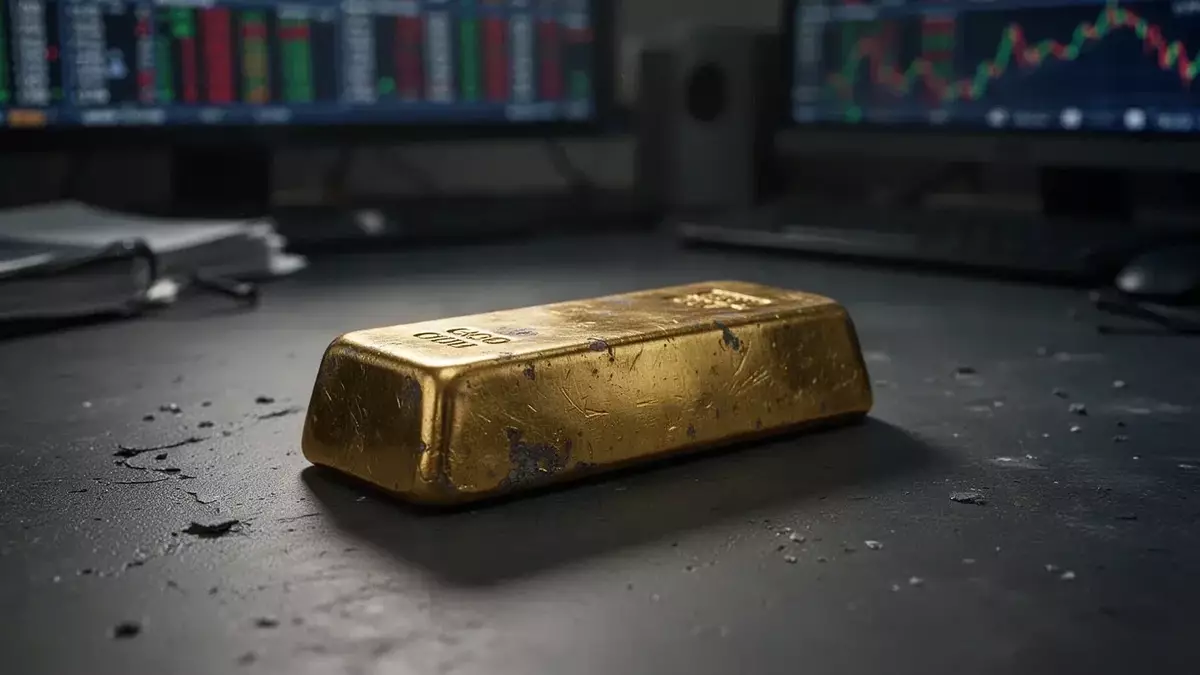
Gold snapped a four-week losing streak with a sharp weekly advance, as a disastrous US jobs report and a surge in central bank hoarding threw a lifeline to the beleaguered metal. The yellow metal closed Friday at $4,187.30 an ounce, chalking up a gain of roughly 2% on the week. Yet the broader picture remains fragile: the metal is still nursing a monthly loss of 6.16% and sits nearly 3.5% below its year-end level. Chartists point to a recent death cross—where the 50-day moving average sliced below the 200-day—as a reminder that the underlying trend has turned hostile.
The catalyst for Friday’s turnaround was the US nonfarm payrolls report for June, which showed only 57,000 new jobs added, barely half the 110,000–115,000 that economists had pencilled in. The miss sent traders scrambling to recalibrate their rate expectations: the probability of a Federal Reserve rate hike at the September meeting plunged from 66% to around 53%. Because gold pays no interest, a delay in tighter monetary policy lowers the opportunity cost of holding the metal, breathing fresh life into a market that had been pummelled through June.
Adding to the bullish cocktail, central banks continue to hoard bullion at a record pace. The World Gold Council reported net purchases of 41 tonnes in May, led by Poland’s 18-tonne addition and China’s 20th consecutive monthly increase, which lifted its total reserves to 2,331 tonnes. A recent WGC survey revealed that 45% of central banks intend to raise their gold holdings over the next 12 months—a new high. For the first time, gold now occupies a larger share of global reserves than US Treasuries, underscoring the metal’s enduring appeal as a reserve asset even as its price struggles.
Should investors sell immediately? Or is it worth buying Gold?
The week ahead is laden with potential catalysts. The Fed is set to release the minutes from its first meeting under new chairman Kevin Warsh, who has recently described inflation risks as easing. Investors will scour the record for any signal on the pace of future rate moves. At the same time, fresh US inflation data is due, while across the Atlantic the European Central Bank—which last month hiked its key rate to 2.25%—will announce its next decision on 23 July. The widening interest-rate differential between the Fed and the ECB could drive further dollar weakness, which in turn would lower the cost of gold for non-US buyers and provide an additional tailwind.
From a technical standpoint, the metal faces an immediate hurdle in the $4,200–$4,300 zone. The 50-day moving average sits at $4,415, roughly 5% above Friday’s close, while the relative strength index of 46.6 points to neither overbought nor oversold conditions. A clean break above $4,200 would open the door to medium-term targets set by major banks: Goldman Sachs sees gold at $4,900 next year, and JPMorgan has pencilled in $4,500 for the fourth quarter of 2026. On the downside, support at $4,000 has proved sturdy in recent weeks, with the 52-week low of $3,901.30 offering a final backstop.
Meanwhile, silver’s jump above $62 an ounce pushed the gold-silver ratio to 66.9, a sign that the precious metals complex is beginning to broaden its recovery. Whether gold can sustain the bounce will hinge on how convincingly it clears the $4,200 resistance. The Fed minutes and the dollar’s trajectory look set to determine the outcome.
Ad
Gold Stock: New Analysis - 5 July
Fresh Gold information released. What's the impact for investors? Our latest independent report examines recent figures and market trends.
Disclaimer regarding our articles: No investment advice, no buy or sell recommendation. Information on prices, companies, and markets is provided without guarantee; changes are possible at any time. Stock market transactions can lead to substantial losses. Our articles are created and reviewed in whole or in part automatically with the support of AI.