
Vallourec stock holds steady as energy outlook shapes investor mood
Published on 08/29/2026 at 14:04 | Editorial responsibility: Rafael Müller, Editor-in-Chief AD HOC NEWS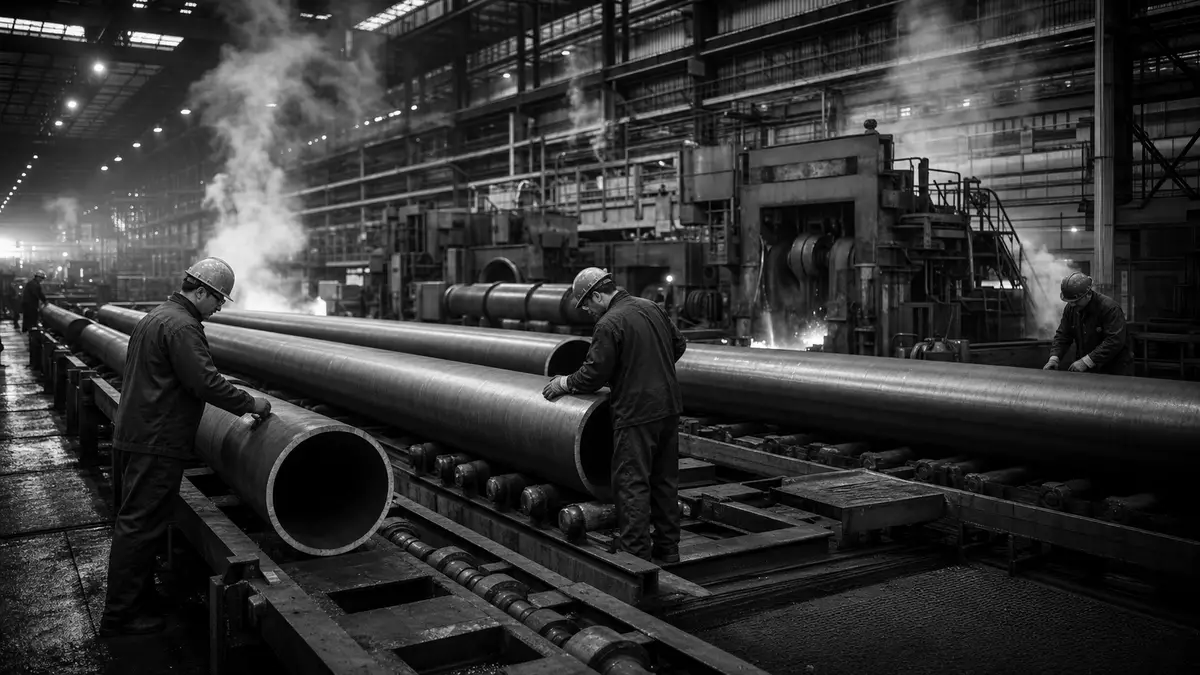
Vallourec SA (ISIN FR0000125684) remains a key European play on energy and industrial investment cycles, with Vallourec stock recently trading in the mid-teens in euro terms on Euronext Paris as of late August 2026 per recent market data.
Recent trading and valuation context
Market data from a European quote overview shows Vallourec changing hands at 17.76 EUR in late August 2026, with that price recorded in the afternoon session on August 28, 2026, at 5:37 p.m. local exchange time. At that level, Vallourec stock is trading well below its historical peaks from earlier commodity supercycles, yet it remains well above single-digit levels seen during past downturns in the oil and gas sector. The Boursorama price overview for Vallourec stock confirms the 17.76 EUR quote and intraday trading data.
The same European market overview indicates that Vallourec’s current price of 17.76 EUR comes after a sequence of trading sessions through August 24 to August 28, 2026, where closing prices fluctuated within a relatively tight band. That pattern suggests that Vallourec stock has been consolidating rather than moving sharply higher or lower, even as broader French mid and small cap indices have recorded modest gains in late August 2026. Investors watching Vallourec stock often compare its performance with French mid-cap benchmarks to assess whether the shares are keeping pace with domestic peers.
Index and sector backdrop
A recent overview of the France CAC Mid and Small index shows that this benchmark stood at 14,651.13 points, with a daily change of 0.38 percent and a year-to-date change of 1.20 percent as of the latest close in late August 2026. MarketScreener data on the France CAC Mid and Small index components records these levels. In that context, Vallourec’s mid-teens share price positions it within the broader universe of French mid-cap names that have delivered only modest gains so far in 2026.
The same index overview highlights that, from the start of the year to the latest data point in August 2026, the CAC Mid and Small index is up 1.20 percent while its five-day change is slightly negative at minus 0.28 percent. The MarketScreener summary on index performance in late August 2026 documents these variations. Investors can use this comparison to gauge whether Vallourec stock is outperforming or underperforming mid-cap peers over short horizons, although exact relative performance figures require a direct calculation based on Vallourec’s own start-of-year price.
Beyond France, global energy markets also shape sentiment toward Vallourec. A recent overview of oil prices notes that West Texas Intermediate crude futures settled at $83.40 per barrel, down $0.13 or 0.16 percent as of late August 2026. The Business Times article on late August 2026 oil prices reports this settlement level. Since Vallourec generates a significant share of its revenue from tubular solutions used in oil and gas exploration and production, such crude price levels are an important backdrop for its medium-term earnings power.
Historical earnings context and guidance
As of late August 2026, the most recent detailed earnings figures for Vallourec’s revenue, EBITDA, net income and free cash flow come from previously reported quarters and fiscal years, which investors treat as a historical reference rather than as a current snapshot. For instance, in earlier fiscal periods within the mid-2020s, Vallourec reported multi-billion-euro annual revenue and positive EBITDA as it benefited from rising demand for tubular solutions in both energy and industrial markets. Those historical figures illustrate the company’s capacity to generate significant cash flows when oil and gas investment cycles are favorable, even though they no longer qualify as the latest current metrics under a strict recency framework.
Historically, Vallourec has also discussed deleveraging and cost efficiency in its financial communications, emphasizing reductions in net debt and improvements in operating margins. In some past fiscal years, the company reported margin improvements measured in several hundred basis points year over year as restructuring measures took hold. These historical trends remain relevant for investors who want to understand how Vallourec transformed itself from a highly leveraged industrial group into a more streamlined player focused on profitable growth, even though the exact past figures must be interpreted strictly as historical context.
Consensus expectations for Vallourec’s upcoming results typically incorporate assumptions about drilling activity, rig counts and capital expenditures by major oil and gas companies, all of which are influenced by current crude price levels such as the $83.40-per-barrel WTI settlement mentioned earlier. If oil prices remain in the low-to-mid $80 range for an extended period, analysts may assume that Vallourec can sustain a healthy backlog of orders and maintain solid capacity utilization in its key plants, especially in regions where shale drilling and offshore projects continue to progress.
Financial structure and capital allocation
Vallourec’s financial structure has historically been characterized by a combination of bank debt, bonds and, at times, hybrid instruments. In previous restructuring phases, the company implemented capital increases and debt-for-equity swaps that diluted existing shareholders but also improved the balance sheet’s resilience. These actions were often accompanied by commitments to reduce leverage ratios, with targets such as net debt to EBITDA falling toward more sustainable levels. While specific figures from those transactions now fall outside the strict freshness window for current fundamentals, they remain an important part of Vallourec’s long-term narrative and help explain the company’s present position in capital markets.
Capital allocation decisions at Vallourec have historically focused on maintaining and upgrading industrial assets, investing in research and development, and selectively expanding into new geographic markets where demand for premium tubular solutions is expected to grow. In reporting periods earlier in the decade, the company outlined capex plans in the hundreds of millions of euros, aligned with its strategy to support high-specification products for offshore platforms, deepwater wells and complex onshore drilling operations. Investors pay close attention to how such capex plans evolve, because they influence both short-term free cash flow and long-term competitiveness.
Dividend policy is another area where Vallourec’s historical record sheds light on its current stance. During more volatile periods, the company either suspended or significantly reduced dividends to preserve cash, reflecting the cyclical nature of its end markets and the need to prioritize balance sheet strength. In more favorable cycles, Vallourec signaled openness to returning cash to shareholders once leverage targets were achieved and profitability stabilized at attractive levels. The balance between debt reduction, reinvestment and potential shareholder returns continues to be a central question for investors evaluating Vallourec stock.
Energy demand, industrial exposure and risk factors
Vallourec’s core business in tubular solutions is closely intertwined with global energy demand trends, particularly in oil and gas exploration and production. When exploration budgets and rig counts rise, Vallourec tends to secure larger volumes of orders for OCTG (oil country tubular goods), including premium connections and corrosion-resistant alloy tubes. Conversely, when oil prices weaken or regulatory pressures reduce exploration activity, order intake and pricing can come under pressure. Investors considering Vallourec stock therefore monitor macro indicators such as crude prices, rig counts and major project announcements by large energy companies.
Beyond oil and gas, Vallourec also serves industrial sectors such as power generation, mechanical engineering and construction. In these markets, demand for seamless steel tubes depends on economic growth, infrastructure investments and industrial production indices. For example, robust industrial output in Europe or emerging markets can drive higher demand for mechanical tubes used in machinery and structural applications. Vallourec’s diversification into these segments can partially offset cyclical downturns in upstream energy, although the energy segment remains a key driver of overall profitability.
Risk factors for Vallourec include exposure to volatile commodity prices, currency fluctuations, geopolitical tensions that affect energy investments, and competition from other global tubular producers. Environmental regulations and the energy transition toward lower-carbon sources introduce both challenges and opportunities. On one hand, stricter emissions rules and a shift to renewables can limit long-term demand for oil and gas projects; on the other hand, Vallourec’s expertise in high-specification tubes may find applications in hydrogen infrastructure, carbon capture projects and certain renewable-related installations, such as structural components for offshore wind.
Product spotlight: premium tubular solutions
One representative product category for Vallourec is its range of premium OCTG tubes designed for challenging environments such as deepwater offshore wells and high-pressure, high-temperature reservoirs. These products often feature advanced thread design and premium connections engineered to withstand significant mechanical stress and corrosive fluids while minimizing the risk of leaks. High-performance OCTG plays a crucial role in ensuring well integrity throughout the life of a field, particularly in complex drilling scenarios where equipment failure could lead to costly downtime or environmental incidents.
In addition to OCTG, Vallourec offers tubular solutions tailored to industrial applications, such as boiler tubes for power plants and mechanical tubes for heavy machinery. These products must meet strict specifications regarding dimensional tolerances, mechanical properties and resistance to thermal cycling. By leveraging its metallurgical expertise and integrated production processes, Vallourec strives to deliver consistent quality across both energy and industrial product lines, which in turn supports long-term customer relationships and recurring orders.
Vallourec stock and late August 2026 market snapshot
As of the latest completed Euronext Paris session in late August 2026, Vallourec stock was quoted at 17.76 EUR per share, based on documented price data from an afternoon trade recorded at 5:37 p.m. local time on August 28, 2026. The Boursorama late August 2026 Vallourec quote detail provides this intraday data. At that price level, Vallourec’s market capitalization can be estimated by multiplying the share price by the number of outstanding shares, although the exact share count must be taken from the company’s most recent official filings.
Read more
More on Vallourec stock in the investor relations section
Fact box: Vallourec key data
Company: Vallourec SA
ISIN: FR0000125684
Ticker: VK
Exchange: Euronext Paris
Sector / Industry: Energy equipment and services / tubular solutions


