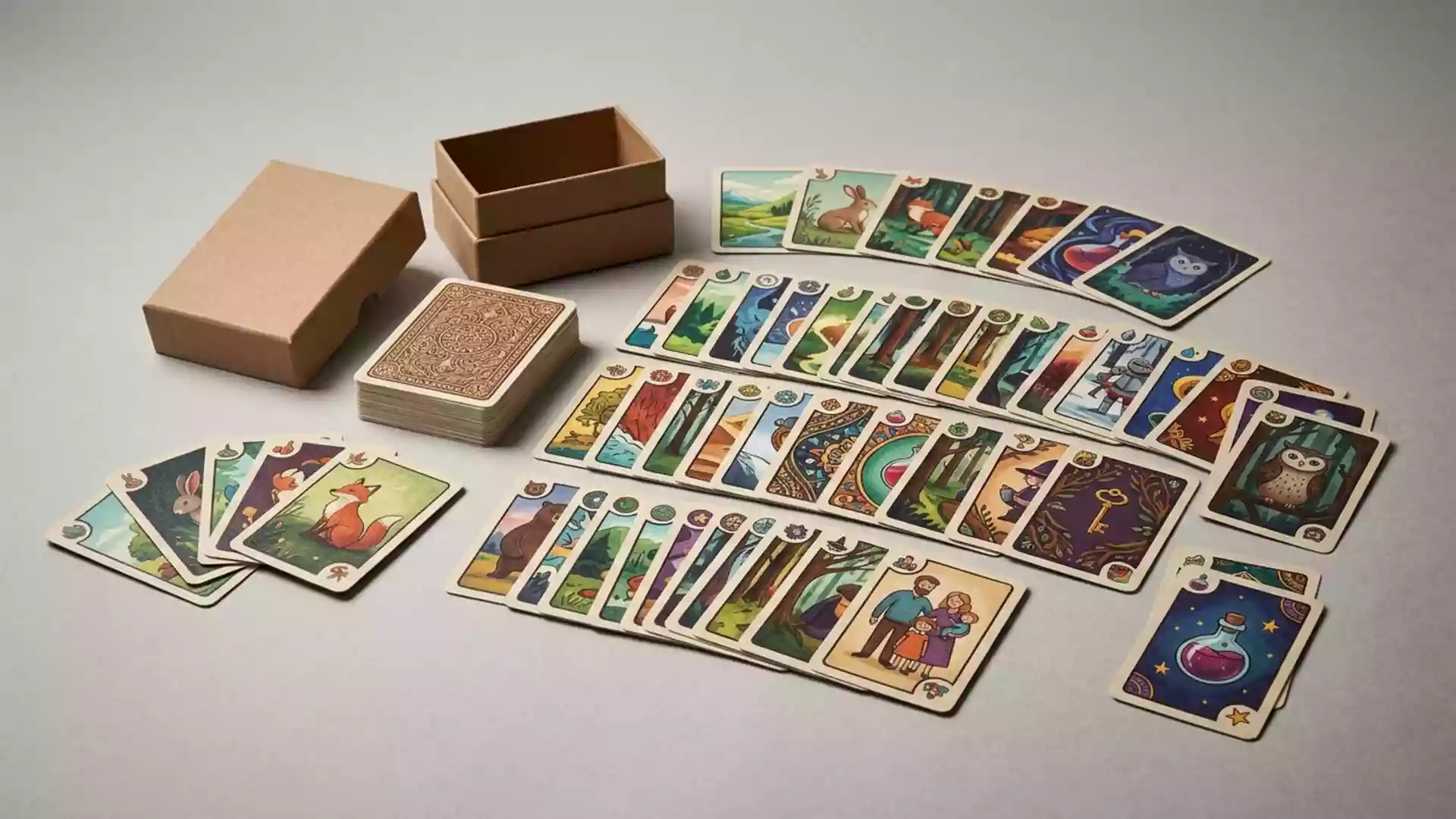
Monopoly Deal Card Game, Quick-Playing Family Fun For 2-5 Players - Fast 15 Minute Property Battles
Published on 09/04/2026 at 20:33 | Editorial responsibility: Rafael Müller, Editor-in-Chief AD HOC NEWS
Monopoly Deal Card Game, Quick-Playing Family Card Game for 2-5 players ages 8 and up, takes the familiar Monopoly property race and compresses it into a compact deck of 110 cards and fast rounds that often finish in about 15 minutes. The objective shifts from amassing the most cash to being the first player to lay down three full property sets of different colors, turning every card draw and action into a sharp tactical decision. With no board, tokens, or paper money to manage, the game fits easily into a small bag or jacket pocket and is built for quick play sessions at home, on vacation, or between other activities.
What Comes In The Monopoly Deal Box
Monopoly Deal focuses entirely on cards, and the standard deck contains 110 cards dedicated to properties, money, and actions. One detailed rules document lists 4 rules cards, 28 property cards, 11 property wildcards, 34 action cards, 13 rent cards, and 20 money cards as the core contents, along with instructions explaining how to play and win with three property sets. That composition gives players a mix of straightforward property and cash cards plus a high number of action effects that drive the game tempo. The rules specify that the game is designed for 2 to 5 players, which helps keep playtime in the short 15 minute band with smaller groups while still supporting a full table without dragging on too long.
Age guidance for Monopoly Deal sets the lower bound at 8 years old, matching the rating printed on official instruction material and packaging for the quick-playing family card game. The setup is intentionally simple: players remove the quick-start rules cards, shuffle the remaining deck, deal 5 cards to each player face down, and place the remaining cards as a draw pile in the center of the table. There is no extra hardware to assemble and no game board to unfold, which keeps setup time in the roughly 1-2 minute window noted in a separate overview of the game. Because all game pieces are flat cards made from cardstock, the entire product is lightweight and easy to pack, with retailer listings describing a compact package designed for travel and storage.
How Monopoly Deal Plays In Practice
During play, each turn starts by drawing 2 cards from the pile and adding them to the player’s hand, except for situations where a player has no cards left and draws 5 instead. After drawing, the player can play up to 3 cards from their hand, choosing between laying properties, banking money, or triggering action effects. Property cards go down in front of the player to build sets, and each card shows how many properties exist in that color set, mirroring the classic Monopoly color groups such as Brown, Light Blue, Pink, Orange, Red, Yellow, Green, Blue, Railroads, and Utilities. To win, a player must end their turn with three complete property sets of different colors displayed, at which point the game immediately ends.
Money cards and some action cards can be banked in front of the player to create a separate pile used to pay rent and other demands from opponents. The rules emphasize that players can charge each other for rent, birthdays, and other events via specific action cards, and opponents pay from their bank piles, sometimes surrendering properties instead of money depending on card effects. Action cards include tools to charge rent, swap properties, steal cards, and demand birthday money, giving players direct ways to disrupt opponents and protect their own sets. Classic action names such as Debt Collectors, Forced Deals, and Deal Breakers feature prominently in rule summaries, highlighting the swingy nature of the card effects.
Key Specs And Catalog Facts
Several core specifications place Monopoly Deal firmly in the modern family card game segment. The standard deck uses 110 cards, divided into 4 rules cards, 28 property cards, 11 property wildcards, 34 action cards, 13 rent cards, and 20 money cards, all made from printed cardstock sized for easy shuffling and handling. Official descriptions classify the game as suitable for ages 8 and up and list a player count of 2 to 5, creating a flexible range that covers small family groups and larger tables without changing the rules. Typical playtime is described as about 15 minutes, and setup time is listed around 1-2 minutes, emphasizing that this product is meant for quick rounds rather than long, evening-length sessions.
A Canadian trademark entry for MONOPOLY DEAL records a registration date of 02/02/2011 and notes that the mark covers card games, with usage documented since at least 12/26/2008. That registry lists Hasbro, Inc., with an address in Pawtucket, Rhode Island, as the registrant, which aligns with the broader corporate information on Hasbro’s consumer care pages and underscores the brand’s ownership of the Monopoly Deal name in North American markets. External encyclopedic summaries add that Monopoly Deal was introduced in 2008 as a card-game derivative of the main Monopoly board game, with a focus on collecting three property sets rather than bankrupting opponents through rent and mortgages.
Brand Ownership And Manufacturing Context
Monopoly Deal sits under the Monopoly brand, a long-running property trading game franchise controlled by Hasbro, Inc., based in Pawtucket, Rhode Island. A Canadian trademark listing for MONOPOLY DEAL identifies Hasbro, Inc. as the registrant and specifies the product type as card games, linking the card game directly to Hasbro’s branded play portfolio. Corporate contact information published by Hasbro lists the headquarters address at 1027 Newport Avenue in Pawtucket and gives consumer care mailing details and phone numbers for US and Canadian customers, illustrating the company’s role both as brand owner and customer support contact for the game.
Manufacturing details for Monopoly Deal call out Cartamundi as the producer and seller under license from Hasbro, according to one widely cited encyclopedia-style article that describes the launch history of the product. That description states that Monopoly Deal was introduced in 2008 and is produced and sold by Cartamundi under a license from Hasbro, positioning Hasbro as the brand owner and rights holder while delegating physical card production to a specialist game manufacturer. For US shoppers, however, the practical perspective is that the game carries the Monopoly brand, references Hasbro on packaging, and is distributed through mainstream US retailers, making Hasbro the relevant corporate name for warranty and consumer care interactions.
Monopoly Deal Rules Highlights
The core objective in Monopoly Deal is straightforward: be the first player to collect three full property sets, each in a different color, and announce the win at the end of your turn. Rules pamphlets emphasize that players must manage their hand and tabled cards carefully, because properties placed on the table contribute to sets but can also be targeted by opponent actions. At the start of every turn, players draw 2 cards and then may play up to 3 cards, which can include laying properties, placing cards into the bank as money, or using action cards to affect themselves or others.
Property cards follow the familiar color coding from Monopoly, including Brown, Light Blue, Pink, Orange, Red, Yellow, Green, Blue, Railroads, and Utilities, with each card showing how many properties exist in that set. Wild property cards can count as multiple colors, such as Light Blue/Brown or combinations involving railroads, and these wildcards make it easier to complete sets but are often targeted by action cards. Rent cards allow players to charge other players based on the properties they control, and house and hotel cards raise rent values when attached to property sets, echoing the build-up mechanics from the board game.
Action cards carry a wide variety of effects. Some allow players to swap properties with opponents, some steal specific cards, and others demand birthday money or trigger rent charges across multiple properties. Debt collectors and Deal Breakers are among the more dramatic action cards; Debt Collectors can force a player to pay a significant amount, while Deal Breakers can dismantle an opponent’s completed set by taking it entirely. Because action cards can often be banked as money or played for their effects, players must decide whether to use them for immediate disruption or retain them as financial defense against future demands.
Packaging, Components, And Physical Format
Physically, Monopoly Deal is marketed as a compact card game that fits into a small box or tuck-style packaging, with retailer descriptions highlighting its portability for family travel and game nights. The deck of 110 cards is printed on cardstock, and there are no plastic tokens, dice, or boards included, which keeps the product light and portable. A typical instruction sheet specifies that there are 4 quick-start rules cards, which can be handed out to players, plus the main deck, which is shuffled and dealt for play. Because the game uses only cards, there is limited risk of losing critical components, and replacement decks are easy to store.
Retail listings for Monopoly Deal emphasize that the game is battery-free and requires no assembly, reflecting its straightforward physical design. All cards feature Monopoly branding and iconography, including property names, color bands, and basic rent values that echo the board game. House and hotel cards visually reference the iconic green houses and red hotels from the classic game, while money cards show denominations such as 1M up to 10M, representing Monopoly money units rather than real currency. This design keeps the game visually linked to Monopoly while making it functionally independent as a self-contained card experience.
Price Positioning In The US Market
Pricing for Monopoly Deal depends on the specific edition, but mainstream US retailers offer licensed versions within a relatively narrow band. One US big-box retailer lists specialty branded variants such as Monopoly Deal NFL Edition Card Game with a price of $6.99 and the Monopoly Deal FIFA World Cup 2026 Edition Card Game at $9.99, indicating that themed editions of the card game generally sit below $10 at regular price. Another assortment listing on the same retailer’s site shows branded Monopoly Deal card games in the $8.79 to $12.99 range, with occasional promotional discounts that lower the price by a few dollars.
Those price points place Monopoly Deal firmly in the mass-market family card game segment, where products often cost between $6 and $15 depending on branding and licensing. Because the game consists of 110 cards with instructions and no additional hardware, the overall manufacturing and packaging costs are relatively modest, helping keep the retail price accessible. For US buyers looking at themed versions tied to sports leagues or events, the $6.99 to $9.99 pricing documented on retailer pages provides a concrete reference for current market positioning as of 09/04/2026.
Comparisons To The Classic Monopoly Board Game
Comparing Monopoly Deal to the traditional Monopoly board game highlights how the card game focuses on speed and tactical card play rather than extended property management. Classic Monopoly often runs for 60-120 minutes or longer, requires a full board setup, uses tokens and paper money, and revolves around bankrupting opponents over many turns. By contrast, Monopoly Deal lists a typical playing time of about 15 minutes and a setup time of only 1-2 minutes, cutting the total time commitment by a large margin.
The win condition also differs substantially. In Monopoly, the goal is to bankrupt all other players, and victory often depends on building houses and hotels to generate high rents across critical board spaces. In Monopoly Deal, the focus is on collecting three complete property sets of different colors, and there is no concept of player bankruptcy or elimination. Rent still matters in the card game, but primarily as a tool to strip opponents of money and properties rather than a long-term financial drain leading to elimination.
From a component standpoint, Monopoly uses a large board, tokens, Chance and Community Chest cards, houses, hotels, and a bank of paper money. Monopoly Deal uses only a small deck of 110 cards, covering properties, wildcards, action effects, rent, houses, hotels, and money, plus instructions. This difference in component complexity makes Monopoly Deal far easier to transport and store. Families who enjoy Monopoly’s property theme but want shorter sessions may find the card game better suited to casual play, while those who prefer deep economic and positional strategy will continue to favor the board version.
Comparisons To Other Fast Card Games
Within the broader family card game category, Monopoly Deal competes with titles that also promise fast rounds and straightforward rules. Many travel-ready games use decks of around 50-120 cards and aim for 10-20 minute play sessions, positioning them for quick entertainment rather than long game nights. Monopoly Deal’s 110-card deck and 15 minute playtime match that pattern closely, and its 2-5 player range is generous compared with some card games that cap at 4 players.
For example, certain compact card games built on number matching or set collection mechanics often support 2-4 players and aim for 10-20 minute sessions. Monopoly Deal adds a layer of property set-building and action-driven interaction on top of set collection, which can make the game feel more dynamic and swingy. The presence of powerful action cards like Deal Breakers and Debt Collectors creates big momentum shifts that differ from more stable scoring-focused card games, appealing to groups that enjoy dramatic reversals and direct interaction.
Strategic Depth And Replayability
Strategically, Monopoly Deal offers more depth than its short playtime might suggest. Because players can bank action cards as money or play them for effects, every decision to hold or use a card has implications for both offense and defense. Banking too many action cards may leave a player with fewer tools to disrupt opponents, while playing every action as soon as it appears may leave them vulnerable to future rent charges and demands. This tension encourages thoughtful planning and timing.
The mix of property sets and wildcards also contributes to replayability. With 28 property cards and 11 wild property cards, there are multiple ways to assemble sets, and the distribution of wildcards can significantly affect strategy. Some games will feature early access to wildcards, making set completion easier, while others will force players to rely on pure color sets and aggressive use of action cards to win. Because the deck is shuffled each game and turns involve drawing 2 cards at a time, the order of card appearance varies widely, ensuring that no two sessions play out exactly the same.
Player Count And Family Use Cases
The 2-5 player range makes Monopoly Deal suitable for a variety of family configurations. At 2 players, games generally move quickly, with playtime sometimes dropping below the typical 15 minute mark as two opponents race to complete sets. At 3-4 players, the game’s interaction shines, because rent charges and action cards often affect multiple opponents and set up complex chains of property swaps. At 5 players, the deck’s 110 cards and action density can lead to more chaotic sessions, but official descriptions state that the game still supports this maximum without changing core rules.
The age recommendation of 8 and up reflects both the reading requirements for the card text and the strategic decisions involved in managing hands and properties. Younger players may need guidance at first to understand the effects of different action cards, such as how to resolve rent payments or property swaps, but the overall rules are concise enough to learn within a single session. For families that already know Monopoly, the thematic link makes it easier to explain property sets, rent, and houses, shortening the learning curve.
Edition Variants And Special Themes
Beyond the core Monopoly Deal card game, US retailers stock themed editions tied to popular properties and events. As of 09/04/2026, one major retailer offers Monopoly Deal NFL Edition Card Game at $6.99 and Monopoly Deal FIFA World Cup 2026 Edition Card Game at $9.99, both clearly labeled as Monopoly card games in the product titles. These versions retain the basic mechanics of property sets and action cards but integrate licensed artwork, team names, or event branding into the card designs.
Some instruction pages list specialized editions, such as Monopoly Deal: HARRY POTTER Card Game, which uses the Monopoly Deal branding while incorporating magical theme elements and references. While specific card lists for themed versions may differ from the standard distribution of 28 properties and 11 wildcards, the structural design of 110 cards and 2-5 players remains intact, preserving compatibility with the quick-playing family game format. For US shoppers, the presence of multiple themed SKUs under the Monopoly Deal name creates options without altering the fundamental rules.
Support, Warranty, And Corporate Contact
Consumer contact information for Hasbro provides practical channels for support if components are damaged or rules are lost. Official consumer care documentation lists a US toll-free number, 1-800-255-5516, and a mailing address for Hasbro’s Consumer Affairs Department in Pawtucket, Rhode Island, for customer inquiries about games such as Monopoly Deal. Business hours are specified as Monday through Friday from 8:00AM to 5:00PM Eastern Time, with slight variation on Fridays, giving buyers clear windows for contacting the company.
Corporate information pages mention Hasbro, Inc. as the overarching branded play company responsible for the Monopoly brand and its extensions, including board games and card games. This positioning means that warranty and replacement policies for Monopoly Deal fall under Hasbro’s broader board and card game support framework. For US families purchasing the game, the presence of a well-established corporate contact structure adds reassurance that missing or damaged components can be addressed through official channels.
Verdict: Who Monopoly Deal Suits Best
Taken together, Monopoly Deal Card Game, Quick-Playing Family Card Game for 2-5 players ages 8 and up, is tailored to households that enjoy Monopoly’s property theme but prefer shorter, more tactical sessions. With 110 cards, 2-5 players, and a typical 15 minute playtime, it fits neatly into the modern family card game category and travels easily thanks to its all-card format. The focus on collecting three property sets rather than bankrupting opponents keeps games brisk and reduces the potential for long stalemates.
Compared with the classic Monopoly board game, Monopoly Deal dramatically cuts down setup time and play length, trading the expansive board for a high-density deck packed with properties, money, and action cards such as Debt Collectors and Deal Breakers. For families with limited time or for gatherings where people arrive and leave at different times, the ability to finish multiple rounds in the space of a single traditional Monopoly session is a practical advantage. Players who enjoy direct interaction and swingy card effects will appreciate the tactical tension created by choosing whether to bank or play powerful action cards.
Monopoly Deal Official Instructions And Details
For the latest rules, card breakdown, and age and player recommendations for Monopoly Deal Card Game, Hasbro provides a dedicated instructions page with downloadable materials.
Monopoly Deal Card Game Facts
- Product: Monopoly Deal Card Game, Quick-Playing Family Card Game for 2-5 Players, Ages 8+
- Manufacturer: Hasbro, Inc., Pawtucket, RI
- Category: Card game (family, 2-5 players)
- Deck size: 110 cards including 4 rules cards, 28 property cards, 11 property wildcards, 34 action cards, 13 rent cards, and 20 money cards
- Players: 2-5 players, ages 8 and up
- Typical playing time: About 15 minutes per game
- Setup time: Approximately 1-2 minutes
- Price: Themed Monopoly Deal card games such as NFL and FIFA World Cup 2026 editions listed between $6.99 and $9.99 at US retailers (as of 09/04/2026)
- Target audience: Families and casual groups seeking quick, portable property-themed card games