
Zugspitze and the ridge of Germany’s highest peak
Published on 09/18/2026 at 21:30 | Editorial responsibility: Rafael Müller, Editor-in-Chief AD HOC NEWS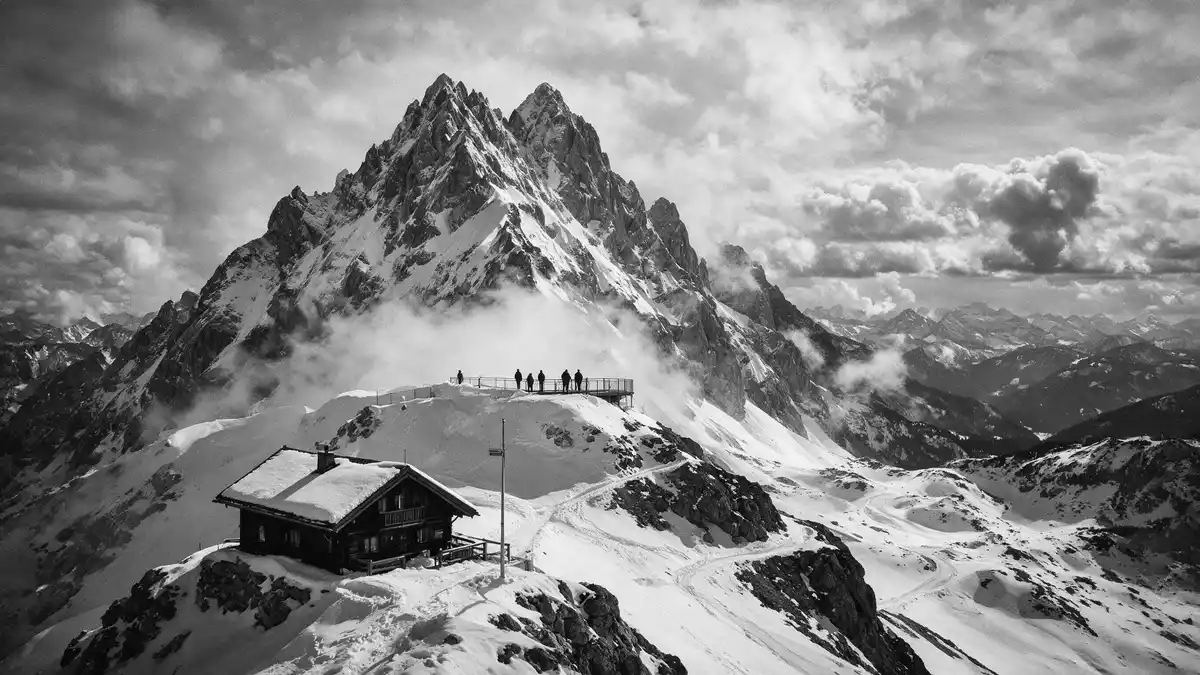
Zugspitze rises to 2,962 m (9,718 ft) and stands as Germany’s highest mountain. Its summit position, ridge line and borderland setting make it a clear Alpine landmark rather than a single-point viewpoint.
Zugspitze above the Wetterstein
The mountain belongs to the Wetterstein range in the Bavarian Alps and lies on the frontier with Austria. Its German name has long been tied to the peak itself, and the summit was first climbed in 1820 by Josef Naus, Johann Georg Tauschl and Maier.
The mountain’s height has been fixed at 2,962 m in modern surveys, and that figure is widely used in descriptions of the summit. The peak forms part of a broader high ridge, with exposed rock and steep slopes visible from the approaches.
A summit marked by ascent and survey
The first recorded ascent in 1820 gives the mountain a firm place in Alpine history. Josef Naus, a survey assistant and a mountain guide reached the summit at a time when mapped peaks and measured heights were closely connected.
That history still matters because Zugspitze is read both as a mountain and as a measured point. The height, the first ascent and the mountain’s place in the Wetterstein are the facts that define it most clearly.
Stone, height and border country
Zugspitze is not a decorative hilltop. It is a high limestone peak with a stark, open profile, and the summit area sits in a landscape shaped by rock, snow and altitude.
The mountain’s setting near Garmisch-Partenkirchen places it within one of Germany’s best-known Alpine regions. The combination of national high point, named range and documented first ascent gives the place its lasting identity.
Visiting Zugspitze: what travellers from Western Europe should know
- The mountain rises south-west of Garmisch-Partenkirchen, with rail and cable-car access from the valley. The Bavarian Zugspitze Railway and the cable car at Eibsee are the best-known approaches.
- The summit lies at high altitude, and the terrain is steep, rocky and exposed. Paths and approaches on the mountain are not the same as a normal town walk.
- In winter, the summit landscape changes under snow and ice. The upper mountain is part of a high Alpine environment rather than a lowland excursion.
- The official language is German and the currency is the euro.
Searching for Zugspitze on social platforms
These links open searches for Zugspitze on each platform.
Frequently asked questions about Zugspitze
Where is Zugspitze?
Zugspitze lies in the Wetterstein Alps near Garmisch-Partenkirchen in Bavaria, on the border with Austria. It is Germany’s highest mountain.
What does a visit involve?
The mountain involves a high-altitude Alpine setting, rocky terrain and access links from the valley. It is a mountain landscape rather than an urban sightseeing stop.
What makes Zugspitze distinctive?
Its best-known features are its height, its first recorded ascent in 1820 and its place in the Wetterstein range. The summit has both topographic and historical weight.


