
Zona Arqueologica de Tulum on the Caribbean cliff edge
Published on 09/08/2026 at 15:08 | Editorial responsibility: Rafael Müller, Editor-in-Chief AD HOC NEWS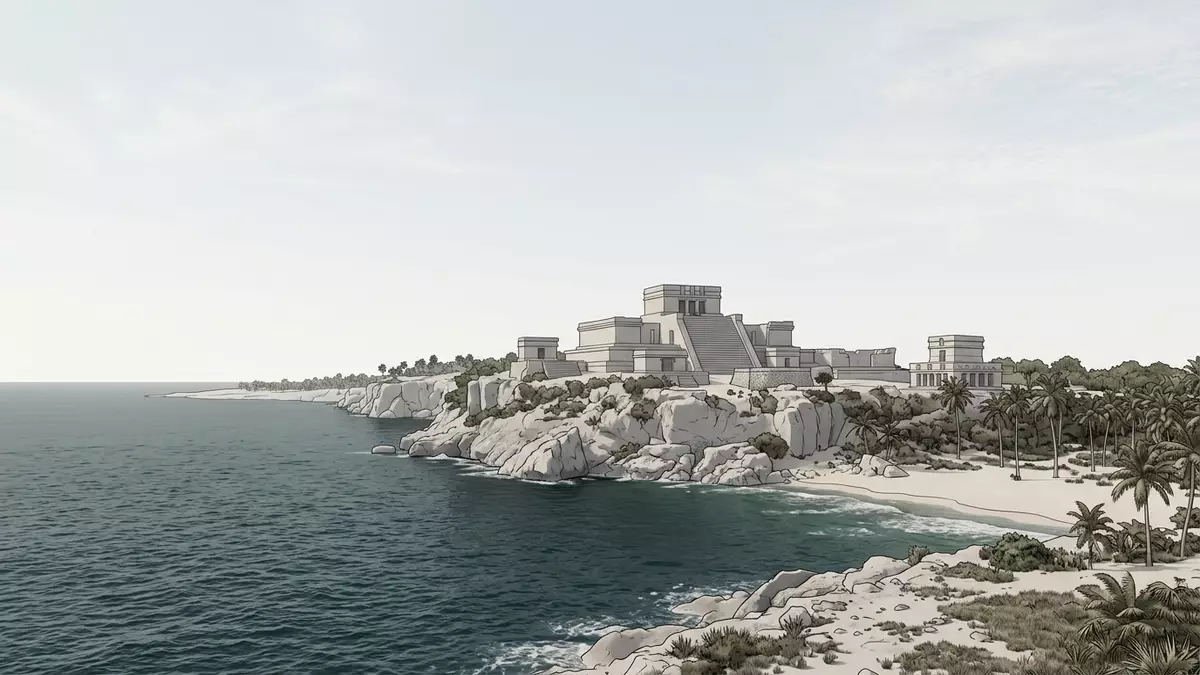
Zona Arqueologica de Tulum is a walled Maya city on the Caribbean coast of Quintana Roo in Mexico, set directly above the sea on a limestone cliff. Its surviving temples and houses belong to the Middle to Late Postclassic period, when Tulum served as a coastal port for the wider Maya world.
A coastal Maya city on the cliff
Tulum stands on the eastern edge of the Yucatán Peninsula, where coral limestone forms a low cliff above the Caribbean Sea. The archaeological zone lies beside the present-day town of Tulum and within the boundaries of Tulum National Park, bringing ancient masonry and coastal vegetation into the same protected landscape.Within Tulum National Park the ruins occupy a compact site, making it possible to see the main structures in a single circuit.
The city’s position on the cliff is central to its character. The main temple platform known as El Castillo rises close to the edge, overlooking the beach and the shallow sea below.El Castillo forms the most striking silhouette, with masonry stepping up from the plaza towards the seaward side. Below the cliff lies a small sandy cove, framed by rock and surf, which shows how close the ancient port stood to the waterline.
The walled layout and principal buildings
Tulum is one of the few Maya cities with a clearly defined defensive wall enclosing its ceremonial and residential core. The wall runs along the landward sides of the site and leaves the seaward edge open, where the cliff itself forms a natural barrier. Built of limestone, the enclosure stretches several hundred metres and is substantially thick, with gateways that once controlled movement into the city.The limestone wall marks Tulum as a fortified settlement as much as a religious centre.
Within the walls stand temples, platforms and smaller structures laid out around plazas. The Temple of the Frescoes, a compact building near El Castillo, preserves traces of mural painting on its interior walls, giving a glimpse of Postclassic Maya iconography and colour.Buildings visible at Tulum belong to the architectural style known as the Oriental Coast Style, characterised by relatively small, thick-walled structures with simple forms adapted to the coastal environment. Other named temples include the Temple of the Descending God and the Temple of the Wind God, each adding detail to the religious landscape of the site.Temple of the Frescoes and other shrines
Trade, chronology and the meaning of Tulum
The occupation of Tulum belongs to the Middle and Late Postclassic, broadly between about 1200 and 1550 CE, the final phase of pre-Hispanic settlement on the Yucatán Peninsula.Middle-Late Postclassic dating During this period, the walled town functioned as a seaport that linked coastal navigation routes with inland centres. Its setting on the coast allowed canoes to land close to the city, tying maritime travel into the ceremonial life of the site.
The name “Tulum” reflects its character as a fortified place: in Modern Maya usage the word refers to a wall or fortification.Tulum as a walled city Earlier sources also record the name Zamá, associated with dawn, underlining the city’s orientation towards the sunrise over the Caribbean. The combination of stone enclosure, cliff edge and sea horizon makes Zona Arqueologica de Tulum a compact record of late Maya coastal urbanism, where defence, trade and ritual share the same small piece of ground.
Visiting Zona Arqueologica de Tulum: what travellers from Western Europe should know
- Zona Arqueologica de Tulum lies on the Caribbean coast of Quintana Roo, just north-east of the modern town of Tulum, reached by road from the main Highway 307 corridor.
- The archaeological zone is compact but involves walking on uneven limestone paths and grassy ground, with steps and slopes between the plazas, the cliff edge and the beach.
- The ruins stand within Tulum National Park on a low cliff above the sea, and the combination of open ground and coastal exposure means sun and heat can be strong in the middle of the day.
- The official language is Spanish and the currency is the Mexican peso.
- Entry requirements depend on your nationality; UK travellers can check the FCDO travel advice at gov.uk/foreign-travel-advice, Irish travellers the Department of Foreign Affairs at ireland.ie.
Searching for Zona Arqueologica de Tulum on social platforms
These links open searches for Zona Arqueologica de Tulum on each platform.
Frequently asked questions about Zona Arqueologica de Tulum
Where is Zona Arqueologica de Tulum located?
Zona Arqueologica de Tulum is on the Caribbean coast of Quintana Roo in Mexico, beside the town of Tulum and within the Tulum National Park boundary.
What can visitors expect on a visit?
Visitors walk through a walled Maya city with temples, platforms and a coastal cliff, following paths between plazas, gateways and viewpoints above the beach and sea.
What makes Zona Arqueologica de Tulum distinctive among Maya sites?
The combination of a substantial defensive wall, Postclassic temples and a cliff-top position directly above the Caribbean Sea gives Tulum a coastal character unusual among Maya cities.


