
Zona Arqueologica de Tulum and its clifftop Maya walls
Published on 08/26/2026 at 20:48 | Editorial responsibility: Rafael Müller, Editor-in-Chief AD HOC NEWS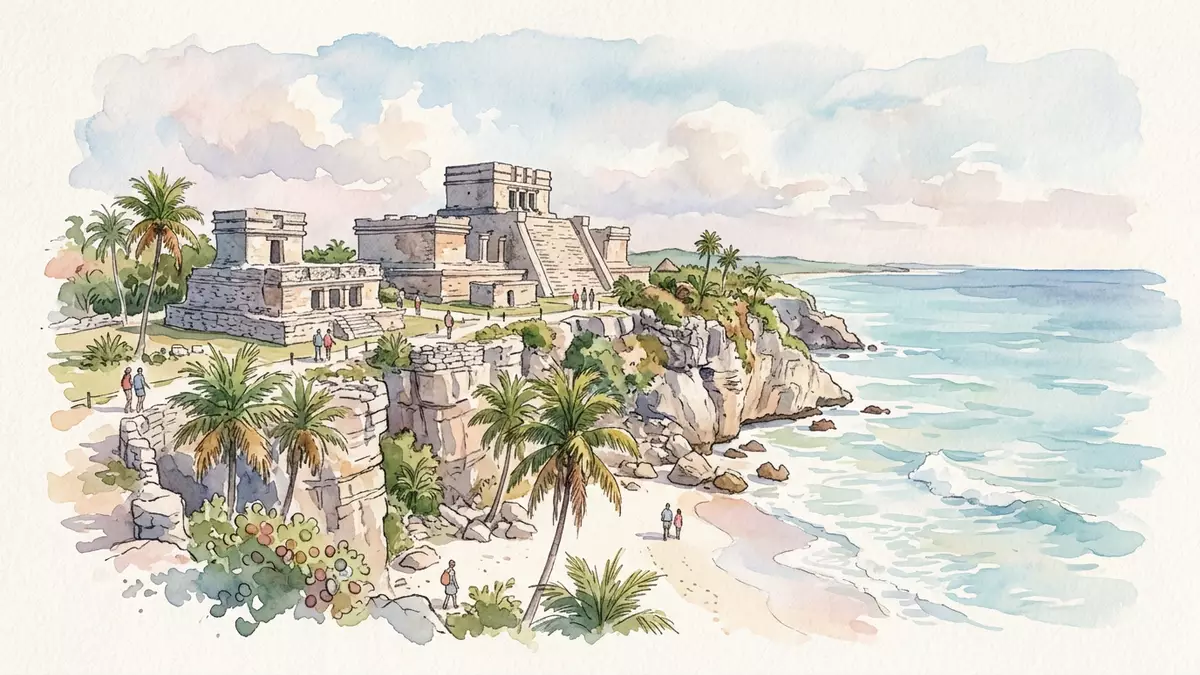
Zona Arqueologica de Tulum is a pre-Columbian Maya walled city set on low cliffs above the Caribbean Sea near Tulum in the Mexican state of Quintana Roo. The fortified settlement formed part of the wider Maya world on the Yucatán Peninsula and is known for the way its stone architecture stands close to the shoreline.
Stone walls between jungle and Caribbean
The core of Zona Arqueologica de Tulum is enclosed by substantial defensive walls that run along the landward sides of the site, while the eastern edge drops towards the Caribbean Sea. The enclosure forms a broad rectangle that separates the ceremonial and residential architecture from the surrounding coastal plain, with gateways marking controlled passage through the defences.
The fortifications and temples form part of the Tulum National Park, a protected area that covers the archaeological zone and adjoining coastal landscape.The site lies within Tulum National Park Stone structures and platforms stand on slightly raised ground, giving views towards the Caribbean and across the Yucatán lowlands.Tulum is described as part of the final pre-Hispanic occupation of the peninsula
El Castillo and the temples of a coastal city
Within the enclosure, the most prominent structure is El Castillo, a stepped masonry building on the edge of the cliff that looks over the Caribbean Sea.El Castillo stands close to the cliff edge Its elevated position and massing make it visible from many points inside the enclosure and from the sea, and a broad stairway rises from a platform at its base to the summit.
Other major buildings include the Temple of the Frescoes and the Temple of the Descending God, both associated with carved decoration and painted surfaces.The three principal structures at Tulum are named as El Castillo, the Temple of the Frescoes and the Temple of the Descending God Many of the buildings use limestone blocks and sit on low platforms, with narrow staircases, colonnaded facades and small interior chambers that open towards plazas or internal courtyards.
Postclassic origins and coastal setting
Zona Arqueologica de Tulum forms part of the late Postclassic phase of Maya civilisation on the Yucatán Peninsula and is associated with occupation between about 1250 and 1550.The buildings visible at Tulum are dated to the Middle and Late Postclassic In this period the city functioned as a coastal centre connected with inland sites such as Cobá, making use of the Caribbean shoreline for transport and exchange.
The name Tulum is associated with the word for “wall” in the local context, while an earlier designation Zama relates to “dawn”, a reference to the position on the eastern seaboard.Tulum is recorded as a walled city also known as Zama The combination of enclosing walls, sea-facing cliffs and low tropical vegetation gives the site a distinctive profile among the coastal remains of the region.
Visiting Zona Arqueologica de Tulum: what travellers from Western Europe should know
- Zona Arqueologica de Tulum stands on the Caribbean coast near the town of Tulum in the state of Quintana Roo, south of Cancún along Federal Highway 307.
- The terrain within the archaeological zone is largely level but includes stone stairways, uneven masonry platforms and paths that cross exposed rock near the cliff edge.
- The official language is Spanish and the currency is the Mexican peso. Entry requirements depend on your nationality; UK travellers can check the FCDO travel advice at gov.uk/foreign-travel-advice, Irish travellers the Department of Foreign Affairs at ireland.ie.
Searching for Zona Arqueologica de Tulum on social platforms
These links open searches for Zona Arqueologica de Tulum on each platform.
Frequently asked questions about Zona Arqueologica de Tulum
Where is Zona Arqueologica de Tulum located?
Zona Arqueologica de Tulum stands near the present-day town of Tulum in Quintana Roo, on the east coast of Mexico’s Yucatán Peninsula facing the Caribbean Sea.
What should visitors expect inside the archaeological zone?
Visitors encounter stone walls, plazas, temples and platforms arranged on slightly raised ground, with paths leading towards viewpoints above the sea and across the former walled city.
What makes Zona Arqueologica de Tulum distinctive among Maya sites?
The combination of enclosing fortifications, cliff-top setting above the Caribbean and preserved temples such as El Castillo gives Zona Arqueologica de Tulum a distinctive coastal character.


