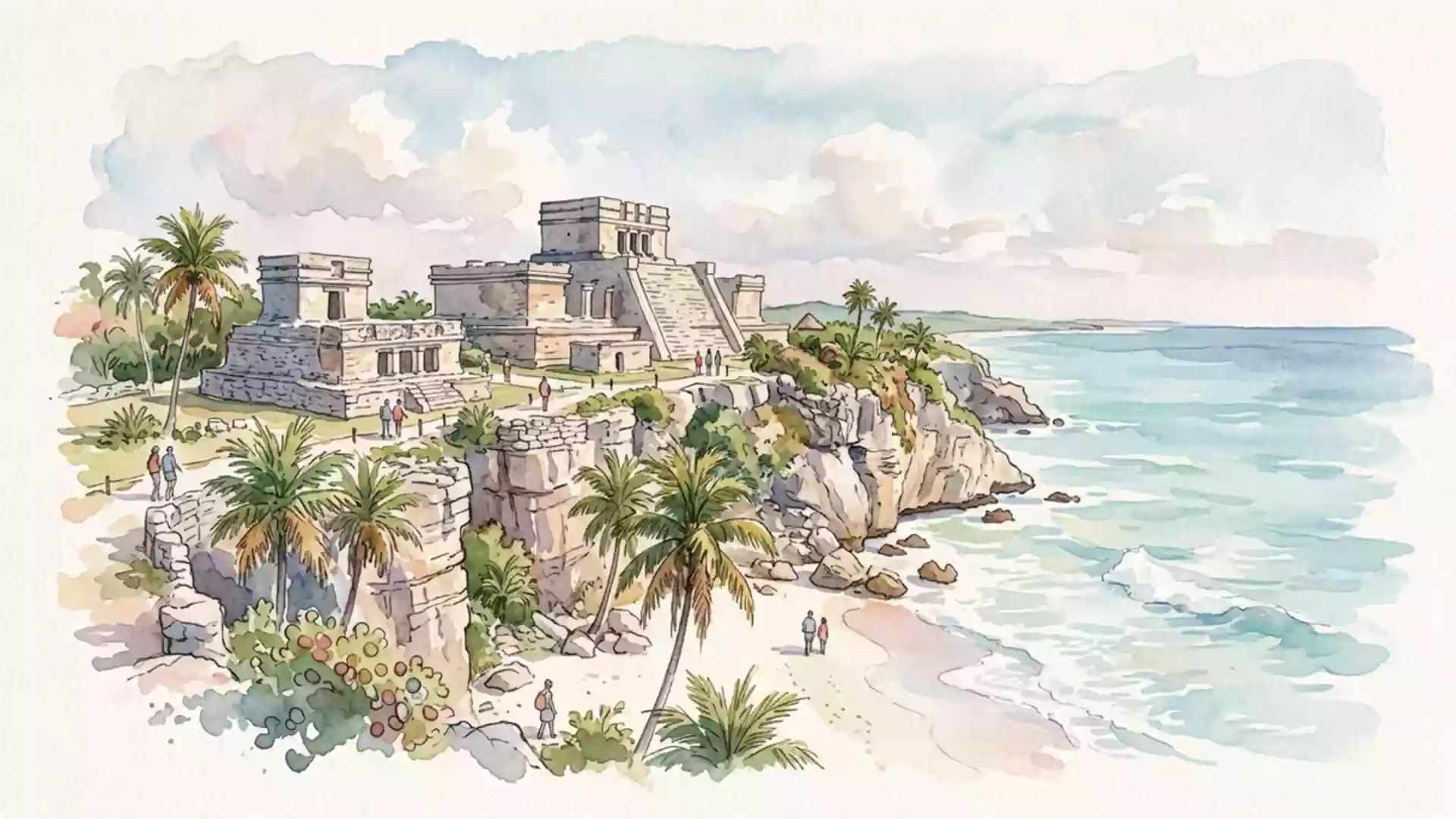
Zona Arqueologica de Tulum, a walled Maya city above the Caribbean
Published on 09/03/2026 at 21:27 | Editorial responsibility: Rafael Müller, Editor-in-Chief AD HOC NEWS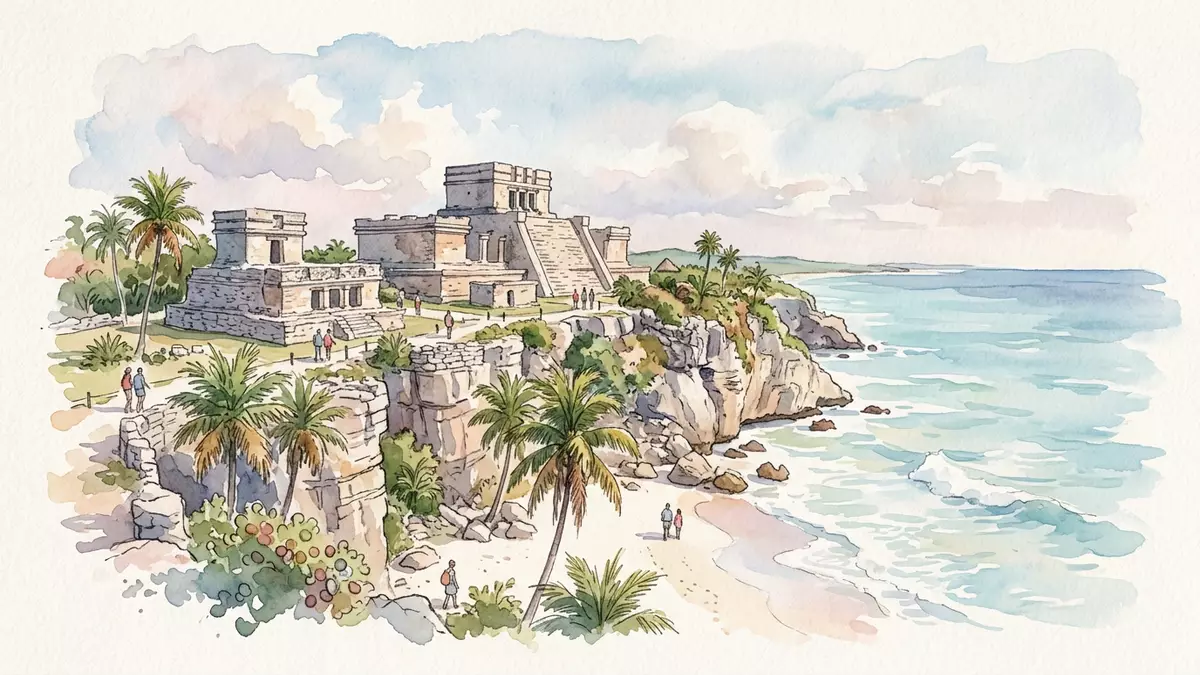
Zona Arqueologica de Tulum is a fortified Maya coastal settlement perched above the Caribbean Sea on the coast of Quintana Roo in Mexico. Built as a walled city during the late Postclassic period, between the thirteenth and sixteenth centuries, it combines masonry temples and palaces with a cliff-edge setting that places ancient architecture directly above the surf.
A coastal Maya city on a limestone bluff
The archaeological zone occupies a strip of limestone coast north of the modern town of Tulum, where the land ends in a bluff dropping to a narrow beach and the Caribbean. The main concentration of remains lies behind a stone wall that defines the city on its landward sides, while the eastern edge opens directly to the sea, giving the settlement a clear boundary between land and water.The walled coastal location is a defining feature of the site.
This enclosure contains temples, platforms and residential structures arranged around plazas, with the cliff carrying the most prominent buildings so that they overlook both the city interior and the sea below. The elevation of the bluff is described as about 12 m (39 ft), which is enough to give the upper buildings clear sight lines up and down the coastline while still allowing access to the shore below for canoes and small craft.The cliff height helps explain why stone structures and turquoise water appear in almost every view across the settlement.
Walls, gates and the name “Tulum”
The defensive wall that gives Zona Arqueologica de Tulum much of its character encloses the core of the ancient town on the north, west and south sides, forming a broad arc around the principal ceremonial and residential group. The Caribbean acts as a natural barrier to the east, so the built wall does not run along that edge. The structure includes gateways that once controlled access between the settlement and the surrounding landscape, making entry into the city something that passed through a series of points rather than being open from all directions.The wall defining the city is reflected in the name “Tulum”, which comes from a Mayan word for wall or palisade.
Historical sources preserve another name for the settlement: Zamá, meaning morning or dawn in Yucatec Maya, a reference to its position facing the Caribbean sunrise.The naming of Zamá underlines the dual identity of the site as both a defended town and a place oriented to the sea and sky. The buildings that survive date largely between about 1250 and 1550, with earlier elements such as a stela from the sixth century indicating that occupation at the location began well before the main phase of construction.
El Castillo and the Temple of the Wind God
The most conspicuous structure at Zona Arqueologica de Tulum is El Castillo, a stepped masonry temple and platform standing on the highest part of the cliff near the eastern edge of the enclosure. It rises above several lower terraces and platforms, making it visible from far along the beach and from the sea. Its upper section carries small rooms where ritual activities took place, while reliefs and masks once decorated its facades.El Castillo as the principal building dominates the skyline of the ruins.
Nearby stands the Temple of the Wind God, built on a circular base that is unusual in Maya architecture and associated with the deity Kukulkan in central Mexican symbolism.The circular platform of the Temple of the Wind God makes it easy to pick out among the more angular platforms around it. The Temple of the Frescoes, a smaller building near El Castillo, preserves mural paintings and stucco work in its interior, giving a glimpse of how colour and imagery once ran across larger parts of the settlement. Together, these structures show how religious, civic and maritime functions overlapped at the site.
Visiting Zona Arqueologica de Tulum: what travellers from Western Europe should know
- Zona Arqueologica de Tulum lies on the Caribbean coast of Mexico’s Yucatán Peninsula in the state of Quintana Roo, north of the modern centre of Tulum and reached from Highway 307 along access roads leading towards the coast.
- The terrain within the archaeological zone includes uneven limestone surfaces, packed-earth paths and slopes towards the cliff edge, with movement between levels involving steps and short climbs rather than long staircases.
- The archaeological zone sits beside the Caribbean Sea, with a narrow sandy beach directly below the main cliff, and views stretching along the coastline in both directions from the higher platforms.
- Spanish is the official language and the currency is the Mexican peso.
- Entry requirements depend on your nationality; UK travellers can check the FCDO travel advice at gov.uk/foreign-travel-advice, Irish travellers the Department of Foreign Affairs at ireland.ie.
Searching for Zona Arqueologica de Tulum on social platforms
These links open searches for Zona Arqueologica de Tulum on each platform.
Frequently asked questions about Zona Arqueologica de Tulum
Where is Zona Arqueologica de Tulum located?
Zona Arqueologica de Tulum stands on the Caribbean coast of Quintana Roo in Mexico, north of the town of Tulum and beside Highway 307 on the Yucatán Peninsula.
What can visitors expect on a visit?
Visitors encounter a walled Maya settlement with temples, platforms and palaces arranged around plazas, many positioned on a limestone bluff above a beach with expansive sea views.
What makes Zona Arqueologica de Tulum distinctive among Maya sites?
The combination of a fortified Maya town, cliff-edge setting, structures such as El Castillo and the circular Temple of the Wind God, and direct contact between stone architecture and Caribbean surf makes the site distinctive.