
Zocalo, Mexico City’s vast ceremonial heart
Published on 09/03/2026 at 21:58 | Editorial responsibility: Rafael Müller, Editor-in-Chief AD HOC NEWS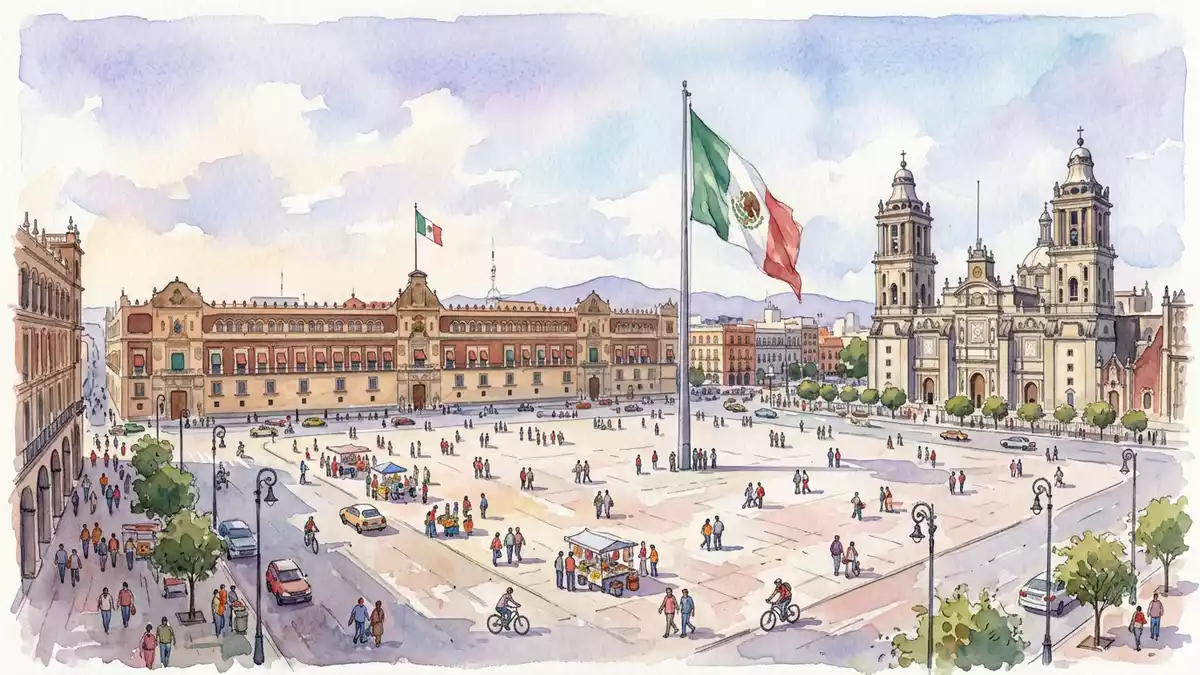
Zocalo, formally known as Plaza de la Constitución, is the main square of Mexiko-Stadt and the vast ceremonial heart of Mexico’s capital. Framed by the Metropolitan Cathedral, the National Palace and the remains of the Aztec Templo Mayor, it brings centuries of political and religious power into a single open space.
A giant square shaped by power and ceremony
Plaza de la Constitución occupies a broad rectangular expanse in the Centro Histórico, surrounded on all sides by streets and monumental buildings.The square is informally known as the Zocalo, a name that has become synonymous with Mexico City’s centre.Its formal designation as Plaza de la Constitución recalls the Cadiz Constitution of 1812, underlining the space’s role in the country’s political life.
The dimensions of Zocalo make its scale immediately evident to anyone crossing from one side to the other. With sides of roughly 220 m and 240 m (722 ft and 787 ft), it ranks among the largest city squares in the world and dominates the historic centre around it.Its broad paved surface offers clear views of the surrounding architecture and leaves space for civic life to unfold.
Layers of history from Tenochtitlan to the modern capital
The story of Zocalo reaches back to the Aztec capital of Tenochtitlan, where this area formed part of the ceremonial centre near the palace of emperor Moctezuma II.After the conquest led by Hernán Cortés in 1521, Spanish builders established the new colonial city on the same ground. Over time, stones from demolished temples were reused in the construction of the cathedral and government buildings, turning the pre-Hispanic sacred precinct into a European-style plaza framed by Christian and royal power.
Through the colonial period and into independent Mexico, the square has carried several official names, including Plaza Mayor, Plaza Principal and Plaza de Armas, before receiving the title Plaza de la Constitución in 1813.The name refers to the Spanish Constitution of 1812, sworn in this very space. In the nineteenth century a pedestal, or zócalo, was built in the centre as the base for a planned monument to Mexican independence; the monument itself was never completed, but the term “zócalo” passed into everyday speech as the square’s informal name.
Cathedral, palace and ruins around the plaza
Standing at Zocalo, three major landmarks define the edges of the square. To the north rises the Metropolitan Cathedral, a vast Baroque and neoclassical church built over several centuries and regarded as the largest cathedral in the Americas.Its façade and towers overlook the paving, and its interior continues the square’s long association with religious authority.
On the eastern side, the National Palace extends along the square, occupying the site once associated with Moctezuma’s palace and later the viceregal residence.Within its walls, murals by Diego Rivera depict episodes of Mexican history, while the building itself symbolises governmental continuity from colonial rule to the modern republic. Close by, the excavated remains of the Templo Mayor bring the Aztec city physically back into view, with stone platforms and carvings exposed beside the Spanish-era structures. Together, cathedral, palace and ruins form a sharp, visible contrast of faiths and regimes around the same open ground.
Visiting Zocalo: what travellers from Western Europe should know
- Zocalo lies in the Centro Histórico of Mexiko-Stadt, in the Cuauhtémoc district, and is reached by city streets and public transport serving the historic centre.
- The square itself is a wide paved expanse with open approaches; moving between its edges involves crossing large areas of hard surface rather than narrow paths.
- The official language is Spanish and the currency is the Mexican peso.
- Entry requirements depend on your nationality; UK travellers can check the FCDO travel advice at gov.uk/foreign-travel-advice, Irish travellers the Department of Foreign Affairs at ireland.ie.
Searching for Zocalo on social platforms
These links open searches for Zocalo on each platform.
Frequently asked questions about Zocalo
Where is Zocalo in Mexiko-Stadt?
Zocalo, formally Plaza de la Constitución, lies in the Centro Histórico of Mexiko-Stadt within the Cuauhtémoc district.
What can visitors expect when they arrive at Zocalo?
Visitors encounter a broad paved square enclosed by historic buildings, with clear sightlines to the Metropolitan Cathedral, National Palace and nearby archaeological remains.
What makes Zocalo distinctive among city squares?
Zocalo combines one of the world’s larger urban plazas with an immediate juxtaposition of colonial cathedral, governmental palace and exposed Aztec ruins around the same open space.


