
Zion National Park’s sandstone canyon near Springdale
Published on 09/07/2026 at 18:15 | Editorial responsibility: Rafael Müller, Editor-in-Chief AD HOC NEWS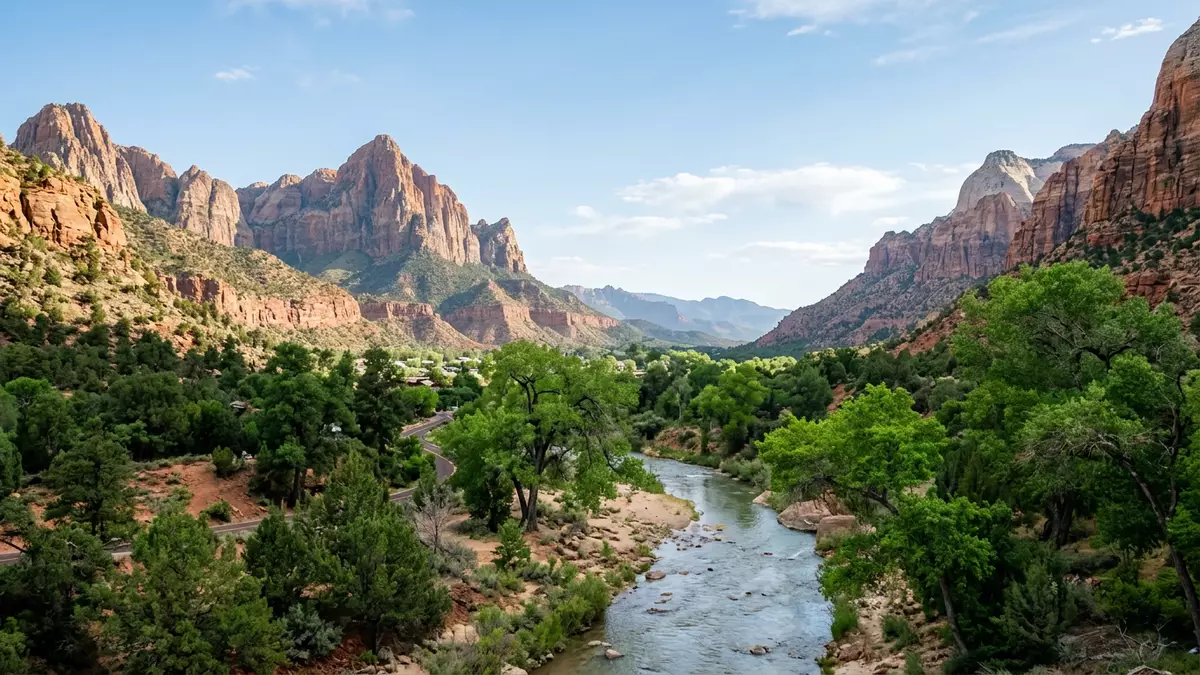
Zion National Park in south-western Utah is centred on a sandstone canyon carved by the North Fork of the Virgin River near Springdale, where desert rock and water meet in a striking landscape. Established as a national park in 1919, it preserves cliffs of Navajo Sandstone that rise high above the riverbed and record millions of years of sedimentation on the Colorado Plateau.
A canyon cut through Navajo Sandstone
The defining feature of Zion National Park is Zion Canyon, a gorge where the North Fork of the Virgin River winds between tall sandstone cliffs close to Springdale. The river has cut down through a thick sequence of sedimentary rock to create walls that in places reach more than 600 m (2,000 ft) above the valley floor.North Fork of the Virgin River The canyon narrows and widens along its length, with stretches where the cliffs stand close to the watercourse and others where slopes and benches give a little more room between rock and river.
The most conspicuous canyon walls are made of Navajo Sandstone, a desert dune deposit that has been lithified into pale orange and cream rock. This unit forms sheer cliffs where cross-bedded sandstone is exposed, creating vertical faces that catch the changing light and emphasise the height of the gorge.Navajo Sandstone cliffs Above and below the Navajo Sandstone, darker and more finely bedded formations such as the Kayenta and Chinle formations create sloping ledges and bands that add reds and browns to the rock palette, so the canyon walls show layered colour rather than a single tone.layered sedimentary formations
Sand, sea and uplift on the Colorado Plateau
Zion National Park lies along the margin of the Colorado Plateau, a region where sedimentary layers have been uplifted and dissected by rivers. The nine exposed formations in the park belong to a larger sequence sometimes called the Grand Staircase, which records about 150 million years of mostly Mesozoic sedimentation in this part of North America.Mesozoic rock sequence Within these layers, geologists read changes from shallow seas to coastal plains, river systems and wind-blown deserts.
The Navajo Sandstone that shapes much of Zion Canyon was formed in a vast sandy desert roughly 180 to 185 million years ago, when wind piled dunes into thick deposits that later became rock.desert dune deposits Beneath it, formations such as the Kayenta and Moenave record streams, floodplains and lakes, while still lower units like the Chinle and Moenkopi preserve mudstone, sandstone and siltstone laid down on tidal flats and coastal plains. At the base of the local sequence lies the Kaibab Formation, a marine limestone formed in a shallow tropical sea, showing that the area once lay beneath ocean water before uplift raised the Colorado Plateau and allowed rivers to carve canyons like Zion.
From Mukuntuweap to Zion National Park
The protected status of Zion’s canyon landscape dates back to the early twentieth century, when federal authorities moved to preserve its sandstone walls and labyrinthine side gorges. In 1909 President William Howard Taft signed a proclamation creating Mukuntuweap National Monument to protect Zion Canyon and surrounding terrain from development, recognising its geological and geographic interest.Mukuntuweap National Monument The canyon’s steep rock faces and intricate network of tributaries were already noted at that time as a record of past geological events.
In 1918 the monument was renamed Zion National Monument, and in 1919 Congress designated Zion National Park, with President Woodrow Wilson signing the bill that made it Utah’s first national park.national park established in 1919 The formal change of status expanded the protected area and confirmed the park’s role in conserving its sandstone monoliths, canyon ecosystems and desert river corridor for visitors and research.
Visiting Zion National Park: what travellers from Western Europe should know
- Zion National Park lies in south-western Utah near the town of Springdale, with the main canyon reached by road that follows the North Fork of the Virgin River from the settlement into the park.
- The central canyon landscape involves substantial elevation change, with routes that pass beside the river and paths that climb onto benches and higher viewpoints along slopes of sandstone and loose rock.
- The broader park extends beyond the main canyon into high plateaus and side drainages, so moving between areas can involve sustained walking across uneven ground and exposed terrain at altitude.
- The official language is English and the currency is the United States dollar.
Searching for Zion National Park on social platforms
These links open searches for Zion National Park on each platform.
Frequently asked questions about Zion National Park
Where is Zion National Park?
Zion National Park is in south-western Utah in the United States, with its main entrance near Springdale where the North Fork of the Virgin River enters Zion Canyon.
What should visitors expect on a first visit?
Visitors encounter a deep sandstone canyon with high cliffs, a river corridor and trails that move between valley floor routes beside the river and steeper paths on slopes and benches.
What makes Zion National Park distinctive among canyon landscapes?
Zion stands out for the height and continuity of its Navajo Sandstone cliffs, which display cross-bedded desert dunes and contrasting bands of colour above a single canyon carved by the Virgin River.


