
Zion National Park and its sandstone walls
Published on 08/27/2026 at 22:58 | Editorial responsibility: Rafael Müller, Editor-in-Chief AD HOC NEWS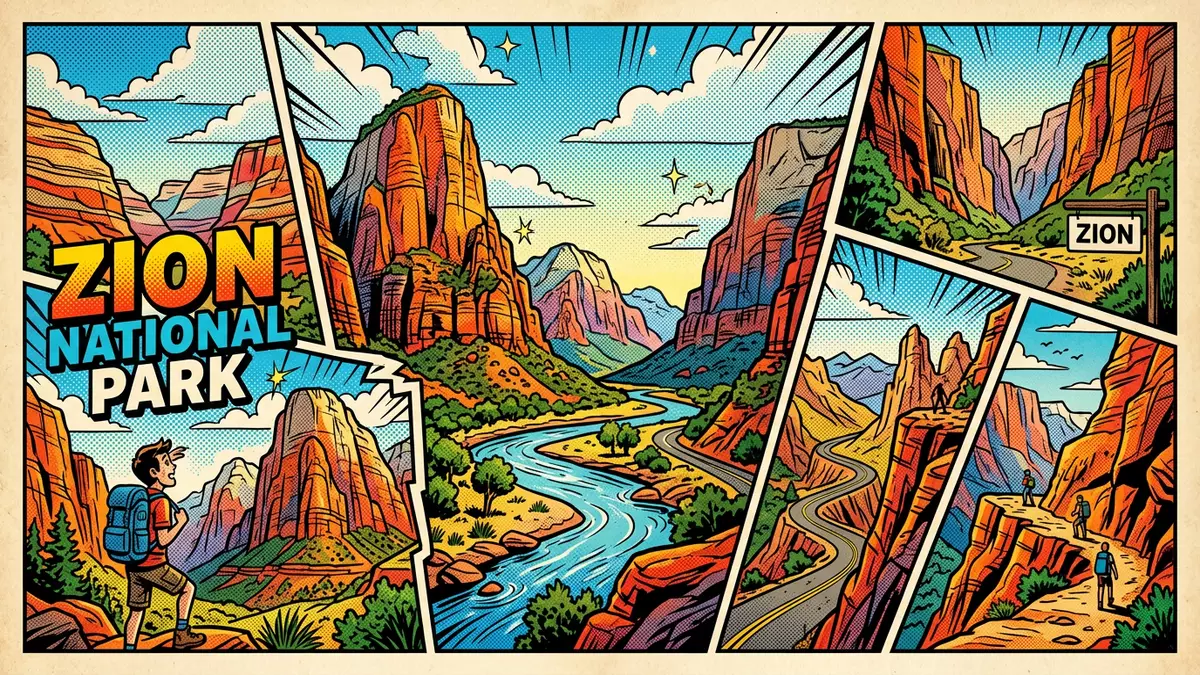
Zion National Park near Springdale is shaped by steep sandstone walls, deep canyons and the broad sweep of the Colorado Plateau. The park was established in 1919, and its cliffs are formed mainly from Navajo Sandstone.
Sandstone walls above the Virgin River
The strongest impression at Zion is vertical scale. The canyon walls rise in layered bands of red, cream and tan rock, with the Virgin River cutting through the lower ground below.
Navajo Sandstone gives the park its tall, pale cliffs and rounded faces in many places. The rock reaches great thickness in Zion and belongs to the Early Jurassic record of the region.
The park’s setting in southwestern Utah places it on the western edge of the Colorado Plateau. That setting links Zion to a wider landscape of mesas, benches, plateaus and canyons.
The name Zion has been attached to the park since 1919, after earlier official names in the same landscape. The park’s history is closely tied to the redirection of federal protection from monument status to national park status.
Zion’s geological layers and canyon forms
Zion contains a stack of sedimentary rocks, not a single cliff face. Younger layers cap older ones, and the exposed sequence records deserts, shallow seas and river-deposited material.
The Navajo Sandstone is the best-known layer because it forms the most dramatic cliffs. It is a cross-bedded sandstone, laid down from ancient dune fields, and it appears in broad faces and broken escarpments throughout the park.
Other formations appear in the canyon walls as ledges, slopes and darker bands. This layered structure gives Zion its sharp alternation between sheer rock and more stepped terrain.
The park’s geology is part of a much larger story of uplift and erosion on the Colorado Plateau. The visible result is a landscape where strata are read directly in the cliffs.
Zion National Park in historical context
Federal protection of the area began in 1909, when President William Howard Taft created Mukuntuweap National Monument. In 1918 the monument was renamed Zion National Monument, and in 1919 it became Zion National Park.
That sequence places the park within the early period of American national park expansion in the Intermountain West. The name changes also mark the shift from a monument centred on one canyon to a broader park identity.
Springdale serves as the main gateway settlement on the southern side of the park. From there, the entrance road leads into the canyon system and towards the main visitor corridor.
Today the park’s identity rests on what can be seen at once: canyon, cliff, river and rock layers. The formal history adds another layer, but the landscape remains the decisive feature.
Visiting Zion National Park: what travellers from Western Europe should know
- Zion lies in southwestern Utah near Springdale. The park is reached by road, and Springdale is the nearest settlement on the south side.
- The main canyons are framed by high walls and narrow valley floors. Several walks follow uneven ground, rock steps and steep slopes.
- The official language is English and the currency is the US dollar.
- Conditions on the mountain change with the seasons; the local cable-car operators and alpine clubs provide information.
Searching for Zion National Park on social platforms
These links open searches for Zion National Park on each platform.
Frequently asked questions about Zion National Park
Where is Zion National Park?
Zion National Park is in southwestern Utah, near Springdale. It lies on the edge of the Colorado Plateau.
What does a visit involve?
The park is a landscape of canyons, cliffs and river-cut valleys. Expect sandstone walls, layered rock and routes that move through uneven terrain.
What makes Zion distinct?
The park is distinguished by the scale of its Navajo Sandstone cliffs and the clarity of its exposed strata. Its formal history adds a clear historical frame to the landscape.


