Ziggurat of Ur, the stepped heart of ancient Ur
Published on 08/29/2026 at 10:12 | Editorial responsibility: Rafael Müller, Editor-in-Chief AD HOC NEWS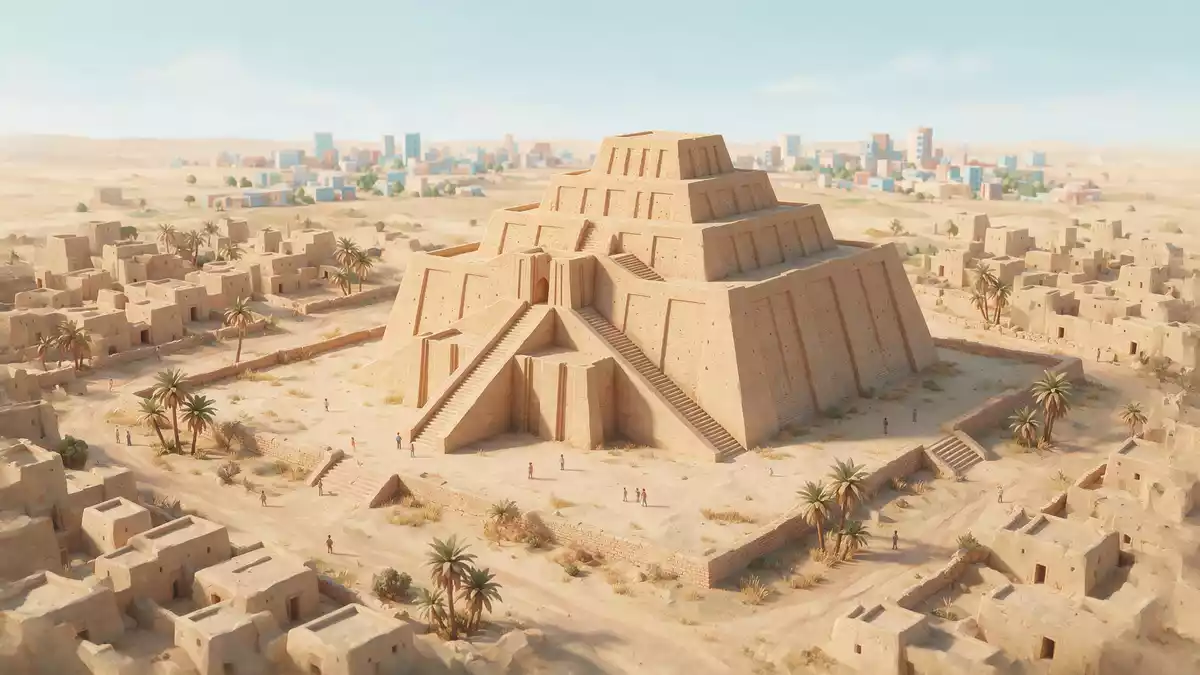
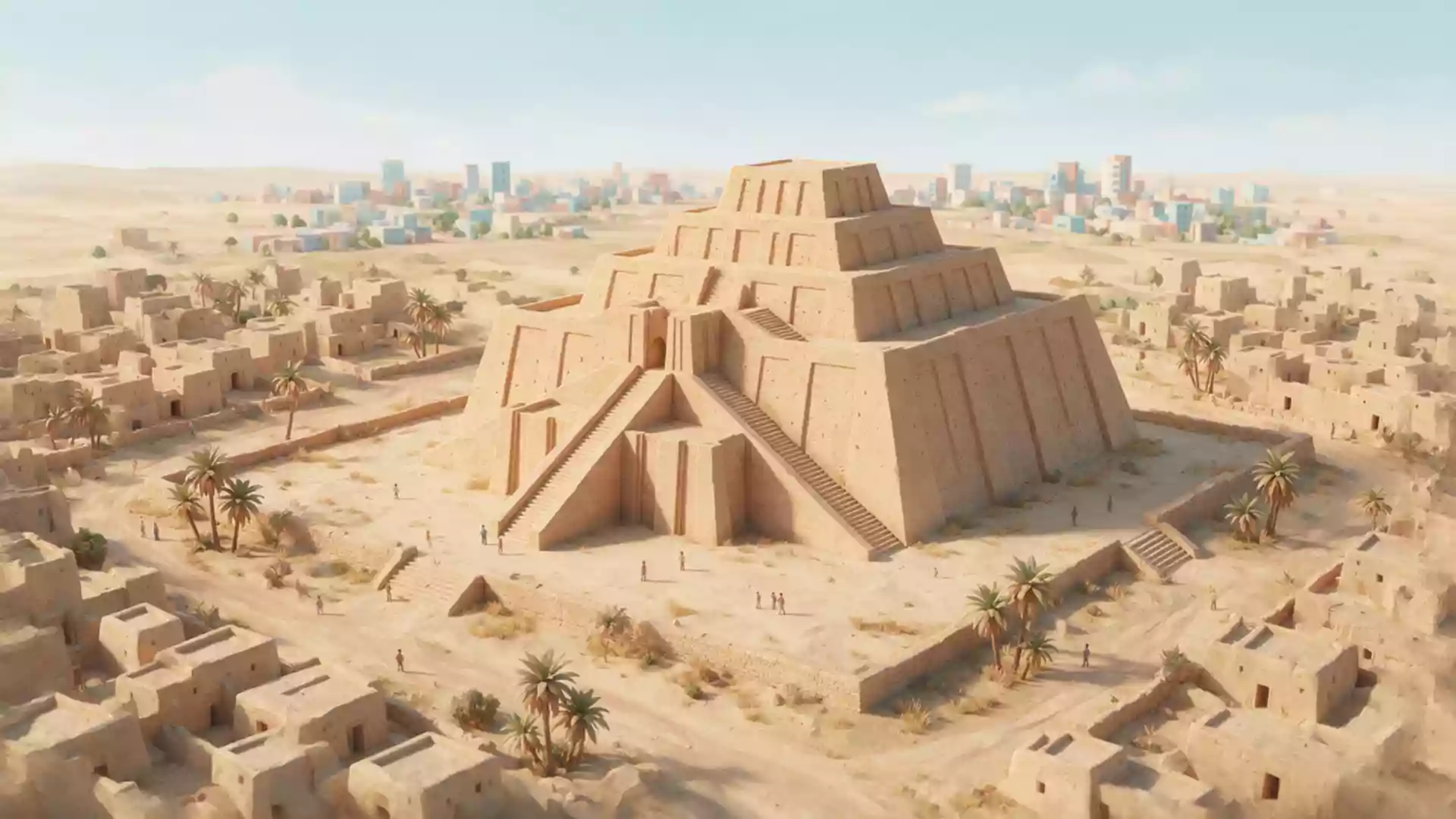
The Ziggurat of Ur near Nasiriya in southern Iraq is a massive stepped temple tower of mud brick, rising above the flat Mesopotamian plain where the ancient city of Ur once thrived in the third millennium BC. Built under the Third Dynasty of Ur and dedicated to the Sumerian moon god Nanna, it survives as one of the clearest architectural expressions of early urban religion in Mesopotamia.
A stepped mountain of brick in the plain
The Ziggurat of Ur stands on the archaeological site of Tell el-Muqayyar in Dhi Qar Province, west of the modern city of Nasiriya, marking the core of the ancient city’s sacred precinct.Tell el-Muqayyar Its overall form is that of a rectangular, tiered mass of mud brick, built as a series of platforms rising one above another, with monumental stairways climbing the eastern side.
Archaeological measurements record a base in the order of 64 m by 46 m (approximately 210 ft by 150 ft), giving the structure a broad footprint in relation to its height.rectangular base Reconstructions and surviving stages indicate that the original ziggurat rose through three main levels, with a temple once standing on the summit, although only the lower stages have remained largely intact.three stages
Ur-Nammu, Shulgi and the moon god Nanna
The Ziggurat of Ur belongs to the Neo-Sumerian period and the Third Dynasty of Ur, a time when southern Mesopotamia was reorganised under kings who revived Sumerian language and culture.Third Dynasty of Ur Construction is securely dated to the reigns of King Ur-Nammu, founder of this dynasty, between about 2112 and 2095 BCE, and his successor Shulgi, who completed the project in the twenty-first century BC.Ur-Nammu and Shulgi
The tower formed the core of a temple complex dedicated to Nanna, the Sumerian moon god also known in Akkadian sources as Sin, who served as the patron deity of Ur.Nanna, the moon god Pilgrims and officials ascended the broad stairways on the ziggurat’s eastern face to reach the temple at the top, where cult rites for Nanna took place above the city. Later, during the Neo-Babylonian period in the sixth century BC, King Nabonidus restored the ziggurat, extending its life as a sacred monument into a different imperial age.restoration by Nabonidus
Architecture, alignment and modern recognition
Excavations led by British archaeologist Leonard Woolley in the early twentieth century revealed the ziggurat’s construction in dense core mud brick with an outer facing of baked brick laid in bitumen, a structure designed to withstand centuries of erosion in the desert climate.mud brick and baked brick Woolley recorded the lower stage as roughly 65 m long, 43 m wide and nearly 10 m high, with the second stage narrower and lower, giving the tower its stepped profile.measured stages
Studies of the monument’s orientation highlight that the ziggurat’s minor axis and central stairway align to a specific lunar rising point, linking its massive brickwork physically to the celestial movements of Nanna.lunar alignment In recognition of its value as part of a wider cultural landscape, the Ziggurat of Ur and its surrounding archaeological sites now form part of a UNESCO World Heritage property named “The Ahwar of Southern Iraq: Refuge of Biodiversity and the Relict Landscape of the Mesopotamian Cities”.UNESCO World Heritage
Visiting Ziggurat of Ur: what travellers from Western Europe should know
- The Ziggurat of Ur stands west of Nasiriya in Dhi Qar Province, reached over the flat plain on roads leading towards the archaeological site of Tell el-Muqayyar.
- The monument rises in stages above level ground, and visiting involves walking across an exposed desert site and climbing broad exterior stairways built into the ziggurat’s eastern face.
- The surrounding terrain forms part of the ancient urban area of Ur, with other excavated structures and foundations visible around the base of the ziggurat.
- The official language is Arabic and the currency is the Iraqi dinar. Entry requirements depend on your nationality; UK travellers can check the FCDO travel advice at gov.uk/foreign-travel-advice, Irish travellers the Department of Foreign Affairs at ireland.ie.
Searching for Ziggurat of Ur on social platforms
These links open searches for Ziggurat of Ur on each platform.
Frequently asked questions about Ziggurat of Ur
Where is the Ziggurat of Ur located?
The Ziggurat of Ur stands on the archaeological site of Tell el-Muqayyar in Dhi Qar Province in southern Iraq, west of the modern city of Nasiriya.
What can visitors expect when they reach the site?
Visitors encounter a stepped mud-brick tower rising above an open desert landscape, approached on foot across the ruins of ancient Ur and climbed via broad exterior stairways.
What makes the Ziggurat of Ur distinctive among Mesopotamian monuments?
The Ziggurat of Ur is a well-preserved Neo-Sumerian temple tower with measurable tiers, a documented lunar alignment and a clear association with the moon god Nanna at the heart of ancient Ur.