
Ziggurat of Ur and its stepped brick terraces
Published on 09/22/2026 at 16:19 | Editorial responsibility: Rafael Müller, Editor-in-Chief AD HOC NEWS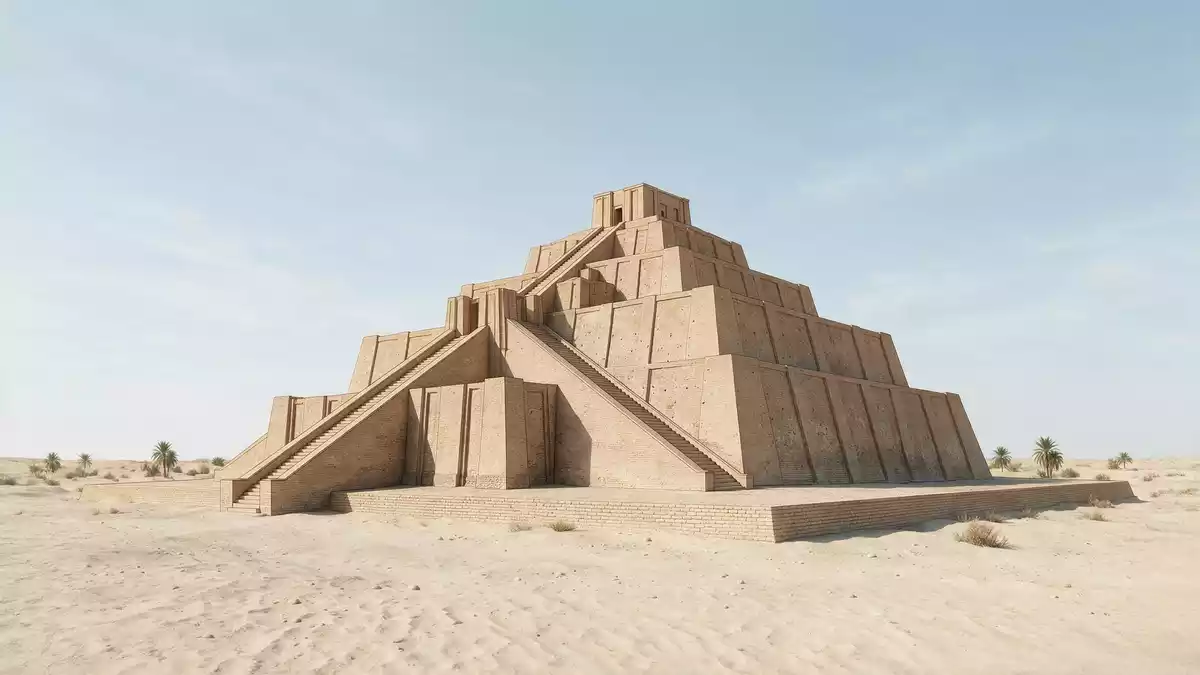
The Ziggurat of Ur rises from the ruins of the ancient city of Ur near Nasiriya in southern Iraq. Its broad, stepped terraces form a massive brick monument whose visible shape has survived more than four millennia.
Built during the reign of Ur-Nammu in the twenty-first century BC, the ziggurat belonged to the religious centre of the Sumerian city. The surviving lower stages combine a mud-brick core with an outer skin of fired brick.
The stepped form of the Ziggurat of Ur
A ziggurat is a raised temple platform built in successive levels. At Ur, the terraces narrow upwards, creating a monumental profile across the flat landscape of southern Mesopotamia. The structure measures about 64 m (210 ft) by 46 m (150 ft) at its base, with the surviving monument reaching roughly 20 m (64 ft) in height.
The lower mass is made from mud brick, a material formed from the alluvial soils of Mesopotamia. Fired bricks cover parts of the exterior, and bitumen appears among the ancient building materials. The monumental stairways meet the broad front of the platform and remain among its clearest architectural features.
Ur-Nammu, Nanna and the city of Ur
Ur-Nammu founded the Third Dynasty of Ur and commissioned the ziggurat during the twenty-first century BC. Its Sumerian name was Etemenniguru, and the monument formed part of a sacred precinct dedicated to Nanna, the moon god of Ur.
The city surrounding the ziggurat was a major Sumerian centre on the Euphrates. The temple complex connected religion, administration and urban life, while the elevated platform marked the centre of the ancient settlement. the temple platform at Ur belongs to a wider Mesopotamian tradition of monumental mud-brick construction.
Rebuilding, archaeology and World Heritage
The ziggurat was restored during the reign of Nabonidus in the sixth century BC, when the Neo-Babylonian Empire controlled the region. Centuries of erosion and collapse reduced the upper structure, leaving the lower terraces as the principal surviving mass.
Archaeological excavations at Ur in the twentieth century brought the monument into wider view. Partial reconstruction restored sections of the lower stages and stairways. The archaeological city of Ur entered the UNESCO World Heritage site “The Ahwar of Southern Iraq” in 2016, linking the ruins with the region’s marshland landscapes. the World Heritage designation places the ziggurat within a mixed cultural and natural heritage setting.
The monument’s historical layers remain visible in its fabric. Sumerian construction, Neo-Babylonian restoration, twentieth-century archaeological work and partial modern rebuilding all belong to the story of the same stepped platform. the excavations at Ur also revealed the surrounding city, including temples, streets, burials and administrative remains.
Visiting Ziggurat of Ur: what travellers from Western Europe should know
- The ziggurat stands at Tell el-Muqayyar in Dhi Qar Governorate, near Nasiriya. Road travel from Nasiriya reaches the archaeological city across the surrounding desert and cultivated plain.
- The monument consists of steep masonry terraces and large stairways. The upper levels are uneven, and the exposed site offers little shade across the brick ruins.
- The archaeological city includes the ziggurat, temple remains, burial areas and traces of ancient urban quarters. The wider landscape belongs to southern Iraq’s Euphrates region.
- The official language is Arabic and the currency is the Iraqi dinar.
- Entry requirements depend on your nationality; UK travellers can check the FCDO travel advice at gov.uk/foreign-travel-advice, Irish travellers the Department of Foreign Affairs at ireland.ie.
Searching for Ziggurat of Ur on social platforms
These links open searches for Ziggurat of Ur on each platform.
Frequently asked questions about Ziggurat of Ur
Where is the Ziggurat of Ur?
The monument stands at Tell el-Muqayyar in Dhi Qar Governorate, near Nasiriya in southern Iraq. It forms part of the archaeological city of Ur.
What can visitors expect at the site?
The principal feature is a large stepped platform of mud brick and fired brick. The surrounding ruins include temple remains, burial areas and traces of ancient urban life.
What makes the Ziggurat of Ur distinctive?
Its broad terraces preserve the form of a Sumerian ziggurat associated with Ur-Nammu and the moon god Nanna. The monument also carries visible layers from Neo-Babylonian restoration and modern archaeological reconstruction.


