
Ziggurat of Ur and its enduring mud-brick terraces
Published on 09/23/2026 at 18:44 | Editorial responsibility: Rafael Müller, Editor-in-Chief AD HOC NEWS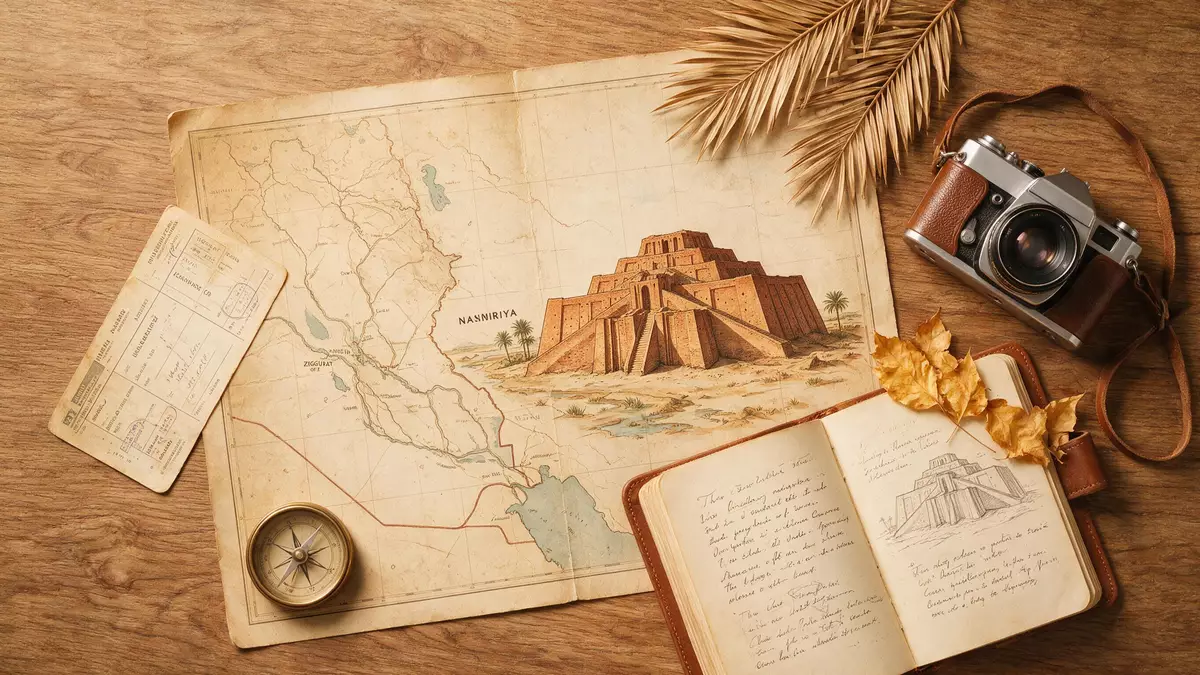
The Ziggurat of Ur is a stepped monument beside the ancient city of Ur, near Nasiriya in southern Iraq. Its broad terraces form a solid mass of mud brick and baked brick, rising above the flat landscape as a surviving fragment of Sumerian religious architecture.
Construction began around 2100 BCE under Ur-Nammu of the Third Dynasty of Ur. The monument was associated with Nanna, the Sumerian moon god, and its surviving platforms preserve the scale and materials of an urban sacred precinct from the early second millennium BCE.
Ur-Nammu and the Third Dynasty of Ur
Ur-Nammu ruled during the period known as the Third Dynasty of Ur, a Sumerian state centred on the city of Ur. The ziggurat belongs to that political and religious setting, when monumental buildings formed part of the city’s sacred quarter.
The earliest bricks date to about 2100 BCE, placing the monument in the late third millennium BCE. earliest bricks at Ur belong to the original building phase, while the completion of the work is associated with Ur-Nammu’s son, Shulgi.
The ziggurat was connected with Nanna, also known as Sîn, the moon deity linked with Ur. A temple stood on the upper part of the monument, although the summit temple does not survive in its ancient form.
A stepped mass of mud brick and baked brick
The monument’s core consists of sun-dried mud bricks. Reed matting and layers of sandy material were incorporated into the construction, while a facing of baked bricks protected the exterior.
Bitumen mortar appears in the baked-brick facing. The combination of mud brick, reed and bitumen reflects the materials available in southern Mesopotamia, where monumental building depended on manufactured brick rather than abundant building stone.
The surviving structure has two clearly preserved levels from an original arrangement of three. Its base measures about 64 metres by 45 metres, and its surviving height is approximately 17 metres. surviving dimensions describe the monument as it stands after the loss of its uppermost level.
Wide stairways and sloping walls define the visible form. The terraces become smaller towards the top, creating the characteristic profile of a Mesopotamian ziggurat without the pointed shape of a pyramid.
From Sumerian sanctuary to archaeological landmark
The Ziggurat of Ur formed part of a larger sacred area within the ancient city. Ur itself was a major Sumerian centre, and its ruins include evidence of temples, houses, burials and administrative buildings.
Babylonian rulers restored parts of the monument in the sixth century BCE. Nabonidus, the final king of the Neo-Babylonian Empire, is associated with restoration work at Ur and with renewed attention to the city’s older religious monuments.
The ziggurat’s surviving brickwork records several layers of history. The original Sumerian core remains beneath later repairs and archaeological reconstruction, while the missing upper temple leaves the terraces as the principal visible element.
Ur became part of the UNESCO-listed Ahwar of Southern Iraq World Heritage property in 2016. The designation includes the archaeological remains of Ur within a wider cultural and environmental landscape in southern Iraq.
The monument is also a reference point for understanding ziggurats as raised temple platforms. Its form combines a heavy architectural body with stairways, terraces and a summit sanctuary, presenting religious architecture through height and layered construction.
Visiting Ziggurat of Ur: what travellers from Western Europe should know
- The ziggurat lies beside the ruins of ancient Ur near Nasiriya in Dhi Qar province, southern Iraq. Nasiriya is the principal modern reference point for the archaeological site.
- The approach crosses an exposed archaeological landscape of compacted earth and scattered ruins. The monument itself is reached on foot across the open site.
- The official language is Arabic and the national currency is the Iraqi dinar.
- Entry requirements depend on your nationality; UK travellers can check the FCDO travel advice at gov.uk/foreign-travel-advice, Irish travellers the Department of Foreign Affairs at ireland.ie.
Searching for Ziggurat of Ur on social platforms
These links open searches for Ziggurat of Ur on each platform.
Frequently asked questions about Ziggurat of Ur
Where is the Ziggurat of Ur?
It stands within the ruins of ancient Ur near Nasiriya in southern Iraq. The site lies in Dhi Qar province, close to the Euphrates region.
What does a visit to the monument involve?
A visit combines the ziggurat with the wider archaeological remains of Ur. The open site contains terraces, stairways, brick ruins and traces of the ancient city.
What makes the Ziggurat of Ur distinctive?
Its defining feature is the surviving stepped form, built with a mud-brick core and baked-brick facing. The monument also preserves a direct connection with Ur-Nammu, Nanna and the Third Dynasty of Ur.


