
Ziggurat of Ur, a stepped temple above the Mesopotamian plain
Published on 09/16/2026 at 09:28 | Editorial responsibility: Rafael Müller, Editor-in-Chief AD HOC NEWS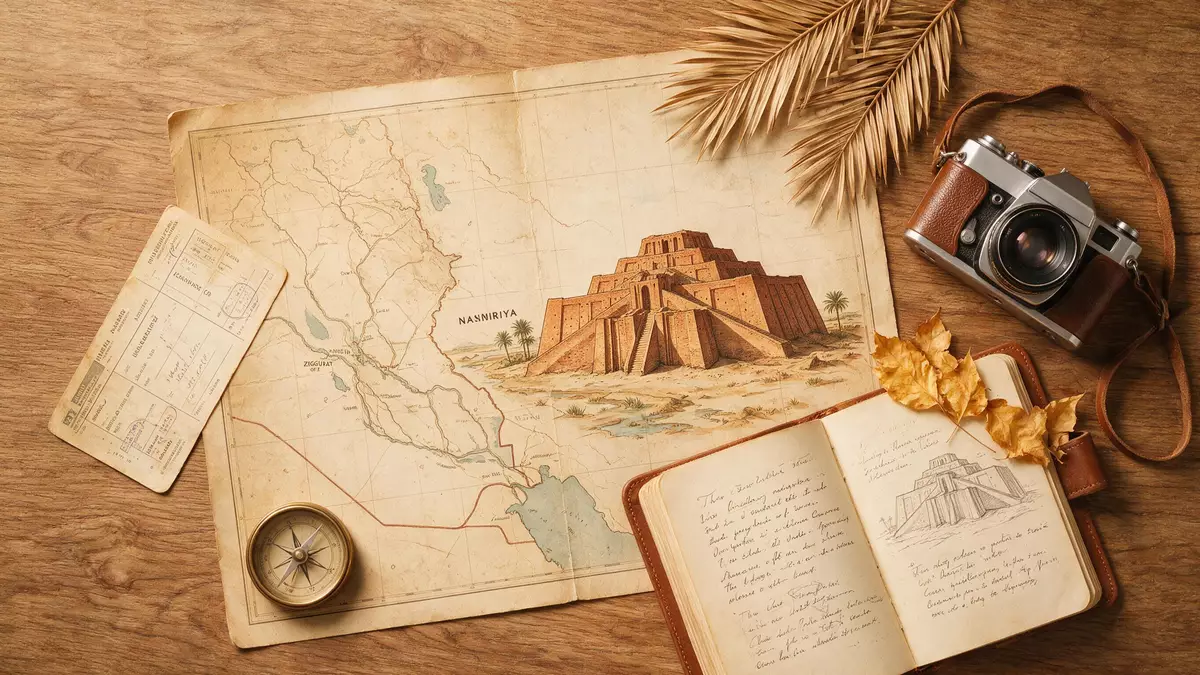
The Ziggurat of Ur near Nasiriya in southern Iraq is a massive stepped temple tower that lifts ancient Ur’s sacred precinct above the flat Mesopotamian plain. Built for the moon god Nanna during the Third Dynasty of Ur around 2100 BCE, it combines a solid mud-brick mass with baked-brick facing to form one of the clearest surviving expressions of early Mesopotamian religious architecture.Third Dynasty of Ur
A mountain of brick in the city of Ur
The Ziggurat of Ur stands on the archaeological mound of Tell el-Muqayyar in Dhi Qar Province, marking the centre of the ancient city of Ur, which lay west of the modern city of Nasiriya.Tell el-Muqayyar in Dhi Qar From the surrounding plain the structure appears as a high, tiered mass of brick rising above low ruins, its stairways cutting a strong vertical line against the horizontality of the landscape.
Archaeologists describe the ziggurat’s plan as a large rectangle, with the base measuring about 64 m (210 ft) in length and around 46 m (151 ft) in width, oriented close to true north.rectangular pyramid oriented north The surviving mass consists of stacked platforms of mud brick, each receding from the one below, forming a stepped outline that once carried a temple for Nanna on its summit.platforms of mud brick
Construction under Ur-Nammu for the moon god Nanna
The building of the Ziggurat of Ur is closely linked to King Ur-Nammu, founder of the Third Dynasty of Ur, who ruled in the late third millennium BCE and initiated major works across his city.Ur-Nammu and the dynasty Its Sumerian ceremonial name, Etemenniguru, is usually translated as “house whose foundation creates awe”, expressing the intended presence of the monument within the sacred quarter of Ur.Etemenniguru, the Sumerian name
The ziggurat’s earliest bricks date to about 2100 BCE, and the temple complex on its summit was dedicated to Nanna, also known as Sîn, the moon god who served as divine patron of the city.earliest bricks around 2100 BCE Structurally, the monument is a solid core of sun-dried mud bricks set in layers with reed matting and bitumen, faced with baked bricks that once formed clean, sloping walls and protected the mass from weather.mud-brick core and baked-brick facing
Terraces, stairways and the experience of the site
In its original form the Ziggurat of Ur rose through three main stages, or terraces, and reached a height estimated between 21 m and 30 m (69 ft and 98 ft), though only the lower levels survive to nearly 17 m (56 ft).original height and surviving stages The most striking external feature is the monumental stairways on the eastern side, where broad flights of steps converge towards a high platform and the position of the former summit shrine.monumental stairways
From the base, visitors see the pronounced inward slope of the baked-brick facing, the thick walls and the pattern of buttresses that articulate the stepped outline.inward-sloping walls and buttresses Around the ziggurat lie further remains of Ur’s sacred and residential quarters, where temple courtyards, administrative buildings and houses once spread across the site, giving context to the temple tower as the focal point of a wider Bronze Age city.surrounding city remains
Visiting Ziggurat of Ur: what travellers from Western Europe should know
- The Ziggurat of Ur stands west of Nasiriya in southern Iraq, within the archaeological site of Ur at Tell el-Muqayyar, reached by road across the flat alluvial plain.
- The monument rises as a stepped mass of brick with long external stairways and sloping walls, and the approach on foot involves climbing exposed steps and walking over uneven archaeological ground.
- The official language is Arabic and the currency is the Iraqi dinar.
- Entry requirements depend on your nationality; UK travellers can check the FCDO travel advice at gov.uk/foreign-travel-advice, Irish travellers the Department of Foreign Affairs at ireland.ie.
Searching for Ziggurat of Ur on social platforms
These links open searches for Ziggurat of Ur on each platform.
Frequently asked questions about Ziggurat of Ur
Where is the Ziggurat of Ur located?
The Ziggurat of Ur stands at Tell el-Muqayyar in Dhi Qar Province in southern Iraq, west of the modern city of Nasiriya, within the ruins of ancient Ur.
What can visitors expect when they reach the site?
Visitors encounter a large stepped brick mass with prominent stairways and sloping walls, set amid low archaeological remains on a wide, open plain.
What makes the Ziggurat of Ur distinctive among ancient structures?
Its combination of a solid mud-brick core, baked-brick facing, three-stage stepped form and dedication to the moon god Nanna marks it as a characteristic monument of Neo-Sumerian temple architecture.


