
Ziggurat of Ur, a stepped monument on the plains of Nasiriya
Published on 09/05/2026 at 17:23 | Editorial responsibility: Rafael Müller, Editor-in-Chief AD HOC NEWS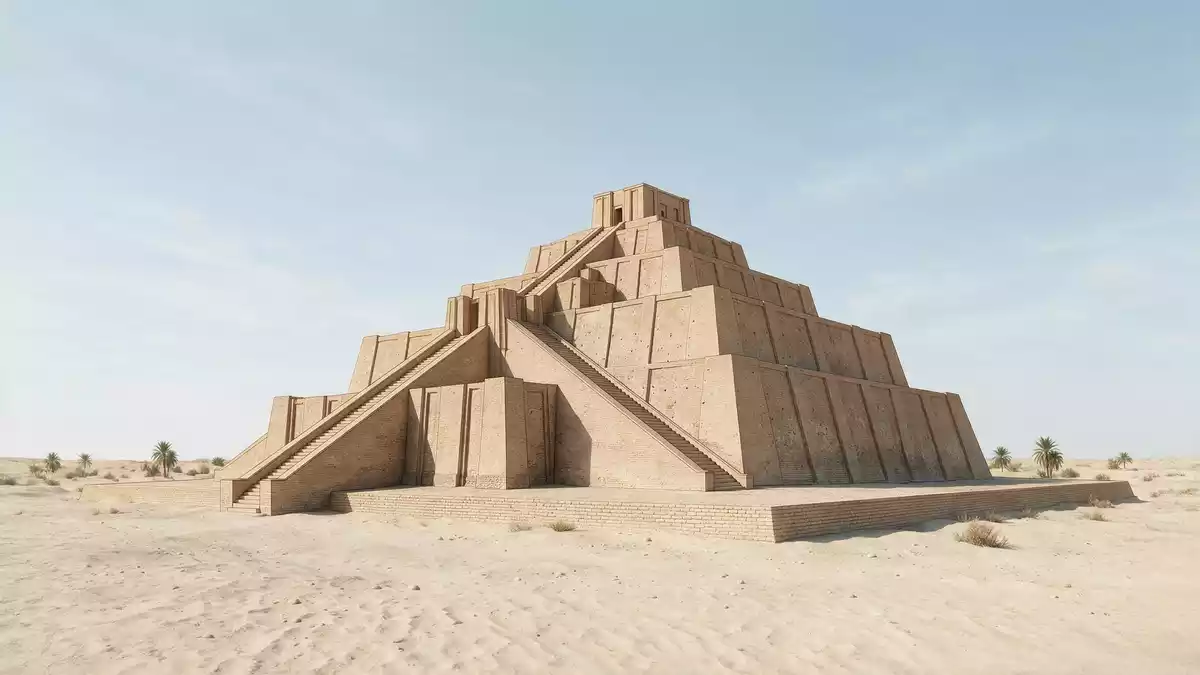
The Ziggurat of Ur near Nasiriya in southern Iraq is a stepped mud-brick monument from the Neo-Sumerian period, commanding the flat plains around the ancient city of Ur. Built during the Third Dynasty of Ur and dedicated to the moon god Nanna, it gives the low Mesopotamian landscape an artificial summit that remains sharply defined against the horizon.
A Neo-Sumerian mountain of brick
The Ziggurat of Ur stands on the archaeological mound of Tell el-Muqayyar in the Dhi Qar Governorate, close to the modern city of Nasiriya in southern Iraq. The site marks the location of ancient Ur, a major Sumerian city-state whose remains spread around the base of the ziggurat.Tell el-Muqayyar in Dhi Qar The structure belongs to the Neo-Sumerian period and forms part of a wider temple complex that once organised religious and administrative life in the city.ancient Mesopotamian city of Ur
The ziggurat takes the form of a large rectangular, stepped platform rising from a broad base. Excavations led by British archaeologist Leonard Woolley in the early twentieth century uncovered its outline as a massive pyramidal structure with successive terraces.Leonard Woolley’s excavations The core consists mainly of sun-dried mud bricks, clad in fired bricks bonded with bitumen, an arrangement that protected the interior from weather and helped the structure endure for millennia.mud-brick core and baked-brick skin
Ur-Nammu, Shulgi and the Third Dynasty of Ur
The monument is closely tied to the political and religious power of the Third Dynasty of Ur, which ruled parts of southern Mesopotamia in the late third millennium BCE. Construction of the Ziggurat of Ur is credited to King Ur-Nammu, founder of the dynasty, whose reign falls around 2112–2095 BCE.Ur-Nammu of the Third Dynasty His son Shulgi, who extended the reach of the kingdom, completed the work, giving the city a monumental focus that anchored both ritual and administration.Shulgi’s completion of the ziggurat
The Sumerian ceremonial name of the ziggurat, Etemenniguru, is usually rendered as “house whose foundation creates awe”.Etemenniguru ceremonial name It was part of a temple complex dedicated to Nanna, also known in Akkadian as Sîn, the moon god regarded as the patron deity of Ur.temple-complex of Nanna Centuries later, during the Neo-Babylonian period in the sixth century BC, the structure had suffered significant decay and was restored by King Nabonidus, whose work helped stabilise at least part of the ancient brick mass.restoration by King Nabonidus
Form, stairways and the surrounding city of Ur
The Ziggurat of Ur stands as a compact, stepped mound whose footprint measures roughly 64 m by 46 m (210 ft by 150 ft) at the base.rectangular pyramidal structure Original estimates place its height around 21–30 m (70–100 ft), though the surviving remains rise less than that. The structure is oriented to the cardinal directions and built on three prominent levels of terraces, with traces indicating more stages in later phases.three layers with temple above
A monumental stair arrangement on one side forms the most striking approach to the ziggurat. Several broad flights of steps converge toward the upper terrace, emphasising the ascent from the flat surrounding plain to the elevated platform where the temple to Nanna once stood.stairways leading to the summit Around the structure lie the remains of Ur itself, including temple precincts and residential areas identified through archaeological surveys.Ur as an archaeological village The ziggurat’s layered brick mass and sharp geometric profile make it the most instantly recognisable element of the site, standing out amid the lower ruins and sandy ground.
Visiting Ziggurat of Ur: what travellers from Western Europe should know
- The Ziggurat of Ur stands west of Nasiriya in the Dhi Qar Governorate of southern Iraq, on the archaeological mound of Tell el-Muqayyar in the Nasiriyah District.
- The monument rises above level desert terrain, and reaching its upper terraces involves climbing a long external staircase with a sustained gradient.
- The official language is Arabic and the currency is the Iraqi dinar.
- Entry requirements depend on your nationality; UK travellers can check the FCDO travel advice at gov.uk/foreign-travel-advice, Irish travellers the Department of Foreign Affairs at ireland.ie.
Searching for Ziggurat of Ur on social platforms
These links open searches for Ziggurat of Ur on each platform.
Frequently asked questions about Ziggurat of Ur
Where is the Ziggurat of Ur located?
The Ziggurat of Ur stands at Tell el-Muqayyar in the Nasiriyah District of Dhi Qar Governorate in southern Iraq, west of the modern city of Nasiriya.
What should visitors expect when they reach the site?
Visitors encounter a stepped brick monument rising from a broad rectangular base, fronted by long stairways and surrounded by low ruins of the ancient city of Ur.
What makes the Ziggurat of Ur distinctive among Mesopotamian sites?
Its Neo-Sumerian date, connection to rulers Ur-Nammu and Shulgi, dedication to the moon god Nanna and well-preserved stepped profile make it a distinctive landmark on the Mesopotamian plain.


