
Zhujiajiao, Shanghai’s lattice of canals and stone bridges
Published on 09/04/2026 at 13:00 | Editorial responsibility: Rafael Müller, Editor-in-Chief AD HOC NEWS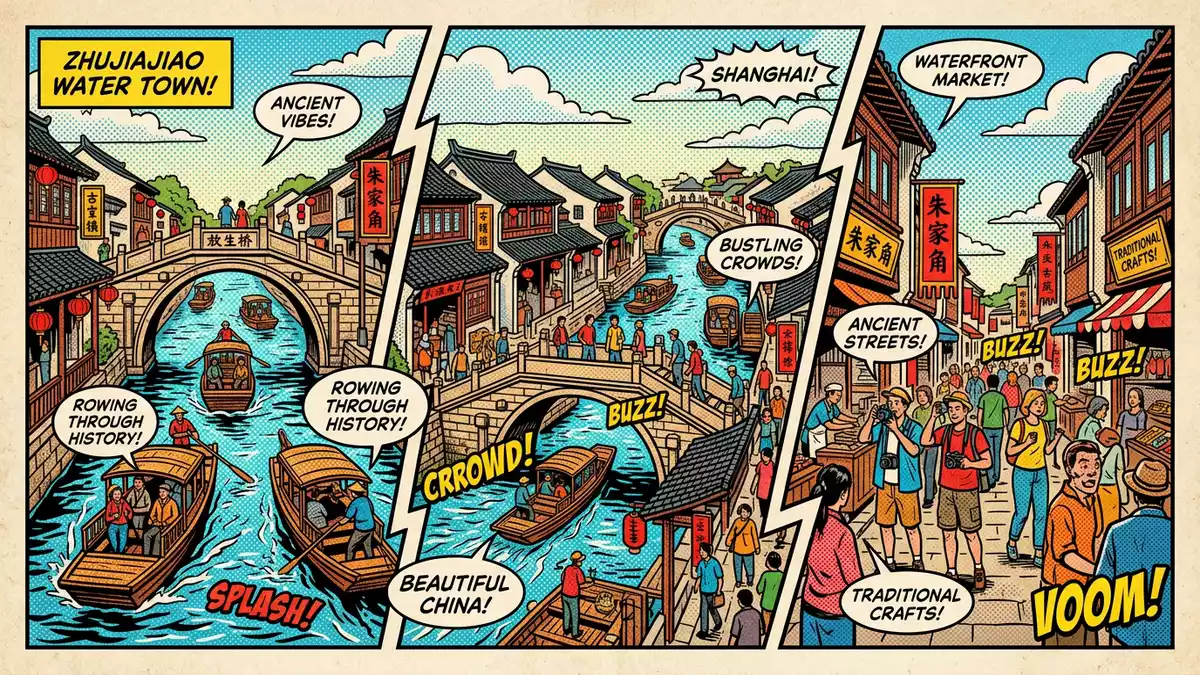
Zhujiajiao in Shanghai’s Qingpu District is an ancient water town arranged around canals, stone bridges and riverside streets that have grown over more than 1,700 years. Set west of central Shanghai and close to Dianshan Lake, it remains one of the city’s best-preserved historic canal settlements, with buildings from the Ming and Qing dynasties still overlooking the water.
Canals, bridges and a fan-shaped townscape
Zhujiajiao is described as a fan-shaped town where waterways replace many streets and boats once carried grain, textiles and other produce between Shanghai and the wider Yangtze River region. A network of rivers and canals crosses the settlement, and historic lanes follow these watercourses, giving the town its characteristic lattice pattern.Zhujiajiao Water Town Bridges are among Zhujiajiao’s most recognised features, with numerous stone and marble spans dating from the Ming dynasty, which began in 1368, and the Qing dynasty, which continued into the early twentieth century.bridges built during the Ming and Qing dynasties
The historic core of Zhujiajiao covers roughly 3 km², with streets that date back centuries running beside the canals and past old dwellings, shops and courtyards.ancient district of Zhujiajiao Within this area are buildings from different periods of the town’s growth, many of them following traditional Jiangnan styles with tiled roofs and timber elements. The settlement’s position beside Dianshan Lake, in the south of the Yangtze River region, contributes to its character as a water-centred community.embedded beside Dianshan Lake
An ancient trading hub with Ming and Qing architecture
Zhujiajiao has a long-recorded history, with a village forming around 1,700 years ago and the settlement developing into a town during the Wanli period of the Ming dynasty in the late sixteenth and early seventeenth centuries.formed village 1700 years ago Its location in the west of modern Shanghai made it a trading centre for the surrounding countryside, and the canals and quays handled goods moving between local farms and urban markets. The town’s historic streets still reflect this mercantile past, with warehouses, shopfronts and courtyards aligned along the waterways.
Architecture from the Ming and Qing dynasties survives across Zhujiajiao’s old quarter, including residences, halls and commercial buildings by the water. The scenic area of the ancient town is documented as covering just over 3 km², with many structures retaining traditional layouts and decorative details such as carved wood and stone.thousand buildings from the Ming and Qing Dynasties Formal recognition of the town’s heritage includes its listing as a Historical and Cultural Town in Shanghai and as part of a group of National Historical and Cultural Towns in China, reflecting its status within the region’s wider history.Zhujiajiao Historical and Cultural Town designation
Streets, riverside life and notable sites
Within the ancient town, historic streets follow the canals, lined with old houses, small shops and occasional temple and garden complexes. Nine streets are described as having histories extending back centuries, each winding along the rivers and connecting bridges with squares and riverfront spaces.nine century-old streets wind along the rivers Stone paving underfoot and close-set buildings beside the water give these lanes a distinctive character compared with newer districts of Shanghai.
Among the sites within Zhujiajiao’s historic core are gardens, former official buildings and religious structures that form part of the scenic area’s visitor route. Kezhi Garden, the Qing dynasty Post Office and a City God Temple are examples of places that appear on town plans, illustrating different aspects of local life from administration to worship.Kezhi Garden and Qing Dynasty Post Office Together with the bridges and canals, these sites show how the water town combined its trading function with cultural and civic institutions.
Visiting Zhujiajiao: what travellers from Western Europe should know
- Zhujiajiao lies in the Qingpu District to the west of central Shanghai, and the town is reached by road and by Shanghai Metro Line 17, which has a station named Zhujiajiao.
- The historic quarter consists of riverside streets, stone paving and several bridges; exploring the old town involves walking along uneven surfaces and crossing steps on bridge approaches.
- The core scenic area of Zhujiajiao is described as covering about 3 km², with canals, historic streets and buildings close together, so visitors encounter frequent changes between narrow lanes and open waterfront spaces.
- Zhujiajiao is in China, where the official language is Chinese and the currency is the yuan (renminbi).
- Entry requirements depend on your nationality; UK travellers can check the FCDO travel advice at gov.uk/foreign-travel-advice, Irish travellers the Department of Foreign Affairs at ireland.ie.
Searching for Zhujiajiao on social platforms
These links open searches for Zhujiajiao on each platform.
Frequently asked questions about Zhujiajiao
Where is Zhujiajiao located?
Zhujiajiao is a historic water town in the Qingpu District of Shanghai in eastern China, west of the city centre and close to Dianshan Lake.
What can visitors expect on a visit to Zhujiajiao?
Visitors encounter canals, stone bridges, paved lanes and historic buildings from the Ming and Qing dynasties, together forming a canal-side townscape that reflects centuries of trading life.
What makes Zhujiajiao distinctive among Shanghai’s historic areas?
Zhujiajiao’s lattice of waterways, fan-shaped plan and concentration of Ming and Qing architecture by the canals give it a character distinct from Shanghai’s urban districts on dry land.


