
Zhujiajiao, Shanghai’s canalside town of bridges and alleys
Published on 09/09/2026 at 21:19 | Editorial responsibility: Rafael Müller, Editor-in-Chief AD HOC NEWS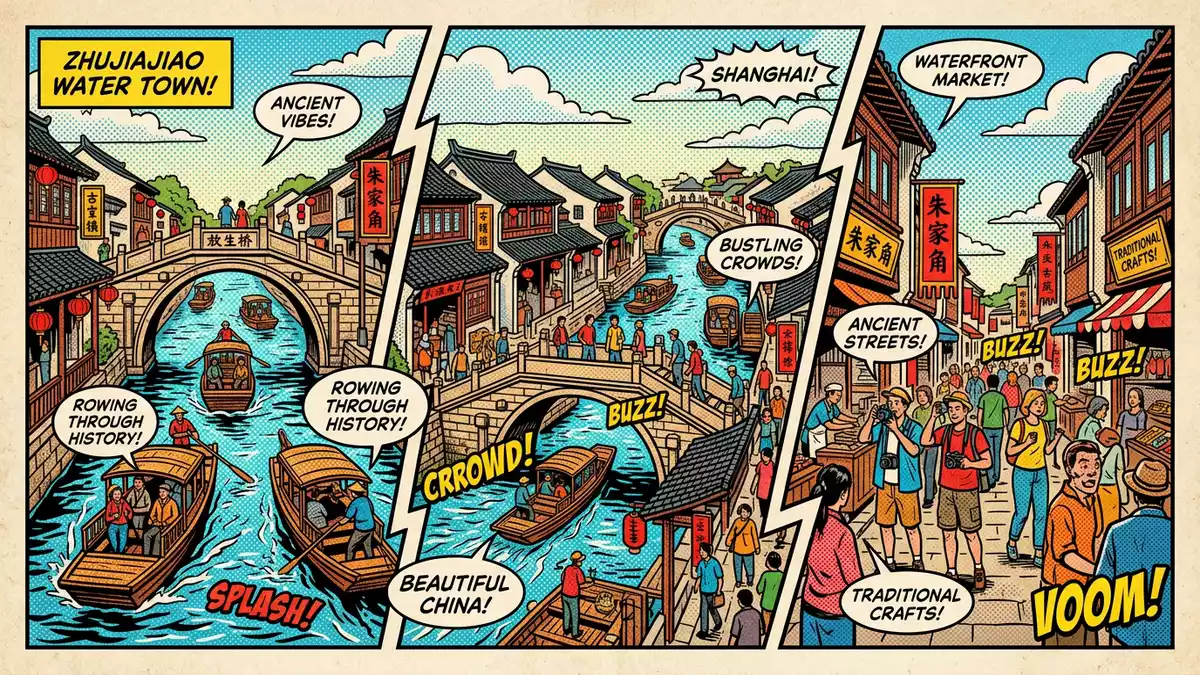
Zhujiajiao is a historic water town on the western edge of Shanghai, where canals, stone bridges and riverside lanes form a dense mesh of waterways and streets that has grown over many centuries. Set in Qingpu District beside the lakes and wetlands of the lower Yangtze region, the town brings together late imperial architecture and everyday life along the water in a compact urban landscape.
Canals, bridges and a town built around water
Zhujiajiao is built at a meeting of waterways in the south-west of Shanghai’s Qingpu District, in a landscape of rivers feeding towards Dianshan Lake.Zhujiajiao is located in the southwest part of Qingpu District Narrow canals run alongside stone-paved lanes, and houses line the water with arcades, docks and small courtyards opening towards the channels. The settlement’s position within the wider network of rivers and lakes of the Jiangnan region made it an important point for moving goods between Shanghai and neighbouring provinces during the late imperial period.an important trading port within the Jiangnan region
The ancient district of Zhujiajiao occupies around 3 km², with a core scenic area of a similar scale that concentrates the town’s canals, historic houses and temples.the ancient district occupies about 3 km²the scenic area of the ancient town covers an area of 3.08 square kilometres Within this area, bridges cross the canals at short intervals and small squares open beside the water, often with teahouses, shops and older residential buildings clustered around them.
A town with deep roots in the Ming and Qing dynasties
Human activity around Zhujiajiao’s waterways reaches back several millennia, with traces of settlement in the surrounding area extending to around 5,000 years ago.archaeological finds suggest habitation reaching as far as 5,000 years ago The town itself is traditionally dated to around 1,700 years ago, forming a village that later grew into a market town.Zhujiajiao has formed village 1,700 years ago During the Song dynasty, from 960 to 1279, and the Yuan dynasty, from 1271 to 1368, merchants and farmers from the wider Jiangnan region used Zhujiajiao as a local trading centre, and its first organised markets appeared in this period.markets developed during the Song and Yuan dynasties
Zhujiajiao was formally recognised as a town in the Wanli period of the Ming dynasty, during the reign of the Wanli Emperor between 1573 and 1620.it became town in Wanli Period of Ming Dynasty In the Qing dynasty, which lasted from the seventeenth to the early twentieth century, canal-side streets and warehouses consolidated Zhujiajiao’s role as a regional distribution centre for rice, textiles and handicrafts, and many of the buildings standing along the water today date from this era.much of the built fabric that survives today dates from the Qing dynasty Within Shanghai, the town has been recognised as a historical and cultural town since the late twentieth century, with formal protection for its old streets and riverside quarters.listed as a Historical and Cultural Town in Shanghai in 1991
Streets, temples and bridges along the water
Walking through Zhujiajiao, the most striking features are its bridges, many of which date from the Ming and Qing dynasties and cross the town’s canals with single or multiple spans.bridges built during Ming and Qing dynasties They are built in materials such as stone, brick and wood, and carry flights of steps that rise from the street level to a crest over the water. Beneath them, small boats move along the canals, passing under the arches and stopping at jetties that lead into side lanes.
Beside the bridges, Zhujiajiao’s historic buildings include houses, former warehouses, religious sites and gardens that line the canals or stand in short lanes behind them. Among these are features such as Kezhi Garden, a compound of courtyards and halls, and a City God Temple, which reflects the town’s place within the wider religious landscape of Shanghai’s traditional neighbourhoods.Kezhi Garden and the City God Temple Other notable elements include an old post office dating from the Qing dynasty and stretches of commercial street with shops and food stalls opening directly onto the paving.
Visiting Zhujiajiao: what travellers from Western Europe should know
- Zhujiajiao lies in the south-west of Shanghai’s Qingpu District, in the wider lake landscape west of the city; it is reached by urban transport links serving the district.
- The historic area is compact, but the lanes and canal embankments involve extended walking over stone paving, with flights of steps on the bridges and in some temple precincts.
- English is not an official language in China, and the currency is the renminbi (yuan).
- Entry requirements depend on your nationality; UK travellers can check the FCDO travel advice at gov.uk/foreign-travel-advice, Irish travellers the Department of Foreign Affairs at ireland.ie.
Searching for Zhujiajiao on social platforms
These links open searches for Zhujiajiao on each platform.Frequently asked questions about Zhujiajiao
Where is Zhujiajiao located?
Zhujiajiao is in Qingpu District in the west of Shanghai, in a water-town landscape of rivers and lakes on the edge of the wider metropolis.
What should visitors expect on a visit to Zhujiajiao?
Visitors encounter canals, stone bridges, paved lanes and historic houses, together with temples, gardens and commercial streets that line the water.
What makes Zhujiajiao distinctive among Shanghai’s historic areas?
Zhujiajiao’s combination of canal-based layout, late imperial trading history and protected townscape makes it stand out among Shanghai’s historic districts.


