
Zamek w Malborku and the brick power of the Teutonic Order
Published on 09/16/2026 at 18:59 | Editorial responsibility: Rafael Müller, Editor-in-Chief AD HOC NEWS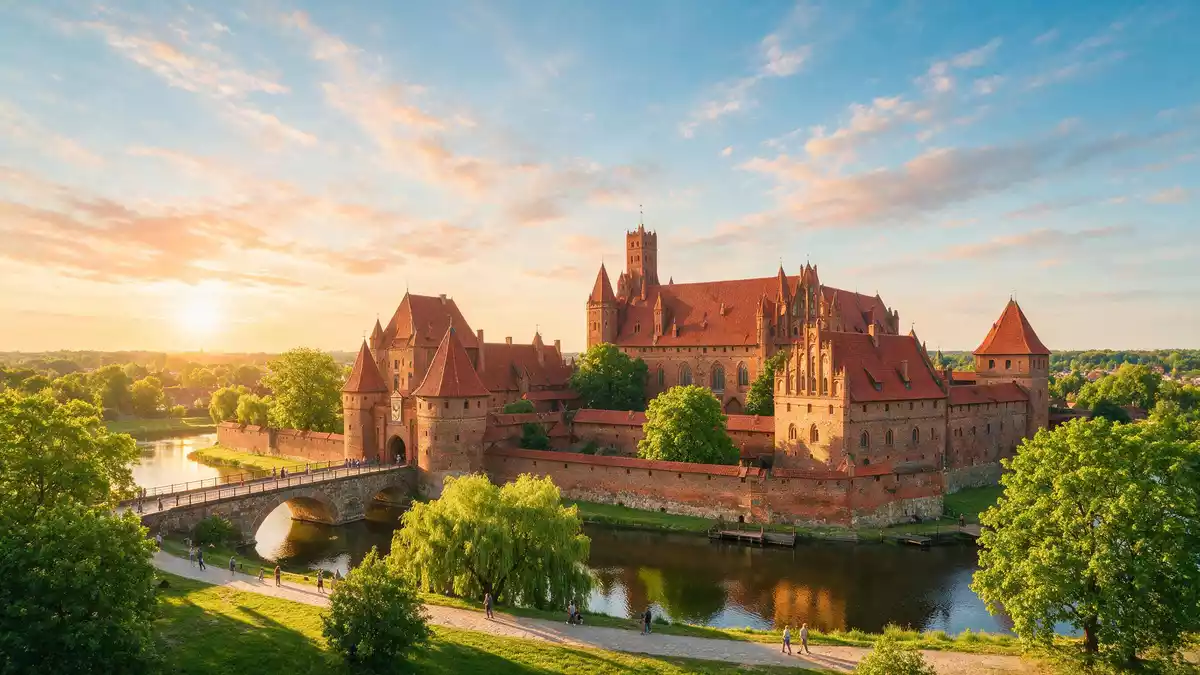
Zamek w Malborku, known in English as Malbork Castle, spreads along the right bank of the River Nogat in northern Poland as a monumental Brick Gothic stronghold built by the Teutonic Order in the thirteenth and fourteenth centuries.Castle of the Teutonic Order in Malbork The complex later became a royal residence and, since 1961, has housed the Castle Museum in Malbork, reflecting centuries of Polish and Prussian history within one of Europe’s largest castle ensembles.Castle Museum in Malbork
Brick Gothic on the Nogat
Zamek w Malborku stands on the east bank of the Nogat, a branch of the Vistula, where water and fortifications form a single continuous landscape.east bank of the River Nogat From the river side the castle’s outer walls rise directly from embanked terraces, their reddish-brown brick surfaces broken by towers and steeply pitched roofs that mark the different parts of the complex.
The architecture is firmly rooted in Brick Gothic, a style common across the Baltic region where brick replaced dressed stone as the main construction material.Brick Gothic castle complex Long ranges of curtain wall, gabled elevations and pointed-arch details show how the Teutonic Order turned simple baked clay units into a fortified monastery, with religious buildings, residential wings and defensive structures set within one integrated design.
A castle built and rebuilt across centuries
Construction at Malbork began in the thirteenth century, when the Teutonic Knights established a fortified monastery at this bend of the Nogat and started raising brick walls and towers on an organised plan.built in the 13th century Work continued into the fourteenth century, extending the complex in stages so that it grew into a multi-part stronghold enclosing religious, residential and military functions in separate but connected zones.built in the 13th and significantly expanded in the 14th century
In 1309 the Grand Master of the Teutonic Order transferred his seat from Venice to Malbork, making the castle the political and administrative centre of the Order’s state in this part of Europe.seat of the Grand Master moved here from Venice Later centuries brought changes of rule and long restoration campaigns, particularly during the nineteenth and twentieth centuries, when damaged sections were rebuilt and Gothic details reinstated to recover the medieval character after war-time destruction.reconstructed in several stages
From monastic fortress to museum and World Heritage
Zamek w Malborku began as a fortress-monastery of the Teutonic Order, a German Catholic military and religious order whose members combined monastic life with crusading campaigns in Prussia and the Baltic region.constructed by the Teutonic Order After the decline of the Order’s power, the complex became a royal residence, and its great halls and chambers were adapted to serve a secular court while still retaining the defensive outline of the medieval stronghold.later a residence of the Polish kings
Since 1961 the castle has housed the Castle Museum in Malbork, which looks after the historic fabric and collections and presents the site as a museum of architecture, history and art.since 1961 the seat of the Castle Museum In 1997 the “Castle of the Teutonic Order in Malbork” was inscribed on the UNESCO World Heritage List as an outstanding example of a medieval brick castle and for the way its long conservation history illustrates changing approaches to restoration.inscribed on the basis of criteria (ii), (iii) and (iv)
Visiting Zamek w Malborku: what travellers from Western Europe should know
- Zamek w Malborku stands in the town of Malbork in northern Poland, on the east bank of the River Nogat, and is reached from the modern town across approach roads that lead towards its outer gates.
- The complex occupies a raised riverside terrace with multiple courtyards and levels, and exploring it involves extended walks over cobbled surfaces, staircases inside towers and passages between the different parts of the fortress.
- The surrounding region lies in the historical area of Pomerania in Poland, and the castle’s brick silhouette is visible from various points near the Nogat and the railway lines serving Malbork.
- The official language is Polish and the currency is the z?oty.
Searching for Zamek w Malborku on social platforms
These links open searches for Zamek w Malborku on each platform.Frequently asked questions about Zamek w Malborku
Where is Zamek w Malborku located?
Zamek w Malborku stands in the town of Malbork in northern Poland, on the east bank of the River Nogat, a branch of the Vistula.
What can visitors expect when exploring the castle?
Visitors encounter a vast Brick Gothic fortress with multiple courtyards, towers and halls, where religious, residential and defensive buildings stand within one connected complex.
What makes Zamek w Malborku distinctive among European castles?
The castle is a major Brick Gothic ensemble built by the Teutonic Order, later a royal residence, and now a UNESCO-listed museum complex known for its extensive brick fortifications.


