
Zamek w Malborku and the brick fortress on the Nogat
Published on 09/04/2026 at 15:52 | Editorial responsibility: Rafael Müller, Editor-in-Chief AD HOC NEWS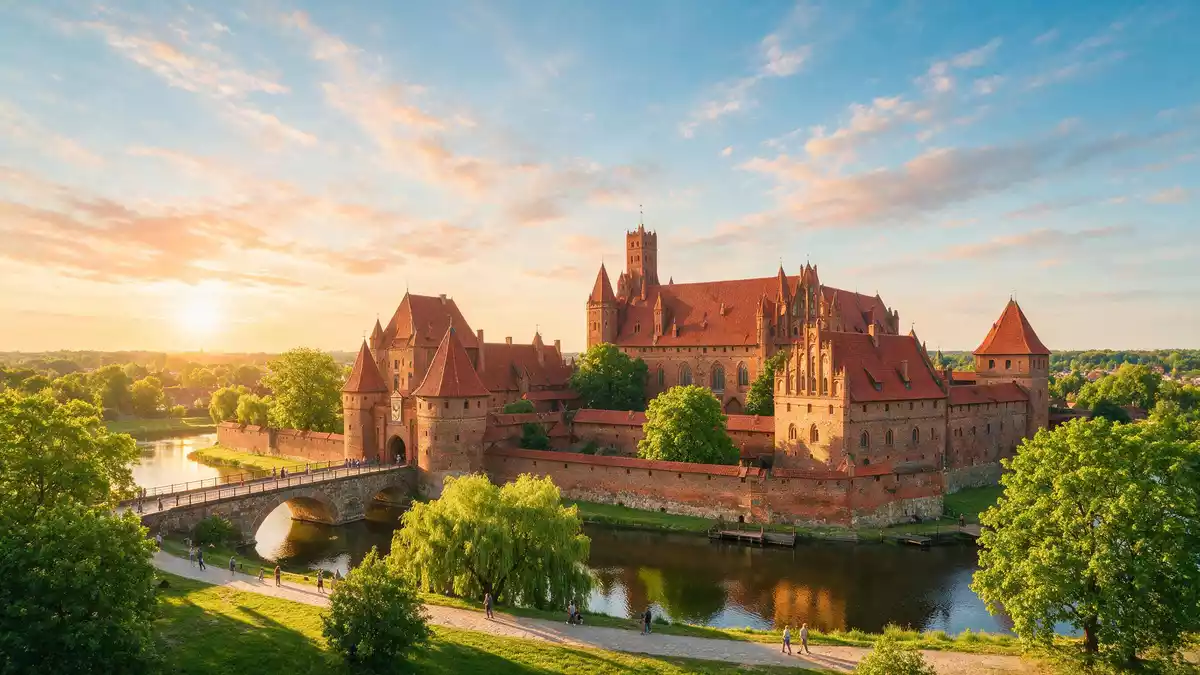
Zamek w Malborku, known in English as Malbork Castle, rises above the River Nogat in northern Poland as a vast Brick Gothic fortress created by the Teutonic Order in the thirteenth century and enlarged in the fourteenth century.Brick Gothic fortress Built from red brick on the east bank of the Nogat, a distributary of the Vistula, it forms one of the largest castle complexes in Europe and has been recognised as a UNESCO World Heritage Site since 1997.UNESCO World Heritage Site
Brick Gothic power house of the Teutonic Order
The core identity of Zamek w Malborku lies in its role as the main fortress of the Teutonic Order, a German Catholic military and religious order that expanded into the Baltic region in the thirteenth century.Teutonic Order fortress Construction began after the conquest of Old Prussia, with the castle named Marienburg in honour of Mary and laid out as an Ordensburg, the fortified monastery-castle type associated with the Order.Ordensburg Marienburg Over the fourteenth century the complex grew into a multi-part stronghold that combined monastic spaces, grand ceremonial halls and defensive structures.
The plan is articulated into three main precincts: the High Castle, the Middle Castle and the Outer Bailey, each enclosed by its own circuit of walls and moats.High Castle, Middle Castle The High Castle was the conventual heart, housing the refectory, church and residential ranges of the Teutonic Knights; the Middle Castle contained the Palace of the Grand Masters and representative rooms; the Outer Bailey accommodated service buildings and further defences. Taken together, these elements read as a brick encyclopaedia of late medieval fortress architecture, expressed through curtain walls, towers, gatehouses and courtyards laid out along the Nogat riverbank.
Red brick architecture and restoration history
Zamek w Malborku is a textbook of Brick Gothic architecture, drawing its character from the use of fired clay units rather than dressed stone.medieval brick castle Gables, facades and defensive walls are built in a consistent brick palette, with decorative details such as blind arcading and pointed window openings concentrated on the principal elevations. The sheer quantity of material is striking: estimates from the castle museum speak of tens of millions of bricks forming walls, vaults and towers, with outer walls alone comprising several million bricks.tens of millions of bricks
The fabric visitors encounter rests on a long history of restoration. After periods of decline and damage, particularly in the nineteenth and early twentieth centuries and again around 1945, extensive conservation campaigns rebuilt collapsed sections and reinstated Gothic forms.reconstructed and restored The Castle Museum in Malbork was established in 1961, giving the complex a formal institutional guardian and turning it into a museum of architecture, history and art.Castle Museum in Malbork UNESCO’s inscription in 1997 singled out the site as a supreme example of the medieval brick castle associated with the Teutonic Order and as an important case in the evolution of restoration practice, reinforcing the idea that the reconstruction history is part of what makes the castle significant.inscription under criteria ii, iii and iv
Castle, museum and riverside setting
Physically, Zamek w Malborku occupies a position on the east bank of the River Nogat, a branch of the Vistula, with its walls and towers running along the river and facing towards the water.east bank of the River Nogat The town of Malbork lies immediately to the west, so that the approach from the urban side leads through outer fortifications before reaching the main gates. Within the castle, brick-lined courtyards, cloisters and halls give a sense of the layered functions the complex has held: fortified monastery, headquarters of a crusading order, royal residence and, in its present form, museum.
As a museum, the castle houses collections and permanent exhibitions that make use of the historic interiors, including the refectories, the Palace of the Grand Masters and other representative spaces.museum of architecture, history and art The division into High Castle, Middle Castle and Outer Bailey still structures movement through the site, with bridges, gates and passageways linking the different parts of the complex. The riverside setting adds another layer, with views along the Nogat that underscore the scale of the brick fortifications and their relationship to the waterway that once connected Malbork to other centres along the lower Vistula.
Visiting Zamek w Malborku: what travellers from Western Europe should know
- Zamek w Malborku stands in the town of Malbork in northern Poland, on the east bank of the River Nogat, a distributary of the Vistula; regional trains link Malbork with other Polish cities.
- The castle complex covers a large area with multiple courtyards, bridges and defensive walls, and visiting involves walking over uneven brick and stone surfaces and climbing staircases inside towers and ranges.
- In winter, the low-lying site beside the Nogat can be cold and exposed, while in summer the brick courtyards and open walkways remain the primary spaces for exploring the High Castle, Middle Castle and Outer Bailey.
- The official language is Polish and the currency is the Polish z?oty.
- Entry requirements depend on your nationality; UK travellers can check the FCDO travel advice at gov.uk/foreign-travel-advice, Irish travellers the Department of Foreign Affairs at ireland.ie.
Searching for Zamek w Malborku on social platforms
These links open searches for Zamek w Malborku on each platform.
Frequently asked questions about Zamek w Malborku
Where is Zamek w Malborku located?
Zamek w Malborku stands in the town of Malbork in northern Poland, on the east bank of the River Nogat, a branch of the Vistula.
What can visitors expect when exploring the castle?
Visitors encounter a vast Brick Gothic complex divided into High Castle, Middle Castle and Outer Bailey, with courtyards, halls, towers and museum exhibitions inside restored historic interiors.
What makes Zamek w Malborku distinctive among European castles?
Its scale as a brick-built fortress of the Teutonic Order, its tripartite layout and its recognition as a UNESCO World Heritage Site together give Zamek w Malborku a distinctive place among European castle complexes.


