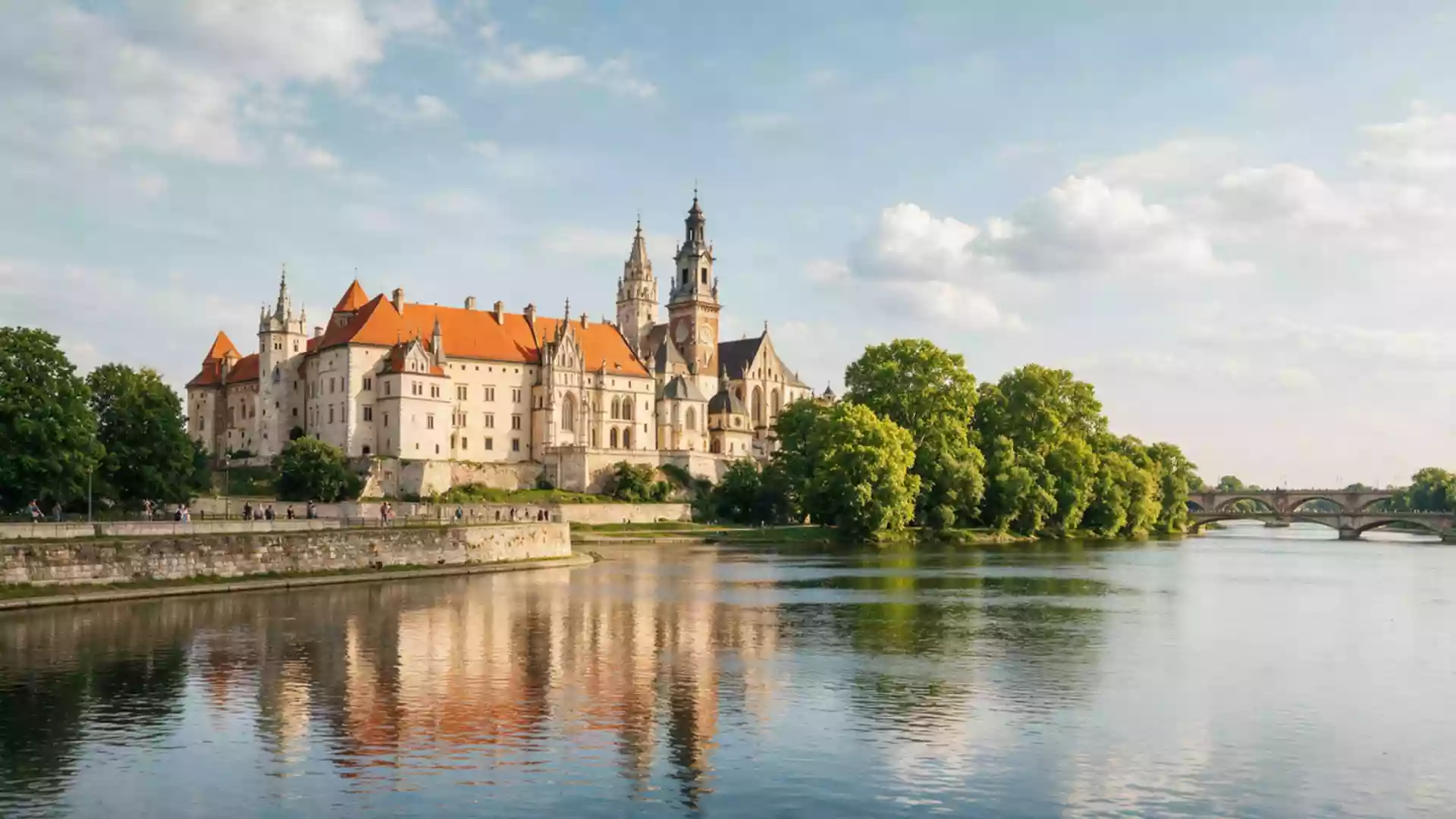
Zamek Krolewski na Wawelu and its hilltop royal courtyard
Published on 09/11/2026 at 19:23 | Editorial responsibility: Rafael Müller, Editor-in-Chief AD HOC NEWS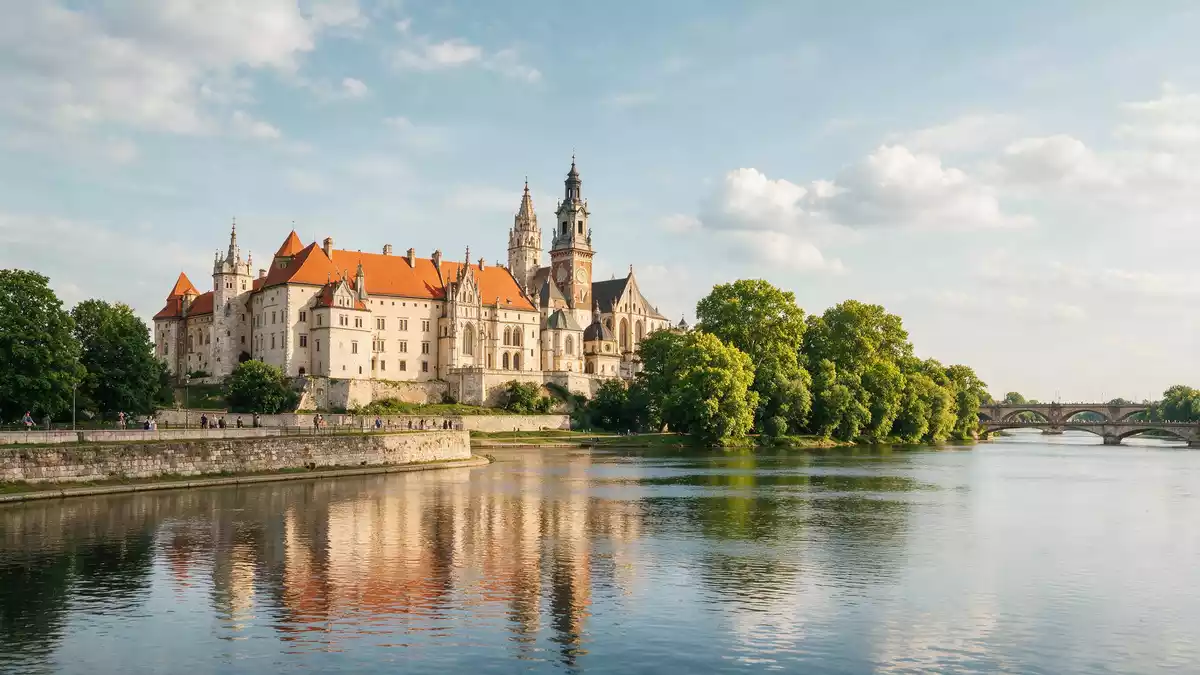
Zamek Krolewski na Wawelu, known in English as Wawel Royal Castle, rises on Wawel Hill above the Vistula River in Krakau, Poland, forming a compact ensemble of palace and cathedral on a rocky outcrop. The castle took shape as a major royal residence in the fourteenth century under King Casimir III the Great, and today its Renaissance courtyard and clustered towers give Wawel Hill the character of a self-contained acropolis overlooking the city.
A royal residence on Wawel Hill
Wawel Hill is a limestone outcrop on the left bank of the Vistula, reaching around 228 m (748 ft) above sea level and commanding views over Krakau’s historic centre.limestone outcrop on the left bank Long before the stone palace emerged, the hill served as a stronghold of early Polish rulers from the Piast dynasty, including Mieszko I and Boleslaus I the Brave.residence of Poland’s rulers on Wawel hill The present royal complex gathers castle buildings and Wawel Cathedral on the summit, with defensive walls tracing the edge of the rock.
The core of Zamek Krolewski na Wawelu is a Renaissance palace organised around a central courtyard, completed after a major phase of expansion in the sixteenth century, although its foundations reach back to earlier medieval structures.renesansow? rezydencj? królewsk? The castle’s plan wraps around this inner space with wings of residential chambers and state rooms, while bastions and towers anchor the outer corners of the hill.
The Renaissance courtyard and palace architecture
Visitors entering the heart of Zamek Krolewski na Wawelu step into a paved courtyard framed by arcaded galleries on several levels, a hallmark of Renaissance palace design in Central Europe.dziedziniec z kru?gankami arkadowymi The galleries run along the inner faces of the palace wings, with rhythmically spaced columns supporting arches and balustrades. Their geometry creates clear horizontal lines, contrasting with the vertical accents of tower roofs and chimneys rising beyond.
The palace façades reflect successive periods of building, from Gothic masonry to later Baroque and Neoclassical adjustments, yet the overall impression is that of a Renaissance courtly residence with symmetrical fronts and proportioned window openings.charakterze renesansowym, barokowym Within these wings lie ceremonial halls, private royal apartments and collections that form a state art museum, occupying thousands of square metres of exhibition space.
Wawel Cathedral beside the castle
Immediately beside the palace complex stands Wawel Cathedral, the Cathedral Basilica of Saints Stanislaus and Vaclav, linked physically and historically to the castle and sharing the summit of the hill.Cathedral Basilica of Sts. Stanislaus and Vaclav The present Gothic cathedral, dating to the fourteenth century, incorporates remnants of earlier Romanesque structures in its crypts and walls.present structure c.1320-64 Its towers, chapels and buttresses form a dense cluster of volumes that rise directly from the rock, giving Wawel Hill its distinctive skyline.
Architecturally, Wawel Cathedral is a layered composition of styles, combining Romanesque, Gothic, Renaissance, Baroque and Neoclassical elements in one building.Romanesque, Gothic, Renaissance, Baroque Chapels with richly modelled domes and sculpted portals project from the flanks, while the main nave rises between clustered piers and pointed arches. This mix mirrors the long history of Polish monarchs using the cathedral for coronations and burials, with royal tombs and national memorials lining its interior.
Wawel as a national symbol and museum
For Poland, Zamek Krolewski na Wawelu and the surrounding hill have long held the status of a national symbol, associated with royal authority, religious ceremony and the story of statehood.most historically and culturally significant site After Poland regained independence in 1918, the castle served as an official residence of the Head of State and as a museum of historic interiors, reflecting its dual function as both living seat and conserved monument.served as an official residence of the Head of State
Today the institution Wawel Royal Castle – State Art Collection manages extensive collections of paintings, tapestries, jewellery, arms and furnishings, arranged in galleries that occupy around 7,040 m² of space within the complex.Area 7,040 m² Many of these exhibitions are displayed in rooms that retain their historical finishes, so the fabric of the building and the objects it holds work together to convey the continuity of royal and national history on Wawel Hill.
Visiting Zamek Krolewski na Wawelu: what travellers from Western Europe should know
- Zamek Krolewski na Wawelu stands on Wawel Hill on the left bank of the Vistula River, a short walk south from Krakau’s main historic square and the surrounding Old Town streets.
- The approach to the castle and cathedral involves a steady ascent along paved ramps and stairways, with sections inside the towers and upper levels reached by narrow stone staircases.
- Nearby, the riverfront boulevards lie at the foot of the hill, and the castle complex connects visually with other historic districts of Krakau, including the streets around the main market square.
- The official language is Polish and the currency is the z?oty.
- Entry requirements depend on your nationality; UK travellers can check the FCDO travel advice at gov.uk/foreign-travel-advice, Irish travellers the Department of Foreign Affairs at ireland.ie.
Searching for Zamek Krolewski na Wawelu on social platforms
These links open searches for Zamek Krolewski na Wawelu on each platform.
Frequently asked questions about Zamek Krolewski na Wawelu
Where is Zamek Krolewski na Wawelu located?
Zamek Krolewski na Wawelu stands on Wawel Hill above the left bank of the Vistula River in Krakau, southern Poland, just south of the city’s Old Town.
What can visitors expect when they visit Wawel Royal Castle?
Visitors encounter a Renaissance palace around an arcaded courtyard, defensive walls and towers, and Wawel Cathedral with its Gothic core and chapels sharing the summit of the hill.
What makes Zamek Krolewski na Wawelu distinctive among European castles?
The combination of royal palace, coronation cathedral and limestone hilltop setting gives Wawel the character of a compact acropolis where architecture and national history are closely intertwined.