
Yungang Shiku: stone Buddhas in the cliffs of Datong
Published on 09/10/2026 at 12:10 | Editorial responsibility: Rafael Müller, Editor-in-Chief AD HOC NEWS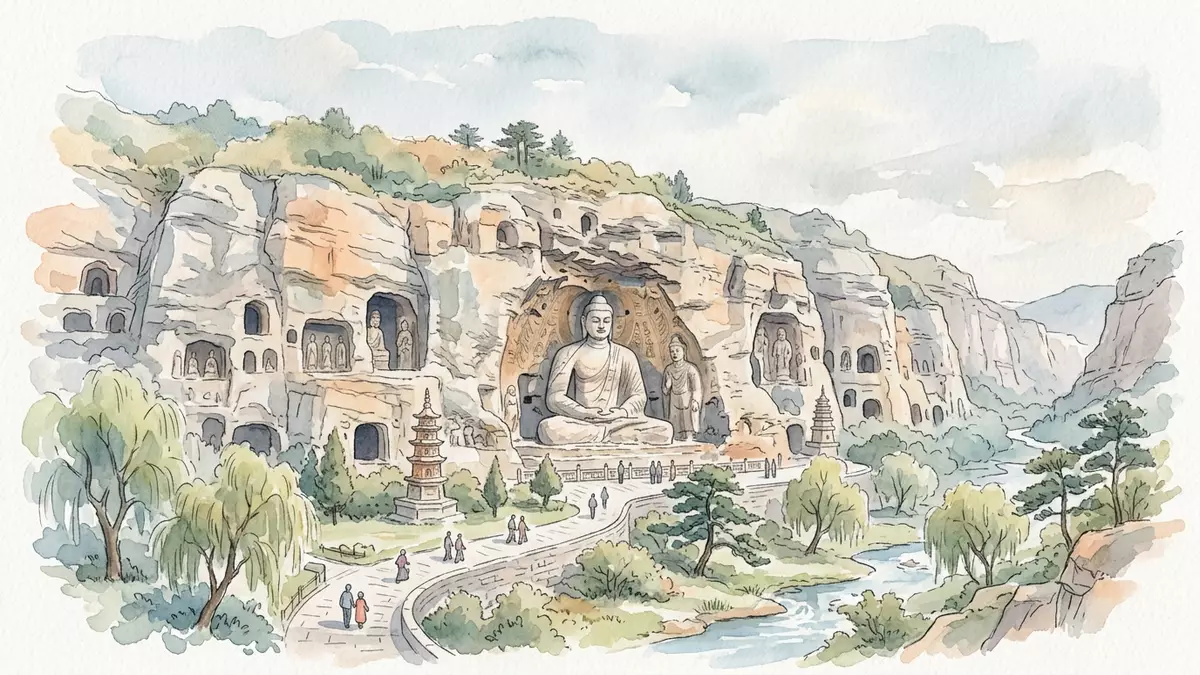
Yungang Shiku outside Datong in northern China is a long cliff face carved into a dense sequence of Buddhist caves and statues dating to the Northern Wei dynasty in the fifth and sixth centuries. The grottoes form one of China’s major ensembles of Buddhist cave art and have been recognised as a UNESCO World Heritage Site since 2001, linking religious devotion with imperial power in stone.
Carved faith under the Northern Wei dynasty
The caves of Yungang Shiku were excavated during the Northern Wei dynasty, a regime that ruled parts of northern China between the fourth and sixth centuries. Construction began in the fifth century and continued for several decades, creating a programme of cave temples that reflected the dynasty’s embrace of Buddhism as a state-supported religion.Buddhist cave art in the 5th and 6th centuries
At the time the grottoes were created, the Northern Wei capital was located at Pingcheng, a city now known as Datong in Shanxi Province.Pingcheng, currently Datong City Yungang Shiku lies on the western outskirts of the city, cut into the southern slopes of the Wuzhou Mountains above the Shi Li River valley. This setting gave the carvers a continuous face of sandstone to work with, allowing them to create caves that extend along the cliff for around one kilometre from east to west.extend about 1 km from east to west
From imperial caves to UNESCO World Heritage
Yungang Shiku is formally inscribed on the UNESCO World Heritage List under the name Yungang Grottoes, with the listing granted in 2001.UNESCO World Heritage Site since 2001 The inscription highlights the site as an outstanding example of early Chinese Buddhist cave art, noting the fusion of religious symbolism that came to China from south and central Asia with existing Chinese cultural traditions.
The ensemble is vast. The caves and shrines at Yungang Shiku are counted in the hundreds, each containing statues and reliefs carved directly from the rock. Descriptions of the site refer to more than 250 caves or shrines and tens of thousands of individual statues, ranging from large seated Buddhas to small figures only a few centimetres high.252 caves and 51,000 statues Together they form a stone record of how Buddhism was expressed visually in northern China in the fifth and sixth centuries.
Statues, caves and cliffside layout
The layout of Yungang Shiku follows the line of the cliff, with caves cut into the rock at different levels and linked by paths and open terraces. Many caves open directly onto the cliff face, where visitors encounter giant Buddha figures carved into the rear walls, framed by sculpted columns and decorative niches.
Among the most studied parts of the site are the first group of caves known as the Five Caves of Tan Yao, named after the monk who oversaw their creation under Northern Wei imperial patronage.Five Caves created by Tan Yao These caves are aligned to the south and contain large Buddha statues carved into the rock, each figure rising well over 10 m (33 ft) in height. Later caves introduce more complex interiors, with multiple levels, side chambers and ceilings covered in carved motifs.
Visiting Yungang Shiku: what travellers from Western Europe should know
- Yungang Shiku lies on the southern foot of the Wuzhou Mountains to the west of Datong in Shanxi Province, with the grottoes cut into a sandstone cliff above the Shi Li River valley.
- The site combines outdoor terraces with cave interiors and rock-cut stairways, so a visit involves walking along uneven stone surfaces and climbing steps within the cliff.
- Datong is served by long-distance rail lines and regional roads within northern China, and Yungang Shiku can be reached from the city by onward travel overland.
- The official language is Chinese and the currency is the renminbi yuan.
Searching for Yungang Shiku on social platforms
These links open searches for Yungang Shiku on each platform.
Frequently asked questions about Yungang Shiku
Where is Yungang Shiku located?
Yungang Shiku is located on the southern foot of the Wuzhou Mountains, around 16 km west of Datong in Shanxi Province in northern China.
What can visitors expect to see at Yungang Shiku?
Visitors encounter a long sandstone cliff cut into caves filled with Buddha statues and relief carvings, reached via outdoor terraces and paths along the rock face.
What makes Yungang Shiku distinctive among Buddhist sites?
The site combines hundreds of caves and tens of thousands of statues carved in the fifth and sixth centuries under Northern Wei imperial patronage, forming a major ensemble of early Chinese Buddhist cave art.


