Yungang Shiku, Datong’s cliff of carved Buddhas
Published on 09/09/2026 at 18:36 | Editorial responsibility: Rafael Müller, Editor-in-Chief AD HOC NEWS
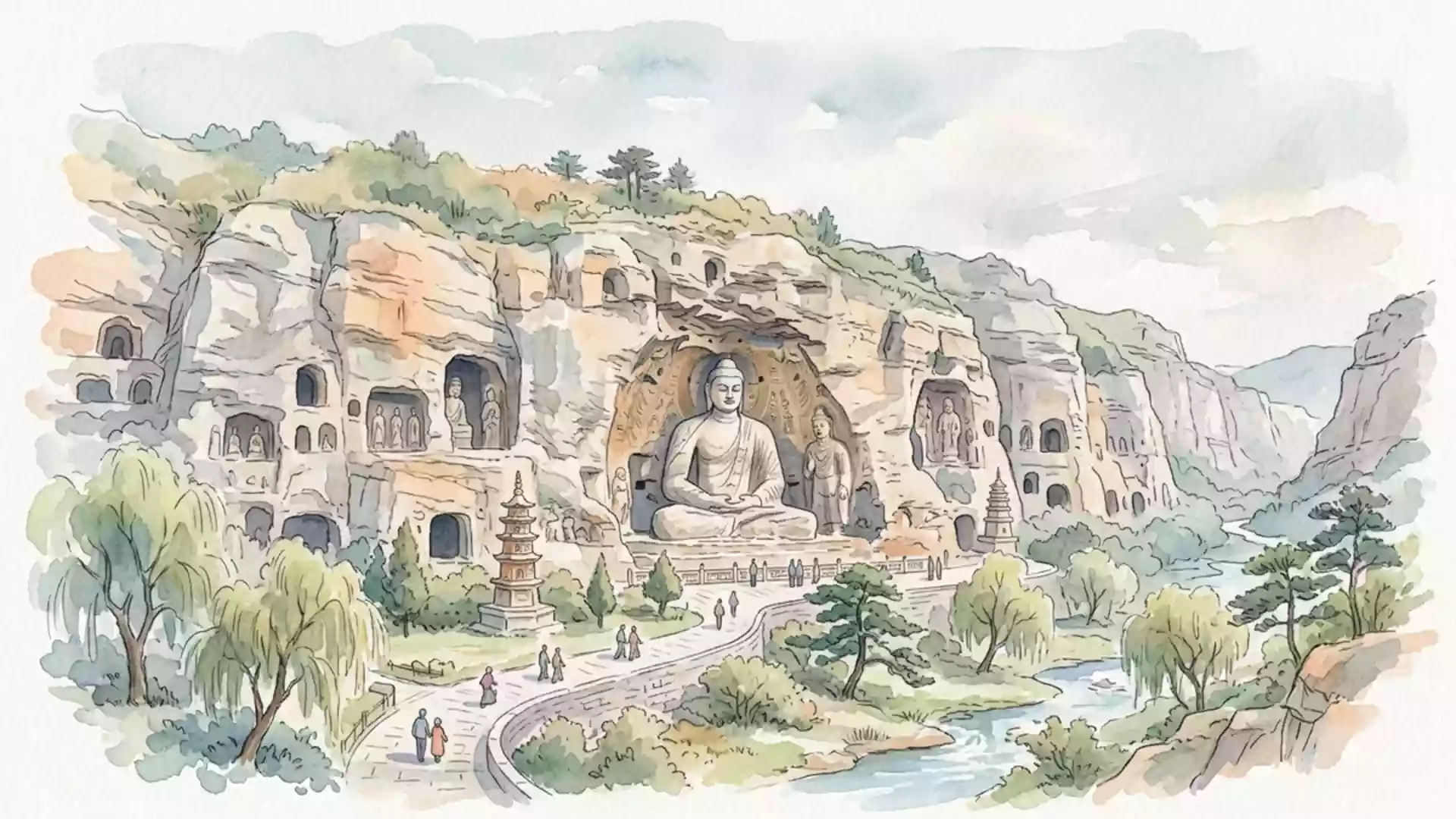
On the western outskirts of Datong in northern China, Yungang Shiku forms a long sandstone cliff carved into a dense field of Buddhist caves and statues from the Northern Wei dynasty. This cave complex, recognised as the Yungang Grottoes and inscribed as a UNESCO World Heritage Site in 2001, stretches along the base of the Wuzhou Mountains with hundreds of chambers cut directly into the rock face.
A cliff turned into a Buddhist temple city
Yungang Shiku is a series of rock-cut sanctuaries carved into sandstone at the southern foot of the Wuzhou Mountains, beside the Shi Li River valley west of Datong. The cliff runs roughly east–west, and the caves follow this line, forming a continuous belt of Buddhist spaces cut into the rock rather than freestanding buildings in a courtyard.southern foot of the Wuzhou Mountains Inside, carved pillars, walls and ceilings take over the structural role, with reliefs and statues covering almost every surface.
The caves at Yungang Shiku were excavated during the Northern Wei dynasty, largely in the second half of the fifth century and early sixth century, when the imperial court was based in Datong, then known as Pingcheng.Northern Wei dynasty near the city of Datong Work on the earliest caves began around 460 CE under imperial patronage, and carving continued until the Northern Wei court moved to Luoyang in 494 CE, shifting large-scale cave construction to other sites along the Yellow River.construction was mainly concentrated between about 460 and 494 CE
Tan Yao’s Five Caves and the scale of the statues
Among the many chambers at Yungang Shiku, a group known as the Five Caves created by the monk Tan Yao forms one of the most studied sequences. These caves, conventionally numbered 16 to 20, stand together as a tightly planned ensemble in which each chamber centres on a colossal seated Buddha carved from the cliff, surrounded by subsidiary figures on the walls and ceiling. UNESCO describes this group as a classical masterpiece of early Chinese Buddhist art, with a strict unity of layout and design across the five caves.Five Caves created by Tan Yao
Yungang Shiku is remarkable for the sheer number of carved images distributed across the cliff. The World Heritage listing records 252 caves containing around 51,000 statues, ranging from miniature figures to giant Buddhas many metres high.252 caves and 51,000 statues Some chambers hold a single dominant figure with an almost cell-like space around it, while others contain complex chapels with multiple levels, relief panels and carved screens. In several caves the main Buddhas reach about 17 m (55 ft) in height, cut directly from the sandstone, with stairways and platforms arranged so that visitors can approach them from different levels.colossal figures of the Buddha up to about 17 metres tall
Silk Road influences carved into sandstone
The cave sculptures at Yungang Shiku form one of the earliest major flowerings of Buddhist art in China, and their style reflects a mixture of influences that had travelled along the Silk Road. The Northern Wei rulers were Tuoba, a steppe-origin dynasty, and the sculptors drew on Indian, Central Asian, Persian, Byzantine and Greek motifs that had reached the region through trade and religious contact.synthesis of Persian, Byzantine, Greek and Indian influences At the same time, the caves integrate Chinese decorative traditions, creating combinations of foreign and local forms that UNESCO highlights as a fusion of Buddhist symbolic art from south and central Asia with Chinese culture.fusion of Buddhist art with Chinese cultural traditions
In practice, this synthesis appears in details such as halo forms and drapery around the Buddhas, celestial figures arranged in bands along the upper walls, and ornamental frames around reliefs that recall imported designs. The sandstone medium ties these influences together: everything, from large statues to the smallest narrative scenes, is cut from the same rock, turning the cliff itself into a continuous religious landscape. Many caves have façades carved with multi-tiered reliefs facing the valley, giving the impression of temple fronts pressed directly into the cliff rather than built in front of it.
Visiting Yungang Shiku: what travellers from Western Europe should know
- Yungang Shiku lies about 16 km west of central Datong in Shanxi Province, at the base of the Wuzhou Mountains above the Shi Li River valley, and is reached along the main road linking the city with the grottoes.
- The core of the site consists of a sandstone cliff cut with caves and niches; visiting involves walking along outdoor paths at the foot of the cliff and climbing flights of stone steps inside some caves and on viewing platforms.
- The surrounding terrain is a river valley framed by low mountains, so exposed sections of the approach and the cliff path can be subject to continental interior temperatures typical of northern China, including cold winters.
- The official language is Chinese and the currency is the yuan (renminbi).
- Entry requirements depend on your nationality; UK travellers can check the FCDO travel advice at gov.uk/foreign-travel-advice, Irish travellers the Department of Foreign Affairs at ireland.ie.
Searching for Yungang Shiku on social platforms
These links open searches for Yungang Shiku on each platform.Frequently asked questions about Yungang Shiku
Where is Yungang Shiku and what kind of place is it?
Yungang Shiku stands about 16 km west of Datong in Shanxi Province, carved into a sandstone cliff along the Wuzhou Mountains, and forms a continuous complex of Buddhist grottoes.
What should visitors expect on a visit to Yungang Shiku?
Visitors walk along an outdoor route beneath the cliff, entering selected caves to see rock-cut Buddhas and reliefs, with stone steps and platforms giving access to different levels inside and outside the chambers.
What makes Yungang Shiku distinctive among Buddhist sites in China?
Yungang Shiku combines the density of its rock-cut statues, including colossal Buddhas, with a fifth-century date and a recognised fusion of imported Buddhist artistic forms and Chinese traditions, all set within a single sandstone cliff.