
Yulong Xueshan, the snow?capped massif above Lijiang
Published on 09/16/2026 at 19:42 | Editorial responsibility: Rafael Müller, Editor-in-Chief AD HOC NEWS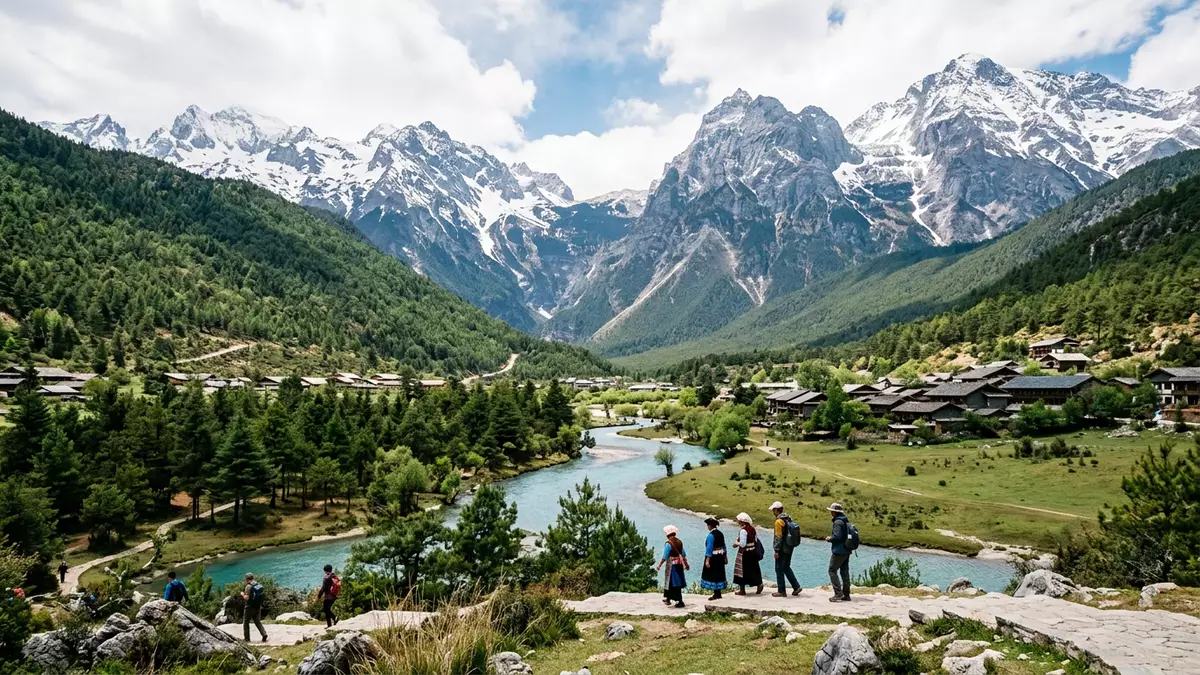
Yulong Xueshan, known in English as Jade Dragon Snow Mountain, is a snow?capped mountain massif north of Lijiang in Yunnan province in southwest China. Its skyline of serrated peaks and hanging glaciers forms a dramatic barrier above the Lijiang plain and is one of the defining natural landmarks of the region, with the highest summit Shanzidou reaching 5,596 m (18,360 ft) above sea levelShanzidou at 5,596 m.
The Jade Dragon massif and its peaks
Yulong Xueshan is a compact mountain range rather than a single peak, with a chain of high summits running roughly north–south above the highlands of northwest Yunnan. The massif lies in Yulong Naxi Autonomous County, directly north of the Lijiang plain, and is part of the wider Yunling ranges of the Hengduan Shan system that rise between the plateau around Lijiang and the deep valley of the Jinsha Jiang, the upper Yangtze RiverYunling ranges of the Hengduan Shan. The massif stands above agricultural land around Lijiang at about 2,400 m (7,874 ft) in elevation, creating a vertical relief of about 3,000 m between the river valley and the highest summitvertical difference of about 3,000 m.
The highest peak of Yulong Xueshan is Shanzidou, a glaciated summit rising to 5,596 m (18,360 ft) above sea level and forming the most prominent point on the skylinehighest peak Shanzidou. Mountaineering surveys describe the range as holding many summits above 5,000 m, with Shanzidou listed as the highest point and several other peaks remaining unclimbedmany summits above 5,000 m. The massif extends for several tens of kilometres, with snowfields and rock faces giving the range its characteristic jagged profile when seen from the streets and courtyards of Lijiang.
Glaciers, meadows and high?altitude landscapes
Yulong Xueshan is notable for its glaciers, which descend from the upper cirques of Shanzidou and neighbouring peaks into high basins above the tree line. The mountain is widely described as hosting the southernmost glacier system in the Northern Hemisphere, a fact which underscores its latitude and climatic position in southwest Chinasouthernmost glacier in the Northern Hemisphere. High?altitude boardwalks and platforms give visitors access to viewpoints close to the glacier margins, where ice, rock and thin air meet above the forested slopes.
Below the glaciers, Yulong Xueshan presents a sequence of alpine meadows and valleys. Named areas such as Glacier Park, Blue Moon Valley, Spruce Meadow and Yak Meadow combine open grassland, conifer woodland and watercourses within the broader scenic areaGlacier Park and meadows. The contrast between high?altitude glacier viewpoints and lower meadows, where oxygen levels are less demanding and vegetation is more varied, allows travellers to experience different ecological zones on the same day in the mountains above Lijiang.
Cultural landscape and protected status
Yulong Xueshan stands within a broader cultural landscape shaped by the Naxi people of northwest Yunnan. The massif gives its name to Yulong Naxi Autonomous County, and the Old Town of Lijiang at the foot of the mountains has long taken the snow?capped ridge as a backdrop and orientation pointYulong Naxi Autonomous County. Naxi tradition treats the mountain as a sacred presence, and local place names reflect this association, although detailed rituals and stories belong to specialist ethnographic accounts rather than general travel writing.
The massif and its surroundings are recognised through formal nature?reserve designations. Conservation registers list Yulong Xueshan Nature Reserve with elevations from 2,415 m (7,923 ft) at the lower boundary to 5,596 m (18,360 ft) at the highest point, encompassing montane forest, alpine shrub and high?altitude rock and ice within a single protected areaYulong Xueshan Nature Reserve. The reserve lies north of Lijiang and forms the main summit group of the Yunling ranges in this part of Yunnan.
Visiting Yulong Xueshan: what travellers from Western Europe should know
- Yulong Xueshan rises north of Lijiang in Yulong Naxi Autonomous County in Yunnan, reached by road from Lijiang, with cable cars continuing from the scenic?area base to high?level platforms on the mountain.
- The terrain combines steep high?altitude slopes, glacier viewpoints reached by wooden boardwalks, and lower meadows and valleys, so visits involve walking on stepped paths at elevations well above 3,000 m (9,843 ft).
- Lijiang lies in southwest China, where the official language is Chinese and the currency is the yuan (renminbi).
- Entry requirements depend on your nationality; UK travellers can check the FCDO travel advice at gov.uk/foreign-travel-advice, Irish travellers the Department of Foreign Affairs at ireland.ie.
Searching for Yulong Xueshan on social platforms
These links open searches for Yulong Xueshan on each platform.Frequently asked questions about Yulong Xueshan
Where is Yulong Xueshan located?
Yulong Xueshan stands north of Lijiang in Yulong Naxi Autonomous County in Yunnan province in southwest China, forming part of the Yunling ranges above the Lijiang plain.
What can visitors expect on a visit to Yulong Xueshan?
Visitors encounter a high?altitude mountain landscape with glacier viewpoints, alpine meadows, wooden boardwalks and cable?car routes, along with wide views across the Lijiang plain and surrounding ranges.
What makes Yulong Xueshan distinctive among Chinese mountains?
Yulong Xueshan combines a compact chain of 5,000 m peaks and glaciers, recognised as hosting the southernmost glacier system in the Northern Hemisphere and rising directly above a historic highland city.


