

Yulong Xueshan rises above Lijiang in one sweep
Published on 08/08/2026 at 15:08 | Editorial responsibility: Rafael Müller, Editor-in-Chief AD HOC NEWS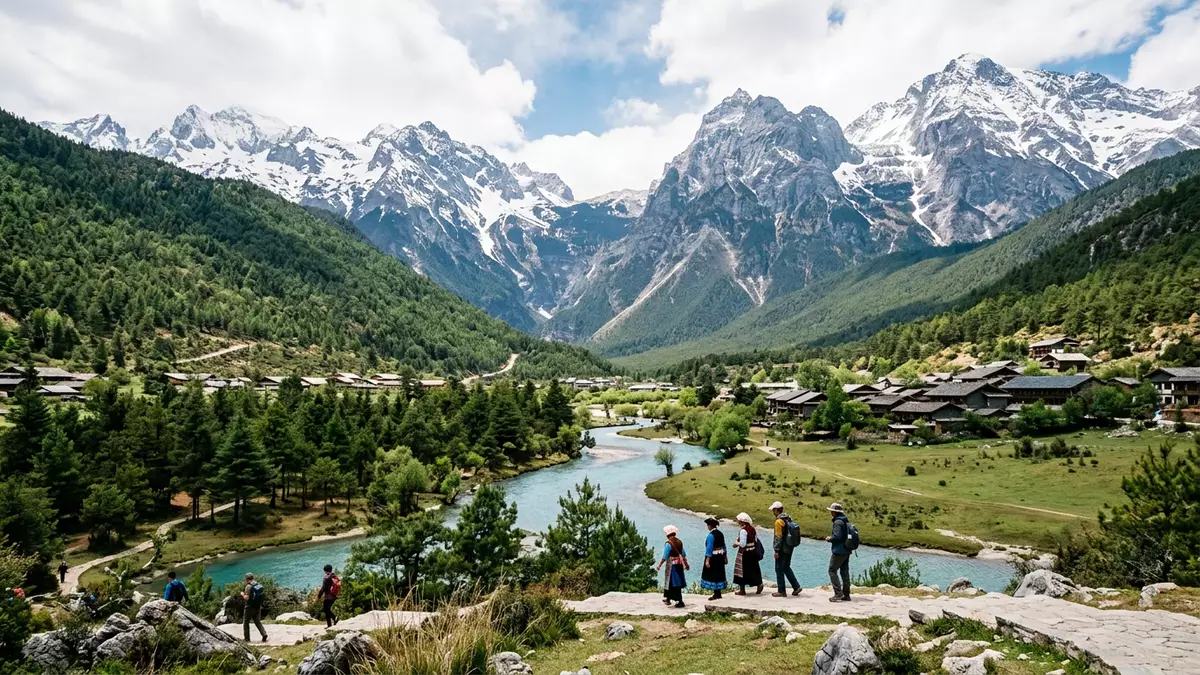
Yulong Xueshan rises above Lijiang as a long ridge of snow-covered limestone and alpine rock. The mountain is linked with the Naxi cultural landscape of north-western Yunnan, and its highest summit is Shanzidou, which reaches 5,596 m (18,360 ft).
Yulong Xueshan’s limestone ridge above Lijiang
The range is best read as a high mountain wall rather than a single peak. Its slopes hold glaciers, cliffs, scree and seasonal snow, with clear changes in vegetation from lower forest to open high-altitude ground.
The name Yulong Xueshan, often rendered as Jade Dragon Snow Mountain, fits the white crest seen from Lijiang’s side of the valley. The mountain sits within a dramatic eastern edge to the Tibetan Plateau, and that setting gives the whole massif a sharp profile against the sky.
Shanzidou and the high mountain setting
Shanzidou is the summit most closely associated with Yulong Xueshan. It belongs to a massif that includes several peaks and ridges, and the snow line and ice remnants are part of its identity.
Yulong Xueshan is also tied to the wider landscape of Lijiang, where old town streets, irrigated plains and high mountains meet within a short span. That contrast is part of the appeal of approaching the mountain from the city below.
Naxi culture and the mountain landscape
The mountain carries cultural weight for the Naxi people, whose communities have long lived in the Lijiang area. It appears in local symbolism, songs and regional identity, alongside the mountain’s physical presence.
That combination of high alpine terrain and cultural meaning gives Yulong Xueshan a layered character. The place is both a mountain landscape and a named landmark in the region’s historical imagination.
Visiting Yulong Xueshan: what travellers from Western Europe should know
- The site is reached from Lijiang by road, with access into the mountain area from the city and surrounding valley.
- Admission arrangements and opening hours are set by the site's operator and change with the season; the official website is the only binding source.
- Late spring, summer and early autumn bring the clearest mountain scenery, while winter adds more snow and a sharper high-altitude feel.
- Altitude is a major factor on the mountain, and some viewpoints and paths lie high above the valley floor.
- Payment and visitor services in the Lijiang area may mix cashless and cash transactions, and basic Mandarin or a translation app can help.
- Entry requirements depend on your nationality. UK travellers should check the FCDO travel advice at gov.uk/foreign-travel-advice; Irish travellers the Department of Foreign Affairs at ireland.ie; EU and EEA citizens their own national foreign ministry.
Searching for Yulong Xueshan on social platforms
These links open searches for Yulong Xueshan on each platform.
Frequently asked questions about Yulong Xueshan
Where is Yulong Xueshan?
Yulong Xueshan stands near Lijiang in Yunnan, China, on the eastern edge of the Tibetan Plateau. It forms a prominent mountain backdrop to the city and the surrounding valley.
What should travellers expect on a visit?
Expect high altitude, changing weather and wide views across ridges, snow patches and valleys. The mountain area is best approached with time for acclimatisation and unhurried movement.
What makes Yulong Xueshan distinctive?
Its long, pale limestone ridge and the summit of Shanzidou give it a sharply recognisable profile. The mountain also carries strong Naxi cultural associations within the Lijiang region.


