
Yosemite National Park’s glacier-carved granite valley
Published on 08/24/2026 at 07:20 | Editorial responsibility: Rafael Müller, Editor-in-Chief AD HOC NEWS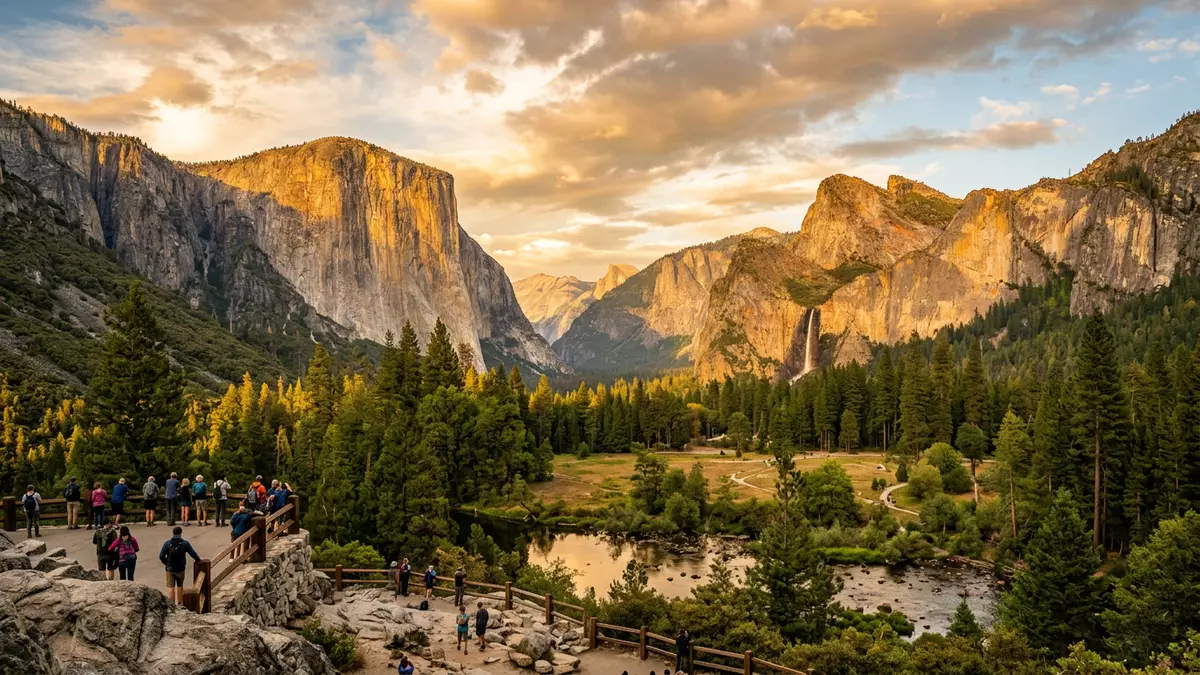
Yosemite National Park in California’s Sierra Nevada is defined by Yosemite Valley, a deep glacier-carved cleft where pale granite walls rise steeply above the Merced River and meadows on the floor. The park was established as a national park in 1890, and Yosemite Valley itself had already been protected under the Yosemite Act of 1864, making this landscape a long-recognised focus of conservation. Within this relatively compact valley, rock faces such as El Capitan and domes such as Half Dome give a concentrated view of how ice and granite have interacted over geological time.
Granite walls and a U-shaped valley
Yosemite Valley is a classic U-shaped glacial valley, cut into granitic bedrock that forms part of the Sierra Nevada batholith and framed by near-vertical cliffs and domes. The World Heritage description of the park highlights Yosemite Valley as a roughly 900 m-deep bedrock cleft with massive sheer granite walls, created by repeated glaciations acting on this hard rock over millions of yearsglacier-carved cleft with granite walls. These walls are composed mainly of granitic rocks emplaced during the Cretaceous period and later exposed by uplift and erosion, giving the valley its light grey to off-white tones and massive jointed facesgranitic rocks formed in the Cretaceous.
Glacial erosion has polished many of these granite surfaces and produced striations where sediment in the ice scratched the rock, while also leaving behind moraines and hanging valleys that can be seen from viewpoints along the rim. The National Park Service notes that landforms in Yosemite commonly include U-shaped canyons, rounded domes, waterfalls and glacially polished granite, all linked to episodes of glaciation such as the Tioga Glaciation that began about 26,000 years agolandforms that are the result of glaciation. Standing in Yosemite Valley, these features appear compressed into a single amphitheatre where cliffs, domes and cascades are all within sight along the curving river corridor.
El Capitan, Half Dome and other granite landmarks
Among the most recognisable granite features of Yosemite Valley are El Capitan and Half Dome, each showing different ways that granitic rock responds to fracture and erosion. El Capitan is a prominent monolithic cliff on the north side of the valley, rising in a single sweeping face of light-coloured granite and providing one of the world’s most famous long rock climbsEl Capitan as a granite cliff. Half Dome, at the eastern end of the valley, has a rounded western side and a much steeper eastern face, creating the distinctive profile that has become emblematic of the park’s geologyHalf Dome and sheer faces like El Capitan.
These forms are part of a broader pattern of granitic domes and spires throughout Yosemite, many of them shaped by exfoliation, where sheets of rock peel away along curved surfaces. The geology of the Yosemite area is dominated by granitic plutons that crystallised kilometres below the surface and later fractured along vertical and curved joints, setting up the domes, spires and cliffs visible in and above the valleygranite cliffs, domes and valleys. In Yosemite Valley this structure can be read from multiple vantage points, from close views of joint patterns on rock faces to distant panoramas where whole dome profiles stand out against the sky.
Waterfalls, river and forest on the valley floor
While granite and glaciation define the valley’s walls, water and vegetation give Yosemite Valley its shifting textures on the floor. The Merced River flows along the valley, with meadows and forested patches on its banks and sandbars in bends, illustrating how a glacially carved basin fills with alluvium and plant life. Above, waterfalls plunge from hanging valleys and notches in the cliffs, including well-known cascades such as Yosemite Falls and Bridalveil Fall, which bring snowmelt and rainwater down over the granite faces in distinct seasonal patternsdeep bedrock basin with steep walls.
Beyond the valley, Yosemite National Park extends across high country where glacial basins, tarns and remaining small glaciers sit among subalpine and alpine terrain. The Lyell Glacier, for example, is described as the largest glacier in the park, perched in the higher reaches of the Sierra Nevada within Yosemite’s boundariesLyell Glacier as the largest glacier. For travellers focusing on Yosemite Valley, this wider setting matters because views from the valley rim and from points such as Glacier Point connect the close-up granite walls to the broader pattern of glaciated uplands, forested slopes and distant summits.
Visiting Yosemite National Park: what travellers from Western Europe should know
- Yosemite National Park lies in eastern California, with Yosemite Valley on the western side of the Sierra Nevada; road access runs from communities such as Mariposa and Oakhurst towards the valley.
- The terrain in Yosemite Valley includes level meadows and riverbank paths on the floor, contrasted with steep trails on the valley walls and long ascents to viewpoints on the rim.
- Within the wider park, high-country areas sit at significantly greater elevations than the valley floor, with thinner air and exposed mountain terrain on domes, passes and ridges.
- English is the official language in this part of the United States and the currency is the US dollar.
- Entry requirements depend on your nationality; UK travellers can check the FCDO travel advice at gov.uk/foreign-travel-advice, Irish travellers the Department of Foreign Affairs at ireland.ie.
Searching for Yosemite National Park on social platforms
These links open searches for Yosemite National Park on each platform.
Frequently asked questions about Yosemite National Park
Where is Yosemite National Park and Yosemite Valley located?
Yosemite National Park lies in eastern California on the western flank of the Sierra Nevada, with Yosemite Valley forming a central low-elevation section of the park.
What should visitors expect on a first visit to Yosemite Valley?
Visitors encounter steep granite cliffs, domes, waterfalls and a river meandering across meadows on the valley floor, with road and trail access to viewpoints and riverside areas.
What makes Yosemite National Park distinctive among mountain landscapes?
The combination of glacier-carved granite valley walls, prominent features such as El Capitan and Half Dome, and a long history of landscape protection gives Yosemite a concentrated, clearly readable geology.


