
Yosemite National Park and the granite walls of Yosemite Valley
Published on 09/22/2026 at 01:58 | Editorial responsibility: Rafael Müller, Editor-in-Chief AD HOC NEWS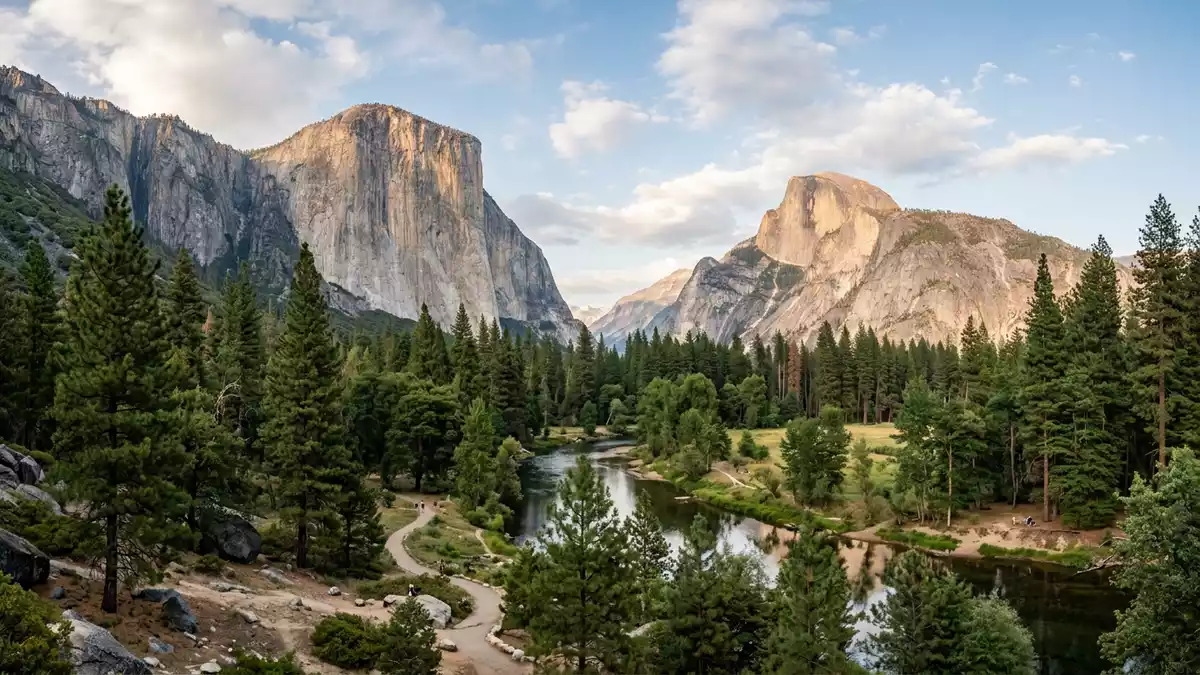
Yosemite National Park in California’s Sierra Nevada is defined, more than anything else, by the granite walls and waterfalls of Yosemite Valley. The national park was established on 1 October 1890 as a protected mountain landscape, and Yosemite Valley sits at its west?central heart within a vast area of wilderness. Granite domes, cliffs and monoliths rise steeply above the valley floor, creating one of the most concentrated assemblies of sheer rock faces in the United States.
Granite giants above the valley floor
Yosemite National Park lies on the western slopes of the Sierra Nevada mountains in east?central California, within Mariposa, Tuolumne, Mono and Madera counties.east?central California Yosemite Valley itself is a glacially carved valley running broadly east–west for about 12 km, with steep granite sides that rise several hundred metres from the floor.a glacial valley Visitors arriving in the valley encounter vertical rock faces that frame the meadows and river bends, with the granite catching changing light through the day.
Among the most recognisable granite formations in Yosemite National Park are Half Dome and El Capitan, both of which rise high above Yosemite Valley.Half Dome and El Capitan Half Dome stands at an elevation of 2,693 m (8,842 ft), with a steep cliff dropping towards the valley, while El Capitan is a massive cliff of plutonic granite whose rock face attracts experienced climbers.El Capitan cliff These formations illustrate the park’s geology, where resistant granite has been shaped by glacial carving into domes, towers and cliffs surrounding the valley floor.
Waterfalls, rivers and forests
Water flowing over the granite rim is another defining feature of Yosemite National Park, with several waterfalls dropping from hanging valleys into Yosemite Valley. Yosemite Falls, situated on the north side of the valley, has a total drop of about 739 m (2,425 ft) and is among the tallest waterfalls in North America.Yosemite Falls height The waterfall descends in multiple stages, breaking into mist and streams that reach the valley floor near the Merced River. Bridalveil Fall, near the western end of the valley, drops from a hanging valley into a rocky basin, with wind frequently blowing the falling water sideways so that it appears to drift like a long veil.
The Merced River flows along the floor of Yosemite Valley, curving past meadows and forested areas before leaving the valley through a narrow gorge.Merced River corridor Away from the cliffs and waterfalls, much of Yosemite National Park is covered by coniferous forest, with species that vary by elevation and aspect. The park includes groves of giant sequoias, particularly in areas such as the Mariposa Grove, where individual trees reach heights of over 60 m (197 ft) and can live for many centuries.giant sequoias in Mariposa Grove These forests and groves sit within a wider mosaic of habitats, from foothill chaparral to alpine rock, providing a setting for diverse plant and animal communities.
A protected wilderness with a deep human history
Yosemite National Park covers an area of roughly 3,070 km² (1,187 sq mi), much of which is designated wilderness under United States law.designated wilderness area The majority of this landscape lies beyond the main roads and valley developments, extending across high ridges, alpine lakes and remote basins along the Sierra Nevada crest. In 1984 Yosemite National Park was inscribed as a UNESCO World Heritage site, recognising both its geological significance and its ecological variety.UNESCO World Heritage site The combination of high granite peaks, deep valleys and relatively intact forests makes the park one of the most extensive protected mountain areas in California.
The human history of Yosemite Valley reaches far earlier than the national park’s nineteenth?century establishment. Indigenous communities lived in and around the valley before European?American settlement, drawing on the river corridor, meadows and forest resources.Indigenous presence in Yosemite In 1864 the Yosemite Grant set aside Yosemite Valley and the Mariposa Grove, an early step in American conservation history.Yosemite Grant of 1864 The subsequent creation of Yosemite National Park in 1890 extended protection to a much larger mountain region, and park headquarters today are located at Yosemite Village on the valley floor.Yosemite Village headquarters
Visiting Yosemite National Park: what travellers from Western Europe should know
- Yosemite National Park lies in the Sierra Nevada of east?central California, with Yosemite Valley reached by road from communities such as Merced and Fresno.
- The terrain in Yosemite Valley combines level valley?floor meadows with steep trails on rocky ground, and viewpoints often involve substantial climbs on foot.
- Beyond Yosemite Valley, the park extends over high passes and remote basins, where elevation can exceed 3,000 m (9,843 ft) and weather conditions can change quickly.
- The official language is English and the currency is the United States dollar.
- Entry requirements depend on your nationality; UK travellers can check the FCDO travel advice at gov.uk/foreign-travel-advice, Irish travellers the Department of Foreign Affairs at ireland.ie.
Searching for Yosemite National Park on social platforms
These links open searches for Yosemite National Park on each platform.Frequently asked questions about Yosemite National Park
Where is Yosemite National Park and Yosemite Valley?
Yosemite National Park lies in east?central California on the western slopes of the Sierra Nevada, with Yosemite Valley in the park’s west?central area.
What should visitors expect on a visit to Yosemite Valley?
Visitors encounter high granite cliffs, waterfalls, river meadows and forested slopes, with routes ranging from level valley paths to steep mountain trails.
What makes Yosemite National Park distinctive among mountain parks?
The park combines extensive designated wilderness with dramatic granite formations, tall waterfalls and giant sequoia groves within a single protected Sierra Nevada landscape.


