
Yosemite National Park and the granite walls of Yosemite Valley
Published on 09/12/2026 at 11:56 | Editorial responsibility: Rafael Müller, Editor-in-Chief AD HOC NEWS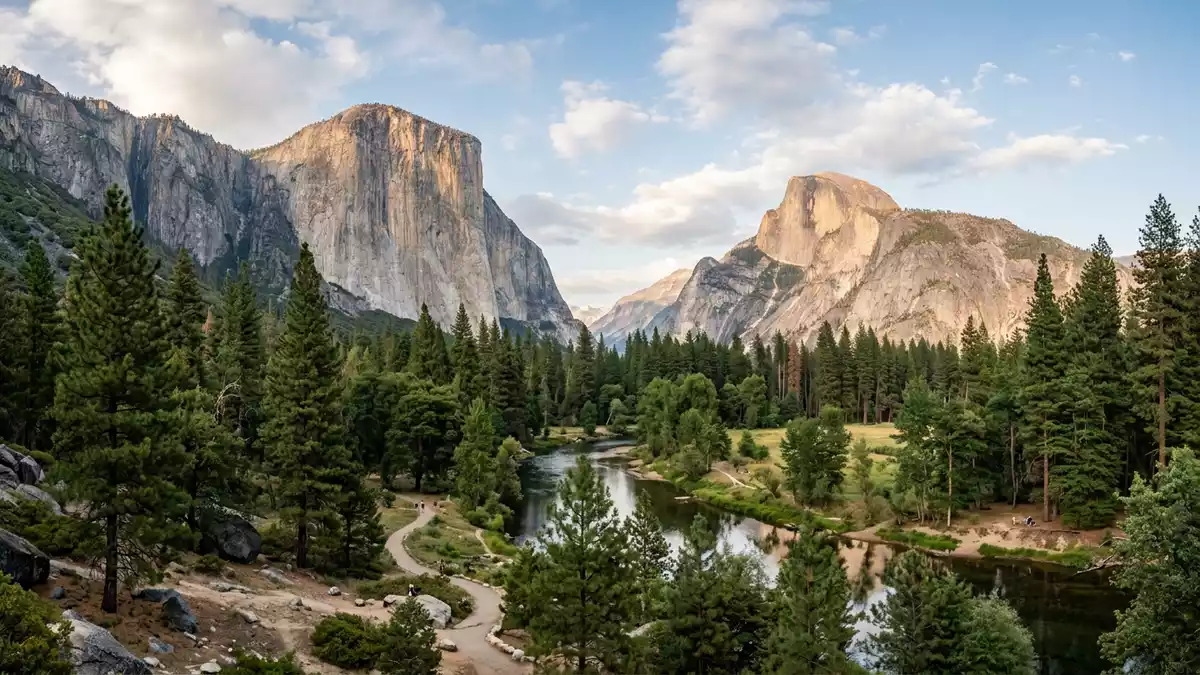
Yosemite National Park is shaped by Yosemite Valley’s granite walls, domes and sheer cliffs. The valley gives the park its clearest profile, with granitic bedrock and glacial forms visible across the landscape.
Granite cliffs above Yosemite Valley
El Capitan and Half Dome anchor the valley’s western and eastern reaches. El Capitan rises more than 915 m (3,000 ft) above the floor, while Half Dome rises almost 1,525 m (5,000 ft) above it.El Capitan is a vast granite wall, and Half Dome is the valley’s most familiar dome.
The park’s geology is not hidden in the background; it forms the view. Yosemite’s cliffs, domes and polished surfaces are part of a granitic landscape that has become one of the best-known in North America.
From a protected valley to a national park
Yosemite Valley entered federal protection in 1864, when President Abraham Lincoln signed the Yosemite Grant. Yosemite National Park followed on 1 October 1890, and the park later absorbed Yosemite Valley into its boundaries in 1906.Abraham Lincoln and John Muir are part of that story, which ties the park to both preservation and public access.
The valley’s significance goes beyond scenery. It helped shape the national park idea in the United States, while also preserving a landscape of cliffs, meadows, sequoias and broad granite faces.
Glacial forms and open viewpoints
The valley combines broad open ground with abrupt rock walls. UNESCO describes Yosemite as a glaciated landscape with hanging valleys, waterfalls, polished domes, moraines and U-shaped valleys, and that mix remains visible in the park’s main corridor.glaciated topography makes Yosemite Valley distinctive without needing ornament.
Mirror Lake gives a close view of Half Dome, while Tunnel View and the roads through western Yosemite Valley open long sightlines towards El Capitan and Bridalveil Fall. The park works as a sequence of wide views rather than a single lookout.
Visiting Yosemite National Park: what travellers from Western Europe should know
- Yosemite National Park lies in California, and Yosemite Valley is the most concentrated visitor area. Road access links the valley with the rest of the park, including routes towards Wawona and Tuolumne Meadows.
- The terrain combines valley floor, steep granite walls and long climbs on foot. Half Dome rises almost 1,525 m (5,000 ft) above the valley floor, and the rock faces are a defining part of the setting.
- The official language is English and the currency is the United States dollar.
- Entry requirements depend on your nationality; UK travellers can check the FCDO travel advice at gov.uk/foreign-travel-advice, Irish travellers the Department of Foreign Affairs at ireland.ie.
- Conditions on the mountain change with the seasons; the local cable-car operators and alpine clubs provide information.
Searching for Yosemite National Park on social platforms
These links open searches for Yosemite National Park on each platform.
Frequently asked questions about Yosemite National Park
Where is Yosemite National Park?
Yosemite National Park is in California, in the western United States. Yosemite Valley sits in the centre of the park’s most familiar scenery.
What does a visit reveal?
It reveals a high granite valley with cliffs, domes, waterfalls and broad open ground. El Capitan and Half Dome are the two names most closely tied to that view.
What makes Yosemite National Park distinctive?
Its landscape combines glacial shaping with exposed granite on a large scale. The result is a park where the rock forms are as important as the forest and water.
Yosemite National Park and the granite walls of Yosemite Valley


