
Yosemite National Park and the granite walls of Yosemite Valley
Published on 08/31/2026 at 13:46 | Editorial responsibility: Rafael Müller, Editor-in-Chief AD HOC NEWS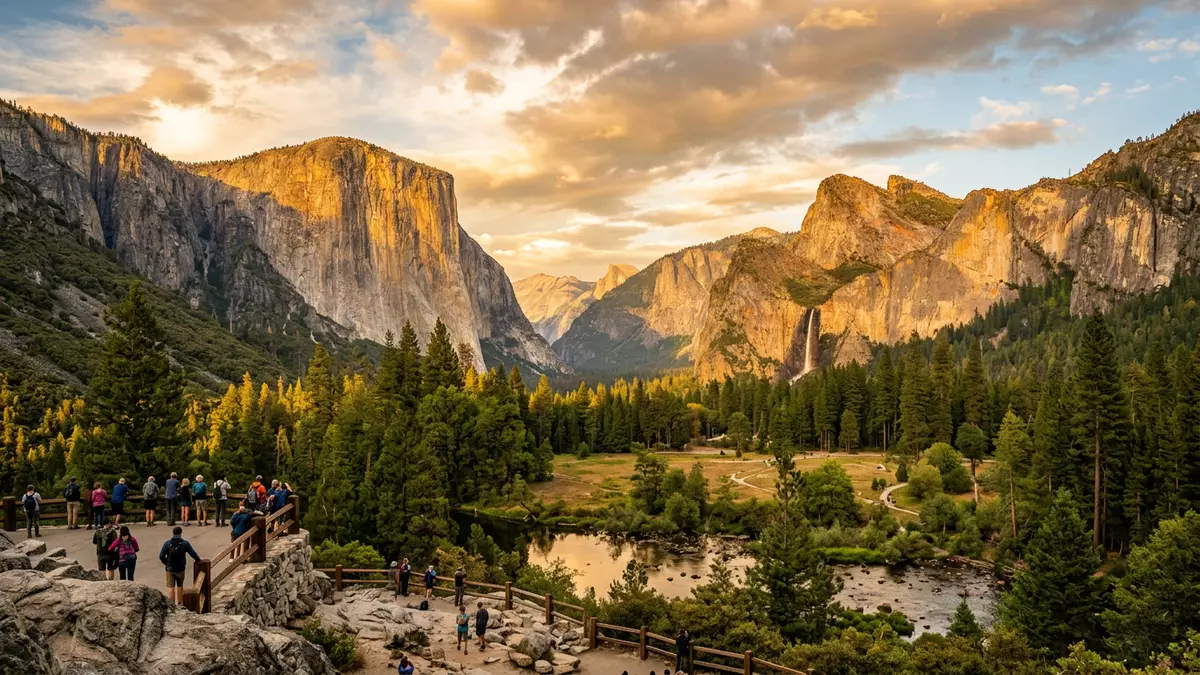
Yosemite National Park in California gathers much of the Sierra Nevada’s drama into a single mountain region, and nowhere is that more concentrated than in Yosemite Valley itself. The valley’s granite walls, waterfalls and forests sit within a protected landscape that was established as a national park on 1 October 1890, framing a setting that has become a central image of the American West.
Granite, glaciers and the making of Yosemite Valley
Yosemite Valley lies on the western slopes of the Sierra Nevada, where the mountains rise above the foothills east of California’s Central Valley. Within this belt of high ground, the valley forms a deep trough cut into granitic rocks of Cretaceous age, part of a larger mass of granite and granodiorite exposed across the park.Granitic rocks of Cretaceous age Jointing within these rocks shapes cliffs and domes, giving Yosemite Valley its combination of sheer faces and rounded summits.
The valley’s present form reflects extensive mountain glaciation on the windward side of the Sierra Nevada. An ice cap once spread across the high plateau, feeding tongues of ice that descended into river valleys and carved them into pronounced U-shaped troughs.U-shaped glacial troughs Differences in glacial erosion between main valleys and side valleys produced hanging valleys and waterfalls that drop from tributary basins to the valley floor, a pattern that is central to Yosemite’s scenery.
A national park shaped by protection and recognition
Yosemite National Park occupies a large area of east-central California, spread across Tuolumne, Mariposa, Mono and Madera counties.Tuolumne, Mariposa, Mono and Madera counties The park extends over more than 3,000 km² (over 1,160 square miles), surrounding Yosemite Valley with high peaks, plateaus and forested uplands.Over 3,000 km² of protected land Most of this area is designated wilderness, with only a small fraction developed for roads, settlements and visitor facilities.
On 1 October 1890, Congress created Yosemite National Park, following earlier protection of Yosemite Valley and Mariposa Grove under the Yosemite Grant signed by President Abraham Lincoln in 1864.Yosemite Grant of 1864 In 1984 the park was inscribed as a UNESCO World Heritage Site, recognising its granite cliffs, waterfalls, clear streams, groves of giant sequoias, lakes, mountains, meadows, glaciers and biological diversity.UNESCO World Heritage Site in 1984
Yosemite Valley’s cliffs, waterfalls and forests
Within the wider park, Yosemite Valley is a relatively short stretch of canyon compared with the whole protected area, yet it concentrates many of Yosemite’s best-known landforms.Yosemite Valley length and park size Sheer granite cliffs rise from the valley floor, forming faces and domes that are central to the visual character of the valley and that have long drawn rock climbers to the area.Granite cliffs and climbing Above and between these walls, waterfalls pour from hanging valleys, while forests of conifers and mixed woodland line the lower slopes and the valley floor.
Beyond the main valley, groves of giant sequoias form another distinctive element of Yosemite National Park. These trees belong to a species that reaches substantial sizes and ages, with some specimens in the park dated to around 3,000 years.Giant sequoia groves Together with alpine meadows, clear streams and lakes scattered across the higher country, they complete a landscape in which Yosemite Valley stands as one dramatic corridor among many, but one that remains the easiest place to see the park’s geology and ecology side by side.
Visiting Yosemite National Park: what travellers from Western Europe should know
- Yosemite National Park lies in east-central California, with Yosemite Valley reached by mountain roads from the west and by passes across the Sierra Nevada to the east.
- The valley floor sits at mountain altitude, and approaches from the rim involve steep gradients and extended uphill walking on paths and trails.
- Rocky ground, uneven surfaces and stairways occur on many routes to viewpoints and waterfalls, so footwear suited to mountain terrain is important.
- Snow and ice affect higher passes and peaks in colder months, while lower elevations carry forests and rivers that reflect the changing seasons.
- The official language is English and the currency is the US dollar; entry requirements depend on your nationality, UK travellers can check the FCDO travel advice at gov.uk/foreign-travel-advice, Irish travellers the Department of Foreign Affairs at ireland.ie.
Searching for Yosemite National Park on social platforms
These links open searches for Yosemite National Park on each platform.
Frequently asked questions about Yosemite National Park
Where is Yosemite National Park and Yosemite Valley located?
Yosemite National Park lies in east-central California, in the Sierra Nevada, with Yosemite Valley in its west-central part.
What can visitors expect on a visit to Yosemite Valley?
Visitors encounter steep granite cliffs, waterfalls dropping from hanging valleys, forests on the valley floor and a setting framed by higher peaks and plateaus.
What makes Yosemite National Park distinctive among mountain parks?
The combination of deep glacial valleys, extensive wilderness, giant sequoia groves and its status as a UNESCO World Heritage Site gives the park a particular profile.


