
Yokohama Chukagai’s gates, temples and streets
Published on 09/12/2026 at 19:07 | Editorial responsibility: Rafael Müller, Editor-in-Chief AD HOC NEWS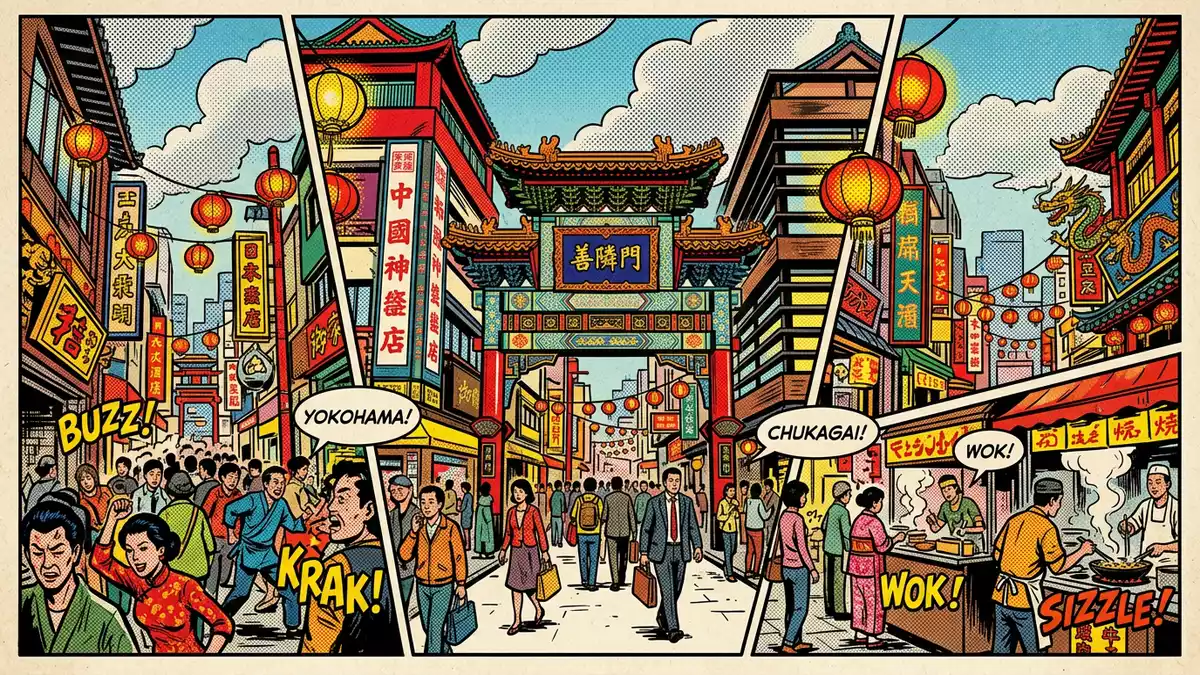
Yokohama Chukagai is Yokohama’s Chinese quarter, a dense urban district in Naka-ku whose streets, gates and temples still carry the imprint of the port city’s nineteenth-century opening. Its story begins with 1859, when Yokohama opened as a seaport, and with the later recognition of the district under the name Yokohama Chukagai in 1955. The result is a place where Chinese religious buildings, painted gateways and close-set shopfronts form a clearly defined city quarter.
From port settlement to named quarter
The district’s earliest growth came with Chinese merchants and settlers linked to Yokohama’s port trade, and that commercial origin still shapes its identity. A later milestone was the construction of the Zenrinmon, the goodwill gate, in 1955, the year the area received official status as Yokohama Chukagai.
That history is visible in the scale of the streets. The quarter is compact, but its built fabric is dense, with gateways, lanterns, temple fronts and narrow commercial blocks appearing one after another. The street pattern gives the area a strong enclosure, and the effect is reinforced by repeated decorative arches and hanging signs.
Kanteibyo and the religious landscape
Among the best-known buildings is Kanteibyo, the temple dedicated to Guan Yu, the deified warrior figure from the Three Kingdoms tradition. It is a major anchor of the district’s cultural life and a direct reminder that Yokohama Chukagai is not only a restaurant zone but also a place of worship and community memory.
The temple’s rooflines, carved ornament and incense-filled halls sit within the same tight urban fabric as the surrounding streets. A second major religious presence is the nearby Yokohama Kuan Ti Miao, which keeps the figure of Guan Yu at the centre of the quarter’s identity. Together, these buildings give the district a layered character that is as much ceremonial as commercial.
Street life, gates and urban texture
Yokohama Chukagai is defined by its gates as much as by its shops. The entrances mark the transition into the quarter, and the painted surfaces, red columns and Chinese-style roofs create a continuous visual language across the district. Within the streets, the concentration of restaurants, food stalls, souvenir shops and decorative facades creates a compact walking environment.
The district also links to the wider city through Motomachi-Chukagai Station on the Minatomirai Line. Another useful reference point is Yamashita-cho, the neighbourhood name that places the quarter beside Yokohama’s waterfront and the city’s older central districts.
Visiting Yokohama Chukagai: what travellers from Western Europe should know
- The district lies in Naka-ku, Yokohama, and Motomachi-Chukagai Station is the most direct rail name to know. Ishikawa-cho Station on the JR Negishi Line also serves the area.
- The quarter is flat and compact, with short blocks and a dense street network. The gates and temple fronts are close together, so the district is easy to read on foot.
- Yamashita-cho and Yamashita Park sit close by, giving the area a clear waterfront reference point. The setting places the quarter within central Yokohama rather than on the city’s edge.
- The official language is Japanese and the currency is the yen.
Searching for Yokohama Chukagai on social platforms
These links open searches for Yokohama Chukagai on each platform.
Frequently asked questions about Yokohama Chukagai
Where is Yokohama Chukagai?
Yokohama Chukagai is in Naka-ku, Yokohama, in the city’s central area. It sits near Motomachi-Chukagai Station and close to Yamashita-cho.
What does a visit involve?
Expect a compact quarter of streets, gates, temples and restaurants. The area is organised as a walkable urban district rather than as a single enclosed monument.
What makes it distinctive?
The district combines a Chinese temple landscape with gate-lined commercial streets. Its identity is tied to Yokohama’s port history and the 1955 recognition of Yokohama Chukagai.


