
Yiheyuan, the Summer Palace of Peking’s lakes and hills
Published on 09/08/2026 at 17:07 | Editorial responsibility: Rafael Müller, Editor-in-Chief AD HOC NEWS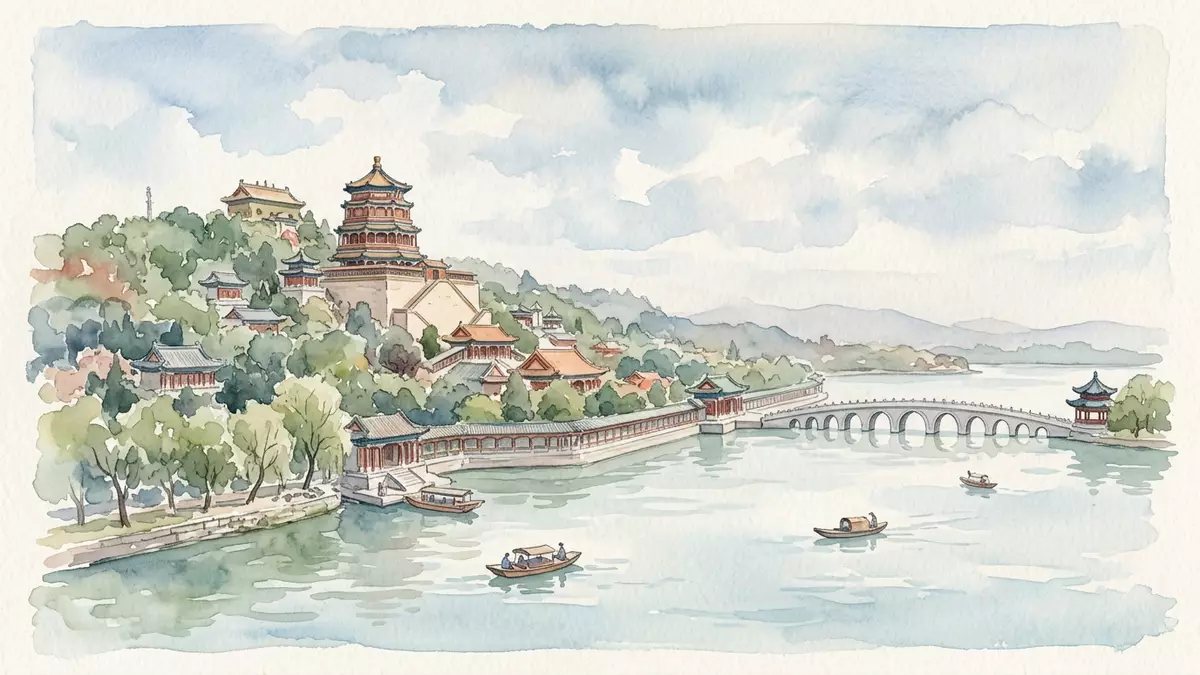
Yiheyuan, known in English as the Summer Palace, is an imperial garden on the north?western side of Peking where water, hills and palaces are composed into one expansive landscape. Rising around the Kunming Lake and the Wanshoushan, the garden belongs to the Qing dynasty period and today stands as one of China’s most prominent classical ensembles of architecture and landscape.
Water, hills and an imperial garden plan
Yiheyuan lies in Haidian District in the western suburbs of Peking, with the Kunming Lake and the Wanshoushan forming the core of its layout.Kunming Lake and Wanshoushan The garden’s area is recorded at around 290 hectares, with lake water covering most of that surface and creating long perspectives across the site.about 290 hectares The water and slopes are framed by dense planting and pavilions, forming a landscape where views shift between broad open water and more confined hillside structures.
The present form of the garden dates to the eighteenth and nineteenth centuries, when the Qing court used the lakeside and hillside ensemble as a seasonal retreat from the centre of Peking.eighteenth?century Qing garden The Chinese name Yiheyuan is commonly translated as a garden of harmony or health, and the site is arranged in distinct zones, ranging from the more formal palace courtyards close to the foot of the hill to the informal lakeside walks and causeways that extend across the water.Chinese name of the garden
Qing dynasty patronage and UNESCO recognition
The core phase of construction at Yiheyuan took place between 1751 and 1764 under the Qing emperor Qianlong, who commissioned extensive works on the site as an imperial garden for his court.commissioned by Qianlong This eighteenth?century garden design integrates temples, halls and corridors with the natural terrain, using artificial hills in places to extend the relief around the lake. Later, in the nineteenth century, the garden became closely associated with Empress Dowager Cixi, who used the ensemble as a primary residence during the warmer months and gave the park its present name Yiheyuan.present name Yiheyuan
In 1998 Yiheyuan was inscribed on the UNESCO World Heritage List as an outstanding example of imperial Chinese garden design.UNESCO World Heritage in 1998 The listing highlights the ensemble’s combination of architecture, water and landscape, and its influence on later garden design in China.imperial architecture and garden design Together with other major gardens such as the Chengde Mountain Resort and the Suzhou gardens, Yiheyuan stands among the most documented historic garden complexes in the country, and its Qing dynasty patronage and preservation have made it a key site for understanding imperial leisure and representation.
Architectural ensembles around Kunming Lake
A walk through Yiheyuan reveals contrasting architectural ensembles arranged around the Kunming Lake and across the slopes of Wanshoushan. Along the eastern shore of the lake lie formal halls and courtyards that once accommodated imperial ceremonies, set behind tall gates and arranged on stone platforms with views towards the water. Rising above them, the hill carries temples and towers aligned along the axis of the main ascent, with long covered walkways linking one terrace to the next.
Across the lake, smaller structures stand on causeways and islands, including waterside pavilions and clusters of buildings designed in the style of southern Chinese towns.southern?style streets and pavilions The long corridor on the northern shore, known for its series of painted beams and panels, runs parallel to the lake for a considerable distance and links several key viewing points.painted corridor and lakeside buildings Taken together, these structures offer a mixture of grand palace architecture and more intimate lakeside buildings, all set against the constant presence of water and hills.
Visiting Yiheyuan: what travellers from Western Europe should know
- Yiheyuan lies in Haidian District in the north?western suburbs of Peking, with main gates on Xinjiangongmen Road and metro connections at Xiyuan, Beigongmen and along the Xijiao Line.
- The garden’s terrain combines lakeside paths with slopes and stairways on Wanshoushan; reaching the higher temple terraces involves sustained climbing on stone steps.
- Yiheyuan is situated around 15 km west of Peking’s historic centre, and sits close to institutions such as Peking University in the wider Haidian district of the city.
- The official language is Chinese and the currency is the renminbi (RMB).
Searching for Yiheyuan on social platforms
These links open searches for Yiheyuan on each platform.Frequently asked questions about Yiheyuan
Where is Yiheyuan located in Peking?
Yiheyuan is located in Haidian District on the north?western edge of Peking, around Kunming Lake and Wanshoushan in the city’s western suburbs.
What should visitors expect on a visit to Yiheyuan?
Visitors encounter an extensive imperial garden with lakeside walks, palace courtyards and hillside temples, arranged across a large area of water and hills.
What makes Yiheyuan distinctive among Chinese gardens?
Yiheyuan stands out for its combination of Qing dynasty palace architecture with a vast lake and hill landscape, preserved as a UNESCO World Heritage imperial garden.


