
Yiheyuan, the lakeside imperial garden of Peking
Published on 09/16/2026 at 15:42 | Editorial responsibility: Rafael Müller, Editor-in-Chief AD HOC NEWS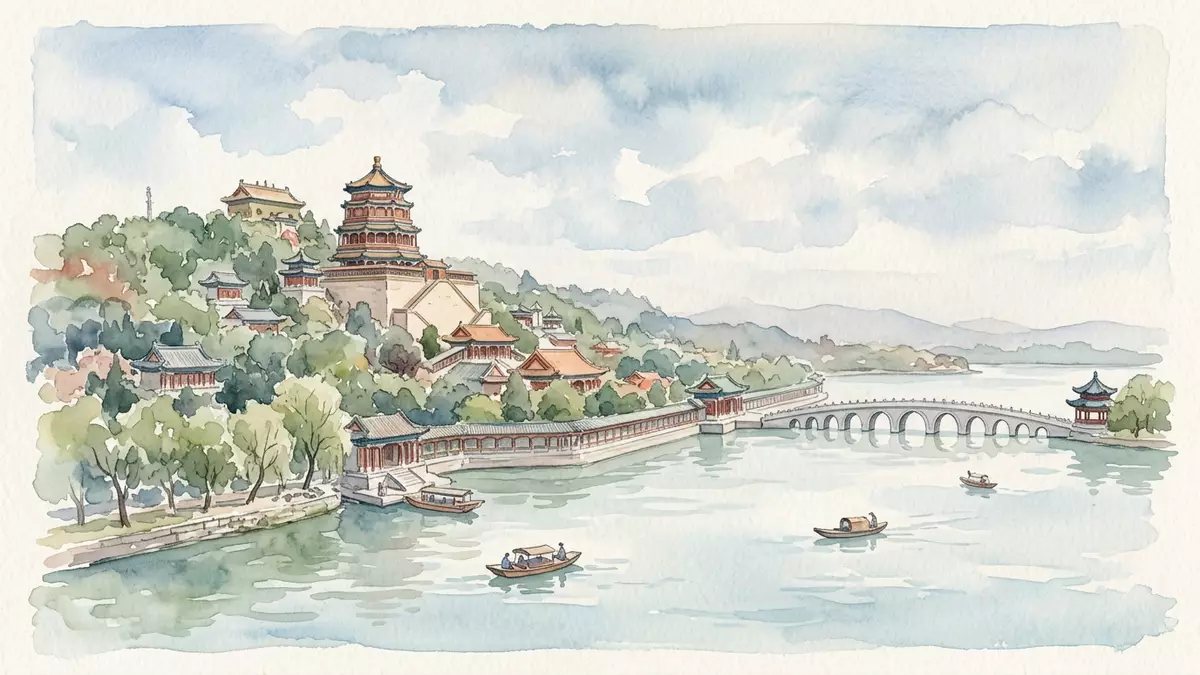
Yiheyuan, known in English as the Summer Palace in Peking, is an extensive Qing-dynasty imperial garden of water, wooded hills and painted corridors set on the north-western edge of the city. It grew around Kunming Lake and Longevity Hill in the eighteenth century under Emperor Qianlong and later took on its present name during the reign of Empress Dowager Cixi, giving Peking a vast landscaped retreat shaped by classical Chinese ideas of harmony between architecture and nature.Emperor Qianlong
Kunming Lake and Longevity Hill: water and height in balance
At the heart of Yiheyuan lies the broad expanse of Kunming Lake, occupying most of the garden’s area and reflecting the wooded slopes of Longevity Hill on its northern shore.Kunming Lake and Longevity Hill The lake’s surface is broken by islands, bridges and causeways, with stone balustrades and waterside terraces giving views back towards the hill and deeper into the park. On the rising ground of Longevity Hill, temple buildings and palace halls step up the slope, linked by stairways and courtyards that frame views over the water and towards the distant city beyond.
The present garden took shape as an imperial project in the mid eighteenth century, when Emperor Qianlong ordered its construction as a birthday gift for his mother between 1751 and 1764.birthday gift for his mother The name Yiheyuan, usually rendered as “Garden of Nurtured Harmony” or “Garden of Good Health and Harmony”, dates from a later phase when Empress Dowager Cixi reshaped the estate and adopted it as a summer retreat.renamed Yihe Yuan Covering close to 290 hectares, with water taking up around three quarters of the whole, the garden reads as a landscape composition at the scale of an entire valley.about 290 hectares
Palace architecture, painted corridors and lakeside pavilions
Yiheyuan combines palace compounds with garden structures, creating a sequence of spaces that shifts from formal courts to relaxed lakeside scenes. Near the eastern side of the lake, clusters of halls and courtyards formed the working and residential quarters of the imperial household, built in the timber-and-tile construction typical of the Qing dynasty and decorated with carved beams, lattice screens and glazed roof ornaments.a kaiserlicher Garten der Qing-Dynastie Further along the shore, garden pavilions sit right beside the water, projecting over the lake on platforms and connected by stone bridges.
One of Yiheyuan’s most distinctive features is the long covered corridor running beside the lake, lined with thousands of painted panels showing landscapes, figures and stories from Chinese literature.The Summer Palace, Yiheyuan in Chinese This corridor links key points along the lakeside and turns a simple walk into an extended architectural sequence, with views opening out towards the water between the timber columns. Elsewhere in the garden, the composition includes imitation garden-street districts, temple terraces on the hillside and quieter wooded paths, each designed in line with classical Chinese garden practice that mixes built structures, planting and borrowed views.
Imperial garden, UNESCO site and part of Peking’s cultural landscape
The Summer Palace, an Imperial Garden in Beijing, is formally inscribed on the UNESCO World Heritage List, recognised as the largest and best-preserved imperial garden in China.largest and best-preserved imperial garden It sits in Haidian District, roughly 15 km north-west of central Peking, west of institutions such as Peking University and linked to the urban fabric by major roads and public transport.west of Peking University As Peking expanded in the twentieth century, the garden’s lake and hill remained a large green and blue space against the denser city around it.
The garden’s layout, with its combination of open water, built slopes and formal courts, became a reference point for later interpretations of classical Chinese garden design.vast ensemble of lakes, gardens and palaces For visitors, it offers a chance to see Qing-dynasty palace architecture in a landscape setting rather than only within the tight courtyards of the Forbidden City. The contrast between wide lake views, intimate pavilion interiors and the stepped rise of temples on Longevity Hill gives Yiheyuan a distinctive character within Peking’s network of historic sites.
Visiting Yiheyuan: what travellers from Western Europe should know
- Yiheyuan lies in Haidian District in the north-west of Peking, around 15 km from the centre, with access from streets such as Xinjiangongmen Road and public transport stops near the east and north gates.
- The garden covers a broad area of lakeshore and hillside, so a visit involves walking on stone paths and stairways, including climbs on Longevity Hill and longer routes along the covered lakeside corridor.
- English is widely used in signage, but the official language is Chinese and the currency is the renminbi (yuan), with names such as Yiheyuan and Kunming Lake appearing on maps and information boards.
- Major institutions including Peking University and other Haidian District campuses lie nearby, so Yiheyuan can be combined with visits to those parts of the city’s cultural landscape.
Searching for Yiheyuan on social platforms
These links open searches for Yiheyuan on each platform.Frequently asked questions about Yiheyuan
Where is Yiheyuan and what kind of place is it?
Yiheyuan is an imperial garden in Haidian District, north-west of central Peking, built around Kunming Lake and Longevity Hill as a Qing-dynasty summer retreat.
What should visitors expect on a visit to Yiheyuan?
Visitors encounter expansive lakeshore walks, palace courtyards, temples on the hillside and long painted corridors, with substantial distances covered on foot between key areas.
What makes Yiheyuan distinctive among Peking’s historic sites?
Its scale as a composed landscape, combining water, topography and Qing-dynasty architecture, and its status as a UNESCO-listed imperial garden give it a character different from city-centre palaces.


