
Yiheyuan, the imperial lake garden of Peking
Published on 09/07/2026 at 20:29 | Editorial responsibility: Rafael Müller, Editor-in-Chief AD HOC NEWS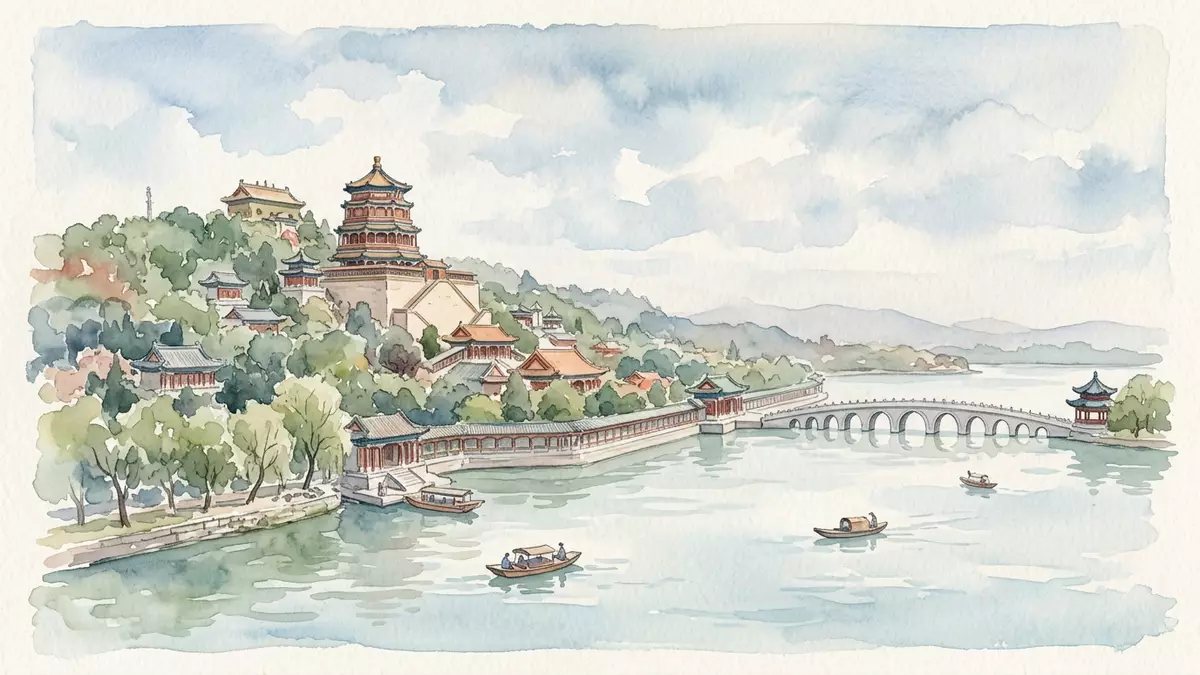
Yiheyuan, known internationally as the Summer Palace in Peking, is an imperial garden landscape that spreads around Kunming Lake and Longevity Hill on the city’s north?western edge. Created in the eighteenth century under the Qing dynasty and later rebuilt in the nineteenth century, it combines palaces, temples, pavilions and water into a single composition that reads almost like a painted scroll in three dimensions.
Water, hill and an imperial garden plan
Yiheyuan is centred on Kunming Lake, a broad expanse of water occupying most of the site, with Longevity Hill rising along its northern shore as a backdrop of slopes and ridges.Kunming Lake and Longevity Hill Together they define the basic layout: water in the foreground, elevation behind, and a band of built structures stepping between the two. The ensemble lies in Haidian District in Peking, in the city’s western suburbs rather than in the dense inner districts.Haidian location
The garden covers an area of around 290 hectares (about 717 acres), with water making up a large proportion of the ground.290?hectare imperial garden It was laid out in the mid?eighteenth century under the Qianlong Emperor and is associated above all with the late Qing court, including Empress Dowager Cixi, who adopted it as a summer retreat in the nineteenth century.Qianlong?period origins
Qing?dynasty architecture reflected in water
Architecturally, Yiheyuan is a catalogue of Qing?dynasty imperial building forms, with palaces, halls, covered walkways and theatrical courtyards strung along the lakeside and up the hill. The principal palace complex lies near the eastern side, facing the lake, with ornate roofs, painted timber beams and stone terraces that speak to the high craftsmanship of the period.imperial palaces and gardens The famous Long Corridor runs close to the water, its ceiling panels painted with scenes from literature, landscapes and flowers, turning a simple lakeside stroll into a sequence of framed images.
Temples and pavilions rise higher on Longevity Hill, including structures aligned along axes that step up towards the crest and give views back across Kunming Lake towards the distant city. Stone bridges cross the water at key points, among them the multi?arched bridge leading towards an island, where smaller pavilions sit among trees and rockwork. While each building follows established forms of Chinese palace and temple architecture, their placement around the lake and hill gives Yiheyuan its distinctive character as a garden that stages architecture, water and terrain together.garden architecture around lake and hill
From imperial retreat to World Heritage landscape
Yiheyuan was conceived as an imperial garden, a place where the Qing court could withdraw from the formal palaces of central Peking into a landscape designed for leisure, ceremony and contemplation. In the late nineteenth century it took the name Yiheyuan, usually rendered in English as “Garden of Nurtured Harmony”, and remained associated with the final decades of the Qing dynasty.Yiheyuan name The complex preserves not only buildings but also a carefully shaped water body, artificial hills and planting that together illustrate the way imperial gardens drew on wider Chinese landscape traditions.
In 1998 Yiheyuan was inscribed on the UNESCO World Heritage List for its significance as a masterpiece of Chinese landscape garden design that integrates natural and built elements.1998 World Heritage inscription Alongside other named classical gardens, it represents a mature stage of garden development in China, with Kunming Lake and Longevity Hill forming a composition that frames views, organises movement and links architecture with water and topography in a single imperial setting.
Visiting Yiheyuan: what travellers from Western Europe should know
- Yiheyuan lies in Haidian District in the north?western suburbs of Peking, reached by urban transport routes that serve its eastern and northern gates.
- The garden landscape includes lakeside walks, steps up Longevity Hill and stone stairways within palace and temple complexes, so visiting involves changes of level.
- The official language is Chinese and the currency is the renminbi (RMB).
- Entry requirements depend on your nationality; UK travellers can check the FCDO travel advice at gov.uk/foreign-travel-advice, Irish travellers the Department of Foreign Affairs at ireland.ie.
Searching for Yiheyuan on social platforms
These links open searches for Yiheyuan on each platform.
Frequently asked questions about Yiheyuan
Where is Yiheyuan located in Peking?
Yiheyuan stands in Haidian District in the north?western outskirts of Peking, a suburban area with transport connections to its main gates.
What can visitors expect when exploring Yiheyuan?
Visitors encounter a large imperial garden arranged around Kunming Lake and Longevity Hill, with palaces, temples, bridges and long painted corridors linked by paths and stairways.
What makes Yiheyuan distinctive among Chinese gardens?
Its scale, its combination of water, hill and architecture, and its role as a Qing?dynasty imperial retreat recognised on the UNESCO World Heritage List distinguish Yiheyuan among classical Chinese gardens.


