
Yiheyuan, Beijing’s lake and hill imperial garden
Published on 09/02/2026 at 08:47 | Editorial responsibility: Rafael Müller, Editor-in-Chief AD HOC NEWS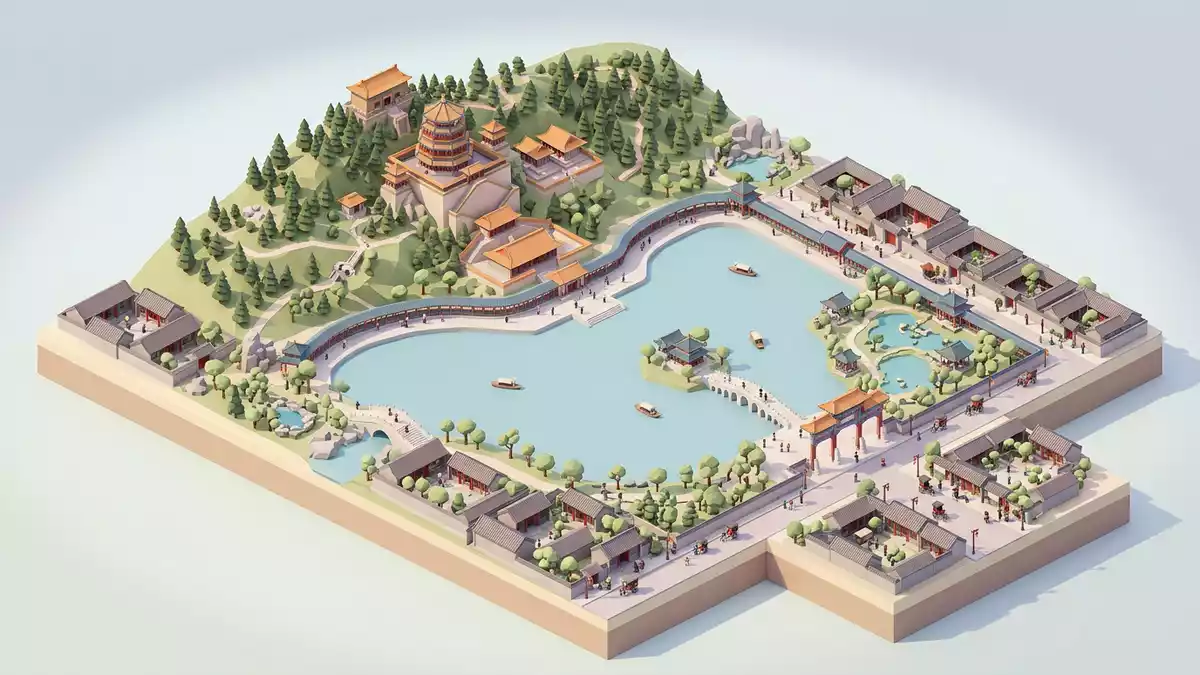
Yiheyuan, known in English as the Summer Palace, is an imperial garden in north-western Peking where an expanse of water and a single wooded hill are composed into an intricate landscape of halls, pavilions and walkways. Set out in the eighteenth century under the Qing emperor Qianlong and reshaped in the nineteenth century, it survives as a classical Chinese garden on a grand, state scale.
Water and hill: Kunming Lake and Longevity Hill
The structure of Yiheyuan is simple enough to describe yet complex to experience: Kunming Lake stretches across most of the estate, with Longevity Hill rising from its northern shore. Together they form an imperial landscape composition in which architecture and terrain are inseparable. The ensemble covers around 290 hectares (about 717 acres), with water taking up most of that area.an area of 290 hectares
Kunming Lake is broad enough that the far shore recedes into a faint line of tiled roofs and trees, while Longevity Hill is low compared with the mountains outside Beijing but dominates the lake edge through its steep, terraced flanks. From the water, the hill appears stepped with palace complexes and temple courtyards, their roofs layered one above another. The overall impression is of a carefully staged vertical axis rising from the lake’s surface to the hilltop temples, with secondary axes running along the shore and across the water over causeways and bridges.
Imperial garden on a grand scale
Yiheyuan in its recognisable form dates to the reign of the Qianlong Emperor in the eighteenth century, when a villa and garden complex north-west of Peking was expanded into an imperial summer retreat.complex of palaces, gardens, and lakes The garden belongs to the late Qing period in architectural terms, with timber halls, carved stone balustrades and painted galleries drawing on long-established styles rather than experimental forms.
The estate is officially recognised by UNESCO as “Summer Palace, an Imperial Garden in Beijing”, with World Heritage status granted in 1998.inscribed on the World Heritage List in 1998 This recognition reflects the way Yiheyuan condenses techniques of Chinese garden-making that had developed over centuries: contrived views, concealed routes and framed perspectives that turn walking into a sequence of scenes. The name Yiheyuan itself is often rendered as “Garden of Nurtured Harmony”, signalling its identity as a cultivated landscape rather than a single palace building.Yiheyuan (Garden of Good Health and Harmony)
Architectural highlights around lake and hill
The most recognisable architectural landmark at Yiheyuan stands on the slopes of Longevity Hill: the Tower of Buddhist Incense, known in Chinese as Foxiang Ge. This many-tiered structure forms the compositional climax of the hill, rising from a high stone terrace and visible from much of Kunming Lake.the Tower of Buddhist Incense Below it runs the Long Corridor, a covered walkway that threads along the hillside close to the water.
The Long Corridor is striking not only for its length, which extends for several hundred metres, but for its dense painted decoration. Beams and crosspieces carry thousands of small, framed scenes drawn from literature, legend and landscape, turning a simple route into an open-air picture gallery.a variety of palaces, gardens and other traditional-style architectural structures Elsewhere around the shore, visitors encounter lakeside pavilions, marble terraces aligned with the water, and garden compounds such as the Garden of Virtue and Harmony, each with its own internal courtyards and theatrical halls.
Visiting Yiheyuan: what travellers from Western Europe should know
- Yiheyuan lies in Haidian District in the north-western suburbs of Peking, with the garden spreading between Kunming Lake and Longevity Hill on the city’s edge.
- The terrain alternates between level lakeside paths and stepped routes up Longevity Hill, where stone stairways and sloping paths link the main temple terraces.
- Peking’s official language is Mandarin Chinese and the currency is the renminbi (yuan).
- Suburban streets and university districts surround the estate; Peking University and other campuses lie nearby on the same north-western corridor.
- Entry requirements depend on your nationality; UK travellers can check the FCDO travel advice at gov.uk/foreign-travel-advice, Irish travellers the Department of Foreign Affairs at ireland.ie.
Searching for Yiheyuan on social platforms
These links open searches for Yiheyuan on each platform.Frequently asked questions about Yiheyuan
Where is Yiheyuan and what kind of place is it?
Yiheyuan is an imperial garden in Haidian District in north-western Peking, built around Kunming Lake and Longevity Hill as a palace and park complex.
What can visitors expect when walking through Yiheyuan?
Visitors move between lakeside promenades, painted covered corridors and stepped temple terraces, with long views across Kunming Lake and close-up garden courtyards.
What makes Yiheyuan distinctive among historic sites in Beijing?
The combination of a large lake, a single dominant hill, and extensive Qing dynasty architecture creates a landscape that reads like a three-dimensional scroll painting.


