Yellowstone National Park and its volcanic landscape
Published on 09/09/2026 at 17:52 | Editorial responsibility: Rafael Müller, Editor-in-Chief AD HOC NEWS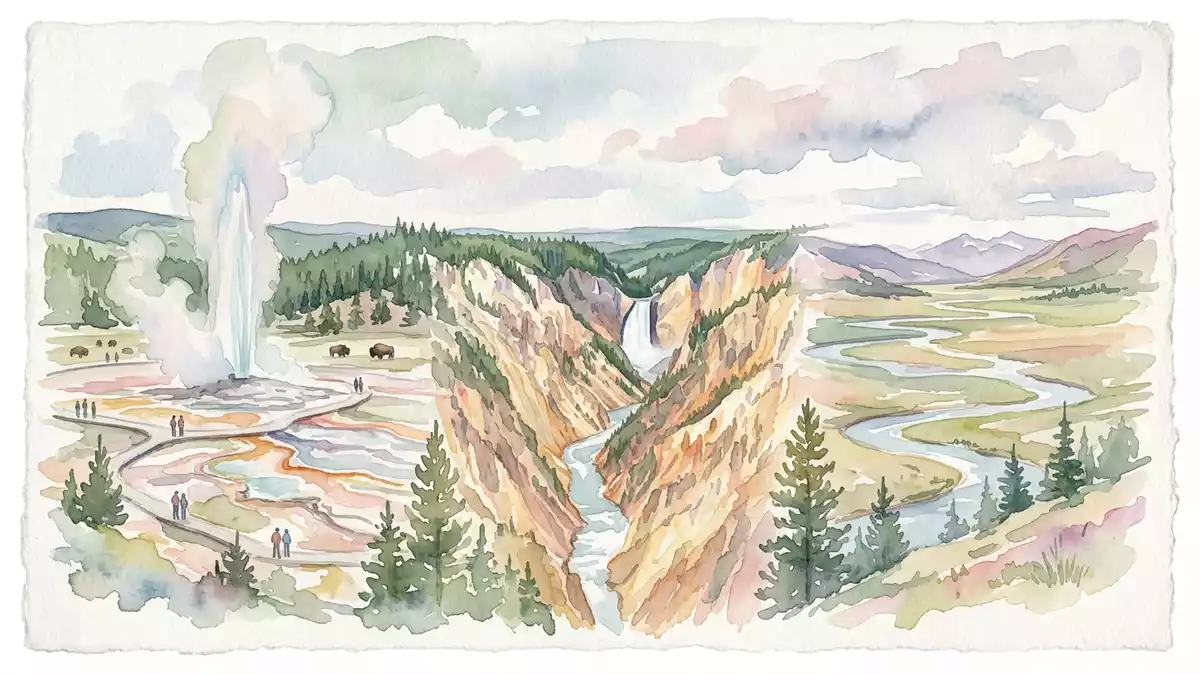
Yellowstone National Park in the United States is a vast highland landscape shaped by an immense volcanic system under the Yellowstone Plateau. Established as a national park on 1 March 1872, it has long been associated with extraordinary hydrothermal features and broad river canyons that make the terrain distinctive even among North American parks.
A park built on a giant caldera
Yellowstone National Park occupies a broad region in north-western Wyoming, extending into southern Montana and eastern Idaho, where the Yellowstone Plateau hides a giant volcanic caldera beneath forest, grassland and wide valleys.North-western Wyoming and its neighbouring states give the park a setting of high country, where rivers cut deep and the ground holds traces of past eruptions.
The caldera is part of a volcanic region that has been geologically active for tens of millions of years, and the present landscape reflects that long history in uplifted plateaus, resurgent domes and broad basins dotted with thermal areas.Geology information from the National Park Service describes how volcanic forces, erosion and glaciation combined to create the mix of cliffs, valleys and open plains that visitors see.
Hydrothermal features shaped by hidden heat
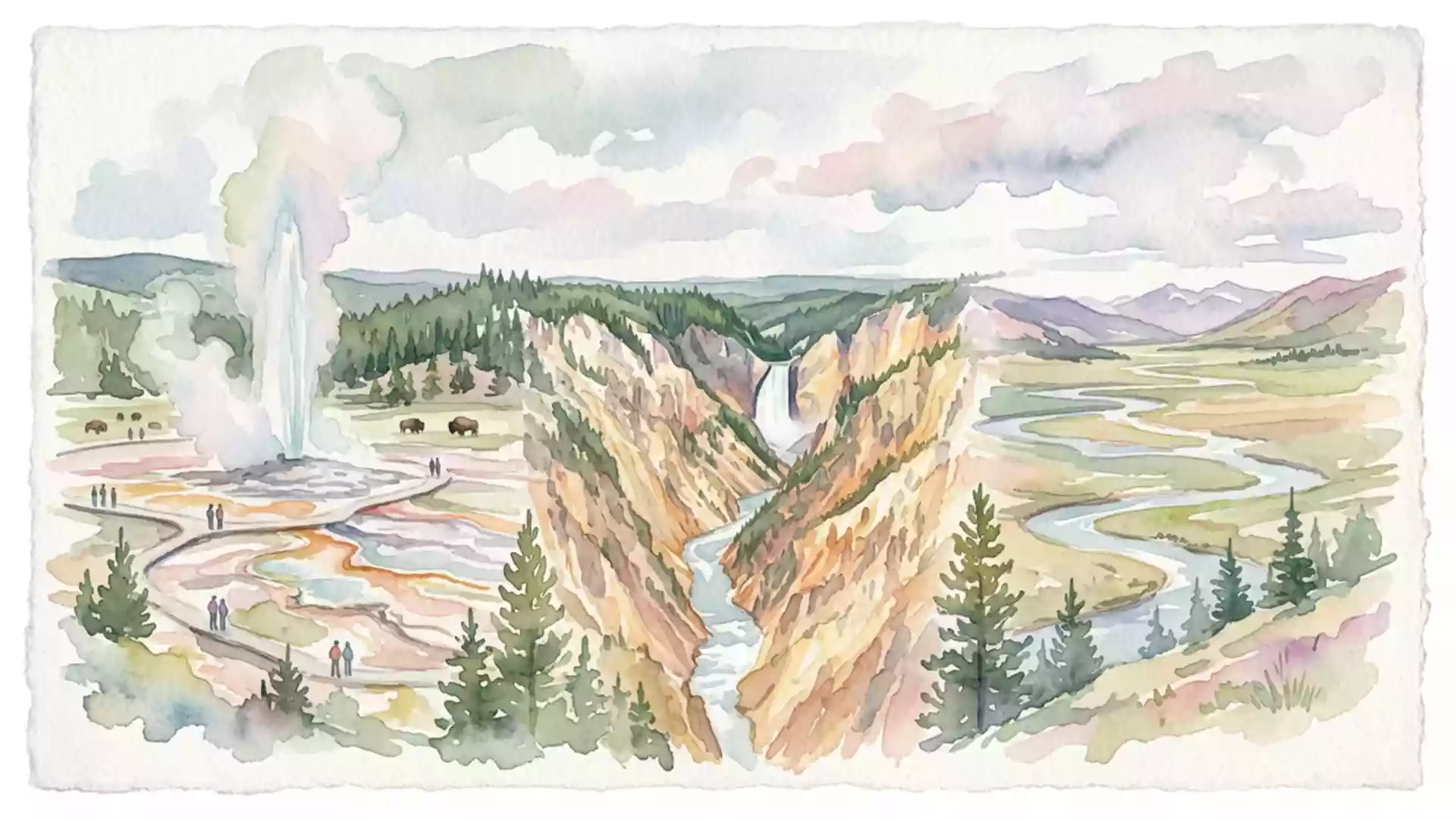
Yellowstone is widely associated with its hydrothermal features, which are the visible expression of the heat rising from the magma body beneath the park. Hot springs, geysers, mudpots and fumaroles appear across the plateau, forming distinct geyser basins and thermal areas that punctuate the lodges, forests and grasslands.National Park Service material on hydrothermal features notes that Yellowstone preserves more than 10,000 such features, including hundreds of geysers.
Several names have become closely associated with these thermal areas. Old Faithful, in the Upper Geyser Basin, is among the park’s best-known geysers, recognised for its frequent eruptions from a cone within a steaming landscape.Descriptions of Old Faithful sit alongside accounts of hot springs such as Grand Prismatic Spring, whose colourful mineral-rich waters and broad surface make it a landmark within the mid-plateau basins.Geothermal areas of Yellowstone also highlight travertine terraces at Mammoth Hot Springs, where thermal water interacts with limestone to build chalky white steps and ledges.
Rivers, canyons and wide high-country scenery
Beyond the geyser basins, Yellowstone National Park presents a network of rivers, broad lakes and deep canyons that cut across the volcanic plateau. The Yellowstone River flows through a multi-coloured canyon, where eroded volcanic rock forms cliffs and slopes in shades of yellow, red and buff, framing waterfalls and rapids. This Grand Canyon of the Yellowstone has long been one of the park’s emblematic landscapes, combining fluted rock faces with viewpoints over the river gorge.References to the Grand Canyon of the Yellowstone place it among the natural features that helped secure the park’s protection.
Elsewhere, broad basins carry meadows, forests and wetlands, with mountain ranges edging the park to the south, east and north. Yellowstone Lake occupies a large high-elevation basin above sea level, near the centre of the caldera, and resurgent domes beneath and around it form subtle rises and rolling ground rather than sharp peaks.Descriptions of Yellowstone Lake and surrounding domes describe how these features sit within a landscape that mixes open water with forests and thermal areas along the shores.
Visiting Yellowstone National Park: what travellers from Western Europe should know
- Yellowstone National Park lies in the north-western part of Wyoming, extending into Montana and Idaho, and is reached by road networks linking regional towns and gateways.
- The park’s terrain includes elevated plateaus, river canyons and thermal basins, with boardwalks across some hydrothermal areas and footpaths crossing slopes and uneven ground.
- The official language is English and the currency is the United States dollar.
- Entry requirements depend on your nationality; UK travellers can check the FCDO travel advice at gov.uk/foreign-travel-advice, Irish travellers the Department of Foreign Affairs at ireland.ie.
Searching for Yellowstone National Park on social platforms
These links open searches for Yellowstone National Park on each platform.
Frequently asked questions about Yellowstone National Park
Where is Yellowstone National Park located?
Yellowstone National Park is principally in north-western Wyoming, with portions in southern Montana and eastern Idaho, in the high country around the Yellowstone Plateau.
What can visitors expect on a first visit to Yellowstone?
Visitors encounter a mix of hydrothermal basins with geysers and hot springs, deep river canyons, broad lakes and plateaus, all influenced by the underlying volcanic system.
What makes Yellowstone National Park distinctive among national parks?
Yellowstone combines a giant volcanic caldera, extensive hydrothermal features and high-elevation scenery, creating an unusual blend of geothermal activity and wide open landscapes.