

Yellowstone National Park and its restless volcanic plateau
Published on 08/25/2026 at 12:29 | Editorial responsibility: Rafael Müller, Editor-in-Chief AD HOC NEWS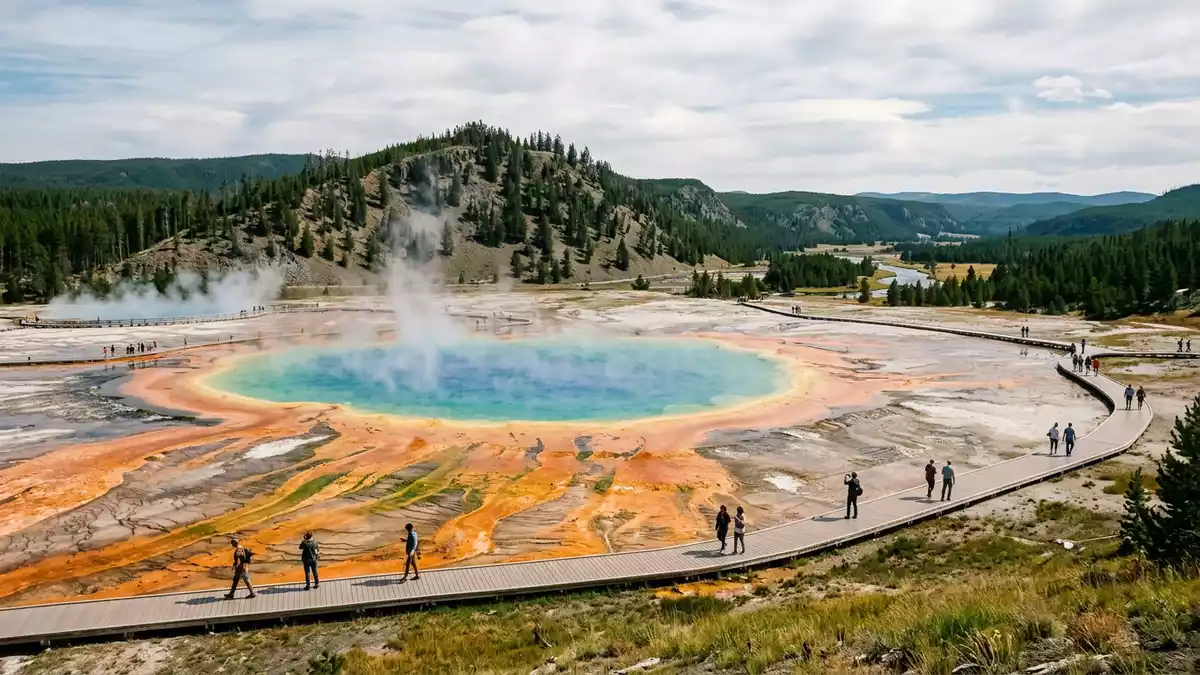
Yellowstone National Park in the Rocky Mountains of the western United States is built around a high volcanic plateau where heat from deep underground reaches the surface in thousands of visible places. The park was established as a protected landscape in 1872, making it the first national park created by the United States government, and later gained recognition as a World Heritage Site under UNESCO’s natural criteria.
A volcanic plateau shaped by a hidden caldera
Much of Yellowstone National Park lies on the Yellowstone Plateau, a high tableland formed from thick layers of volcanic rock. The plateau itself belongs to the Yellowstone Plateau volcanic field, a broad area of rhyolitic lava flows and ash deposits that has been reshaped by successive eruptions and tectonic movements over the Quaternary period.Yellowstone Plateau volcanic field Beneath this plateau lies the Yellowstone Caldera, a huge depression formed by a giant eruptive event, whose outline is partly masked by forests, rivers and Yellowstone Lake.Yellowstone Caldera beneath the park
Geologists identify three major caldera-forming eruptions over the last two million years in the wider Yellowstone region, each producing thick sheets of welded ash-flow tuff and extensive lava fields.three major eruptions The youngest of these eruptions is associated with the Lava Creek Tuff, which helps define the current caldera geometry and underpins much of the modern landscape.Lava Creek Tuff of the Yellowstone Group Overlying these volcanic deposits, glaciers, rivers and physical weathering have carved valleys, canyons and benches, leaving a plateau where the ground surface still records intense volcanic events alongside later erosional forms.
Geysers, hot springs and hydrothermal basins
The most distinctive surface expression of Yellowstone’s volcanic energy is the concentration of hydrothermal features spread across the park. Heat from the underlying magma body drives convection in groundwater, producing hot springs, mudpots, fumaroles and geysers that punctuate the plateau in dense clusters.geothermal landscape of Yellowstone More than 10,000 hydrothermal features have been catalogued, including several hundred active geysers, giving Yellowstone the largest collection of such features anywhere on Earth.over 10,000 hydrothermal features
These features gather in identifiable basins and terraces that visitors encounter as distinct landscapes within the wider plateau. Upper, Midway and Lower Geyser Basins near the Firehole River present a dense array of geysers and pools, while Norris Geyser Basin and the Mud Volcano area offer contrasting forms of steam vents and mudpots.major hydrothermal basins Mammoth Hot Springs forms broad travertine terraces built from calcium carbonate deposits, illustrating the way mineral-rich water can construct new structures on top of existing bedrock.Mammoth Hot Springs travertine terraces
Rivers, canyons and high-elevation lakes
Cutting through the volcanic plateau, rivers expose colourful rock layers and shape deep canyons. The Yellowstone River flows across the central region of the park before plunging into the Grand Canyon of the Yellowstone, a steep-sided valley whose walls display altered rhyolite and hydrothermal alteration products in yellow, orange and red tones.Grand Canyon of the Yellowstone River Other streams, including the Snake River system, incise the edges of the plateau and help define the transition between high volcanic ground and surrounding mountain ranges.rivers cutting into volcanic deposits
Yellowstone Lake occupies a broad basin partly within the caldera, forming one of the largest high-elevation lakes in North America and covering a substantial area of the volcanic depression.Yellowstone Lake within the caldera The lake’s long, branching arms follow faults and fracture zones in the underlying bedrock, while its shores alternate between forested slopes, geothermal areas and open beaches. Away from the lake, smaller ponds and wetlands occupy glacial scours and old lava surfaces, adding a mosaic of water bodies to the plateau.
Visiting Yellowstone National Park: what travellers from Western Europe should know
- Yellowstone National Park spans parts of Wyoming, Montana and Idaho in the western United States, with main road access from regional towns such as Gardiner and West Yellowstone.
- Many of the viewpoints, geyser basins and canyon rims are reached by short walks on prepared paths, with some routes including boardwalk sections and stairways over uneven ground.
- The park sits on a high plateau in the Middle Rocky Mountains, and many developed areas lie at elevations of more than 2,000 m (6,562 ft), which can influence how strenuous walks feel.
- The official language is English and the currency is the United States dollar.
- Entry requirements depend on your nationality; UK travellers can check the FCDO travel advice at gov.uk/foreign-travel-advice, Irish travellers the Department of Foreign Affairs at ireland.ie.
Searching for Yellowstone National Park on social platforms
These links open searches for Yellowstone National Park on each platform.Frequently asked questions about Yellowstone National Park
Where is Yellowstone National Park located?
Yellowstone National Park lies in the Middle Rocky Mountains of the western United States, spanning parts of Wyoming, Montana and Idaho on a high volcanic plateau.
What should visitors expect on a first visit?
Visitors encounter extensive road-accessible areas with short walks to geyser basins, canyon viewpoints and lakeshores, all set across a large, high-elevation landscape shaped by volcanism and erosion.
What makes Yellowstone National Park distinctive?
Yellowstone combines an active volcanic system with more than 10,000 hydrothermal features, a major caldera, high mountain plateaus and deep river canyons, recognised internationally through its UNESCO World Heritage and biosphere reserve status.


