
Yekaterininsky dvorets in Puschkin and its blue?and?gold Baroque façade
Published on 09/15/2026 at 20:12 | Editorial responsibility: Rafael Müller, Editor-in-Chief AD HOC NEWS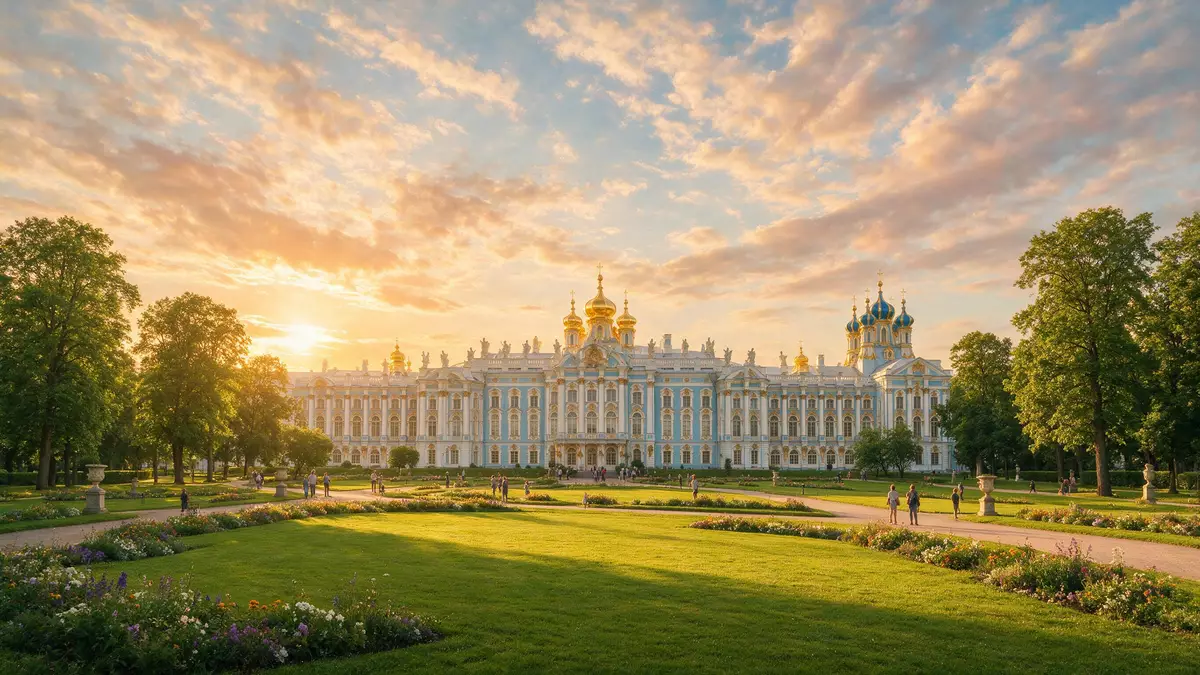
Yekaterininsky dvorets, widely known in English as the Catherine Palace, is a Rococo residence in Puschkin south of St Petersburg whose blue?and?gold Baroque façade stretches along the edge of a formal park. Built in the eighteenth century as a summer residence for the Russian imperial family, it now forms part of the Tsarskoye Selo palace and park ensemble recognised as a World Heritage Site.
The Baroque façade facing the park
The most immediately striking feature of Yekaterininsky dvorets is its long Baroque front facing the main formal park in Puschkin. The exterior runs as an elongated block articulated by a regular rhythm of projecting bays and pilasters, creating a continuous sequence of façades that reads almost like a painted backdrop along the garden side of the palace.Rococo palace in Tsarskoye Selo The walls are painted in a light blue tone, set against white architectural framing and extensive gilded ornament that picks out cornices, window surrounds and sculptural details.
This façade reached its familiar form during the reign of Empress Elizabeth in the mid?eighteenth century, when Bartolomeo Francesco Rastrelli remodelled the earlier building into a grand Baroque residence. Between the 1740s and 1750s he created a palace whose front presents a carefully ordered arrangement of windows, columns and decorative elements aligned with the park avenues.mid?eighteenth century Baroque structure The length and ornament of this façade make it one of the defining views of Puschkin, with the palace forming a backdrop to lawns, sculptures and water features laid out in front of it.
Imperial residence and architectural history
The origins of Yekaterininsky dvorets go back to the early eighteenth century, when Catherine I of Russia commissioned a summer residence at Tsarskoye Selo. Around the 1710s and 1720s, the architect Johann?Friedrich Braunstein created an initial palace building for her, giving the estate a substantial stone residence linked with the wider grounds.early eighteenth?century summer residence Later in the century the complex was enlarged and rebuilt, particularly under Empress Elizabeth, who turned it into a major Baroque palace suitable for large court gatherings.
Further changes continued under Catherine II, better known as Catherine the Great, whose long reign in the later eighteenth century left its mark on the interiors and surrounding landscape. Architects including Charles Cameron introduced neoclassical elements to some of the rooms, while Rastrelli’s sculpturally rich exterior remained a defining feature of the building.commissioning and later rebuilding The palace served for decades as a principal summer residence for the Russian tsars, with its enfilade of state rooms hosting ceremonial events and gatherings that linked the imperial court to the landscaped surroundings of Tsarskoye Selo.
Interiors, park ensemble and World Heritage status
Inside Yekaterininsky dvorets, a sequence of state rooms runs along the garden front, echoing the length of the façade with an enfilade of halls and chambers connected by aligned doorways. These rooms combine gilded decoration, painted ceilings and panelled walls in Rococo and later neoclassical styles, reflecting the tastes of eighteenth?century and early nineteenth?century architects and patrons.Rococo and neoclassical interiors Among the most renowned features is the reconstructed Amber Room, whose amber panels, mirrors and gilding form one of the palace’s emblematic interior spaces.
The palace stands at the heart of the wider Tsarskoye Selo ensemble, which combines several residences with expansive landscaped parks laid out around lakes, canals and formal gardens. This ensemble, including Yekaterininsky dvorets, is inscribed as part of the Saint Petersburg and Related Groups of Monuments World Heritage listing, reflecting its significance in Russian architectural and cultural history.World Heritage inscription and location In the twentieth century the former imperial residence was incorporated into a museum complex, and the palace interiors were restored and reopened, allowing visitors to experience the decorated halls and views across the park from its long garden front.
Visiting Yekaterininsky dvorets: what travellers from Western Europe should know
- Yekaterininsky dvorets stands in the town of Puschkin, historically known as Tsarskoye Selo, to the south of St Petersburg in Russia, and is reached by suburban trains and buses from the city.
- The palace is part of a larger park ensemble, and a visit involves walking through landscaped grounds and across broad approaches, with interior routes including staircases and extended corridors.
- The official language is Russian and the currency is the rouble.
- Entry requirements depend on your nationality; UK travellers can check the FCDO travel advice at gov.uk/foreign-travel-advice, Irish travellers the Department of Foreign Affairs at ireland.ie.
Searching for Yekaterininsky dvorets on social platforms
These links open searches for Yekaterininsky dvorets on each platform.
Frequently asked questions about Yekaterininsky dvorets
Where is Yekaterininsky dvorets located?
Yekaterininsky dvorets stands in Puschkin, historically Tsarskoye Selo, to the south of St Petersburg in Russia, as part of the Tsarskoye Selo palace and park ensemble.
What can visitors expect on a visit to the palace?
A visit centres on the long blue?and?gold Baroque façade, the enfilade of decorated state rooms including the reconstructed Amber Room, and views across the formal park landscape.
What makes Yekaterininsky dvorets distinctive among Russian palaces?
The combination of Rastrelli’s extended Baroque façade, richly gilded exterior details, Rococo and neoclassical interiors, and its role as an eighteenth?century imperial summer residence gives the palace a distinctive character within the Tsarskoye Selo ensemble.


