
Yehliu Dizhi Gongyuan and the sculpted sandstone cape of Neu-Taipeh
Published on 09/12/2026 at 14:09 | Editorial responsibility: Rafael Müller, Editor-in-Chief AD HOC NEWS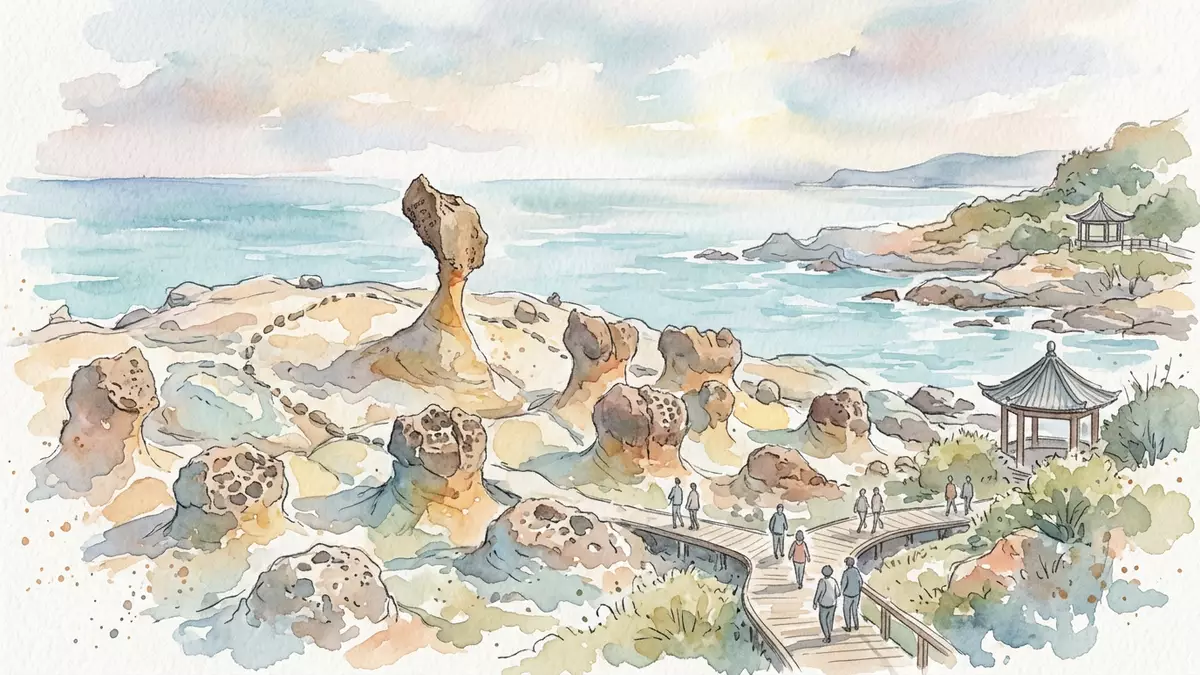
On Taiwan’s north coast in Neu-Taipeh, Yehliu Dizhi Gongyuan turns a long sandstone cape into a natural sculpture park of eroded rock, patterned platforms and restless Pacific surf. The cape, part of the Daliao Formation dating back to the Miocene epoch, projects into the ocean from the Datun Mountain range and has become one of northern Taiwan’s most recognisable coastal landscapes.Miocene Daliao Formation
A cape pushed into the Pacific
Yehliu Dizhi Gongyuan occupies the Yehliu Promontory, a narrow cape of sandstone and shale driven seaward as tectonic forces raised the Datun Volcano Group, leaving this spur reaching into the Pacific Ocean.Yehliu Promontory geology The cape extends for about 1,700 m (5,600 ft), forming a low ridge whose seaward end tapers into a series of weathered rock platforms, tide pools and sea cliffs where waves work constantly on the stone.cape of about 1,700 metres
The strata here belong to the Daliao sandstone and shale sequence, laid down in the Miocene and later lifted and tilted so that the softer beds lie beside more resistant ones.sandstone and shale sequence This contrast in hardness is crucial to the landscape: sea erosion cuts into the more fragile bands to form bays, inlets and trenches, while the tougher layers stand out as capes, ledges and stacks, giving the promontory its uneven, sculpted outline against the sea.
Mushroom rocks, hoodoos and the Queen’s Head
Within Yehliu Dizhi Gongyuan the best-known feature is the concentration of pedestal rocks, often called mushroom rocks or hoodoos, where rounded caps sit on slimmer bases like natural columns left behind by erosion.mushroom-like pedestal rocks These began as layers containing scattered concretions within the sandstone; as waves, wind, spray and sun wore away the surrounding material, harder patches remained as top-heavy forms while their stems continued to narrow, leaving the distinctive silhouettes seen across the park.concretion within sandstone
The single rock most associated with Yehliu Dizhi Gongyuan is the Queen’s Head, known locally as ???, a hoodoo whose profile recalls a woman’s head on a slender neck and which has become a symbol of the cape.Queen’s Head symbol Geological estimates place the age of the Queen’s Head at more than 4,000 years, and the neck has visibly thinned as honeycomb weathering and continued erosion nibble at its base, making it a formation watched closely by geologists and visitors alike.formation dated as old as 4,000 years
Named rocks and patterned platforms
Beyond the Queen’s Head, Yehliu Dizhi Gongyuan is divided into zones where different types of rock feature more strongly, each with formations that have acquired descriptive names over time.three sections of Yehliu One area concentrates mushroom rocks with honeycomb-textured caps above smoother pedestals, another shows blocky Tofu Rocks cut by intersecting joint sets into square blocks, while a third focuses on sea-eroded caves, potholes and seal-shaped rocks close to the breaking waves.Tofu Rocks and mushroom rocks
Differential erosion has also produced columnar formations known as Candle Rocks, and clustered Ginger Rocks whose stacked appearance recalls slices of the spice, as well as fairy-tale shapes like the Fairy Shoe that resemble a high-heeled shoe in profile.Candle Rocks and Fairy Shoe Along the platforms, giant’s kettles, tide pools and trenches show how water has carved potholes and grooves into the rock, leaving yellow sandstone patterned with pits, ridges and patches of honeycomb weathering that make the ground itself one of the park’s most striking surfaces.mushroom rocks, sea caves, tofu rocks
Visiting Yehliu Dizhi Gongyuan: what travellers from Western Europe should know
- Yehliu Dizhi Gongyuan lies on the Yehliu cape in the Wanli District of Neu-Taipeh on Taiwan’s north coast, reached by road from the greater Taipei and Keelung urban area.
- The rock platforms form uneven terrain of sandstone ledges, trenches and potholes, with sections of exposed stone and coastal steps that require sure footing in places.
- The official language is Mandarin Chinese and the currency is the New Taiwan dollar.
- Entry requirements depend on your nationality; UK travellers can check the FCDO travel advice at gov.uk/foreign-travel-advice, Irish travellers the Department of Foreign Affairs at ireland.ie.
Searching for Yehliu Dizhi Gongyuan on social platforms
These links open searches for Yehliu Dizhi Gongyuan on each platform.Frequently asked questions about Yehliu Dizhi Gongyuan
Where is Yehliu Dizhi Gongyuan located?
Yehliu Dizhi Gongyuan is on the Yehliu cape in Wanli District, Neu-Taipeh, on Taiwan’s northern coastline where the Datun Mountain range meets the Pacific Ocean.
What can visitors expect to see inside Yehliu Dizhi Gongyuan?
Visitors encounter mushroom rocks, hoodoo stones, patterned sandstone platforms, named formations such as the Queen’s Head and Fairy Shoe, and a shoreline of trenches, potholes and sea-eroded caves.
What makes Yehliu Dizhi Gongyuan distinctive among coastal landscapes?
The combination of a long Miocene sandstone cape, dense clusters of pedestal rocks, columnar Candle Rocks and the long-watched Queen’s Head formation gives Yehliu Dizhi Gongyuan a geology-focused character that is uncommon on such a compact stretch of coast.


