
Yam HaMelach: where salt water meets desert cliffs
Published on 09/23/2026 at 18:06 | Editorial responsibility: Rafael Müller, Editor-in-Chief AD HOC NEWS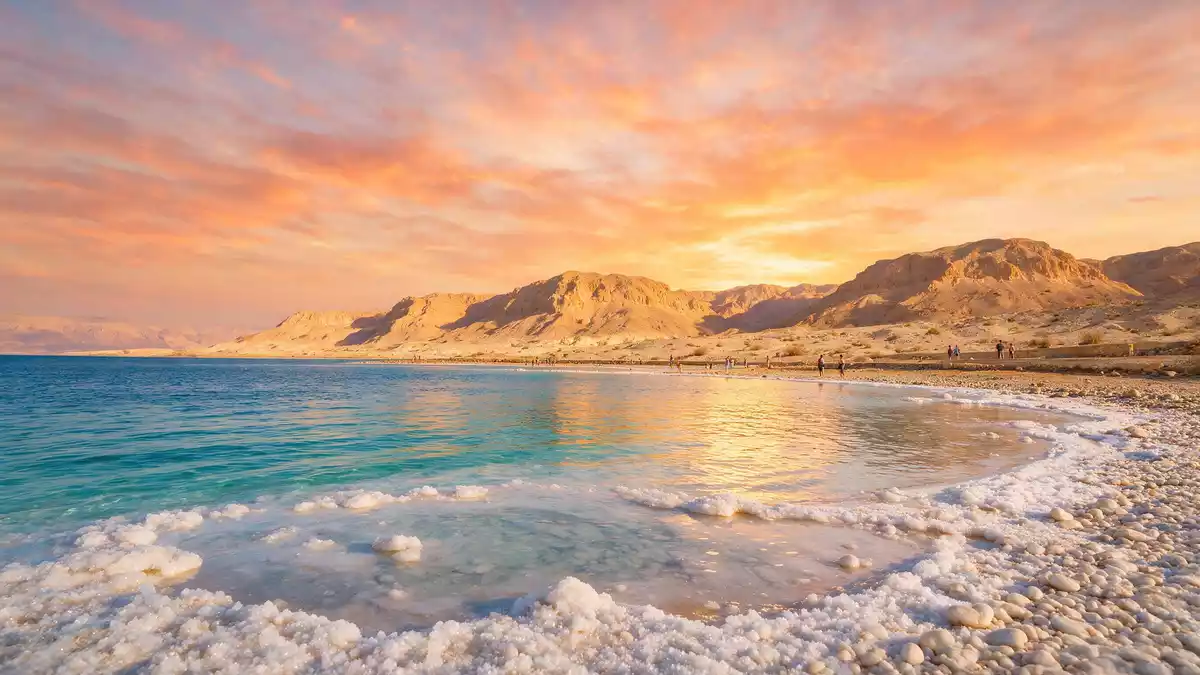
Yam HaMelach reaches En Bokek as a broad sheet of hypersaline water beneath the desert cliffs of southern Israel. The Hebrew name means “Salt Sea”, while the English name Dead Sea describes the lake’s absence of visible aquatic life. At the shore, water, mineral crusts, bare rock and resort buildings occupy a narrow landscape in the Jordan Rift Valley.
Yam HaMelach: a lake below sea level
Yam HaMelach is a landlocked salt lake between Israel and Jordan. Its basin forms part of the Jordan Rift Valley, a major geological depression extending through the region towards the Red Sea and East Africa. The Jordan River enters from the north, while the lake has no natural outlet to the ocean.
The lake’s surface lies hundreds of metres below global sea level. the Dead Sea’s elevation gives the water and its surrounding cliffs an unusual vertical setting. The southern Israeli shore at En Bokek belongs to the Judean Desert, where pale slopes rise behind a strip of hotels, roads and public beaches.
Salt, minerals and the shape of the shoreline
Yam HaMelach receives water but has no river flowing out. Desert evaporation removes water from the basin and leaves dissolved salts and minerals behind. This process gives the lake its hypersaline character, with a concentration far above that of ordinary seawater.
Salt appears along shallow edges and on exposed surfaces as pale crusts and angular deposits. Mineral-rich mud also occurs around parts of the shoreline. the lake’s saline water contains significant concentrations of magnesium, potassium, chlorine and bromine. Fish and other visible aquatic animals do not live in the water, although microscopic organisms can survive in highly saline conditions.
The water’s density supports the familiar floating experience associated with the Dead Sea. Bathers remain at the surface more easily than in ordinary seawater, but the shore itself remains a mineral landscape of salt, mud and rock. The name Yam HaMelach connects this physical character with a long history of Hebrew descriptions.
En Bokek between water, desert and history
En Bokek is a resort district on the southwestern shore of Yam HaMelach. Hotels, spa facilities, planted areas and beachfront promenades occupy the narrow zone between the water and the desert slopes. Route 90 runs along the Israeli side of the lake and connects the settlement with other places in the Dead Sea region.
The wider basin carries historical names as well as geological ones. Ancient writers used the name Salt Sea, and the lake also appears in Greek and Latin geographical traditions. Yam HaMelach’s historical names reflect its position between Judaea and the lands east of the Jordan.
Salt and bitumen from the Dead Sea basin held practical value in antiquity. Natural asphalt-like material occurred around the lake, while mineral deposits formed part of the region’s physical identity. The landscape around En Bokek therefore joins a living resort district with a lake whose names, resources and extreme elevation belong to much older geographical descriptions.
From the waterfront, the essential image remains direct: dense salt water below, dry desert rock above and a line of human settlement between them. Yam HaMelach is read through that visible contrast, with the lake’s mineral surface carrying the main character of the shore.
Visiting Yam HaMelach: what travellers from Western Europe should know
- Yam HaMelach and En Bokek lie in southern Israel’s Judean Desert on the southwestern shore. Route 90 follows the Israeli Dead Sea coast.
- En Bokek occupies a narrow strip between the lake and rising desert slopes. Public beaches, promenades and hotel areas form the settlement’s waterfront.
- The shoreline contains salt crusts, mineral mud and bare rock. The water is hypersaline, and visible aquatic animals do not live in it.
- The official language is Hebrew and the currency is the Israeli new shekel.
- Entry requirements depend on your nationality; UK travellers can check the FCDO travel advice at gov.uk/foreign-travel-advice, Irish travellers the Department of Foreign Affairs at ireland.ie.
Searching for Yam HaMelach on social platforms
These links open searches for Yam HaMelach on each platform.Frequently asked questions about Yam HaMelach
Where is Yam HaMelach?
Yam HaMelach is a landlocked salt lake in the Jordan Rift Valley. En Bokek lies on its southwestern Israeli shore in the Judean Desert.
What can visitors expect at En Bokek?
The waterfront combines hypersaline water, salt deposits, mineral mud, public beaches and resort facilities. Desert slopes rise behind the settlement.
What makes Yam HaMelach distinctive?
Its surface lies hundreds of metres below sea level, and its dense mineral water supports floating. The lake has no natural outlet and contains far more salt than ordinary seawater.


