
Yam HaMelach at En Bokek and the meeting of salt water and desert rock
Published on 09/19/2026 at 06:23 | Editorial responsibility: Rafael Müller, Editor-in-Chief AD HOC NEWS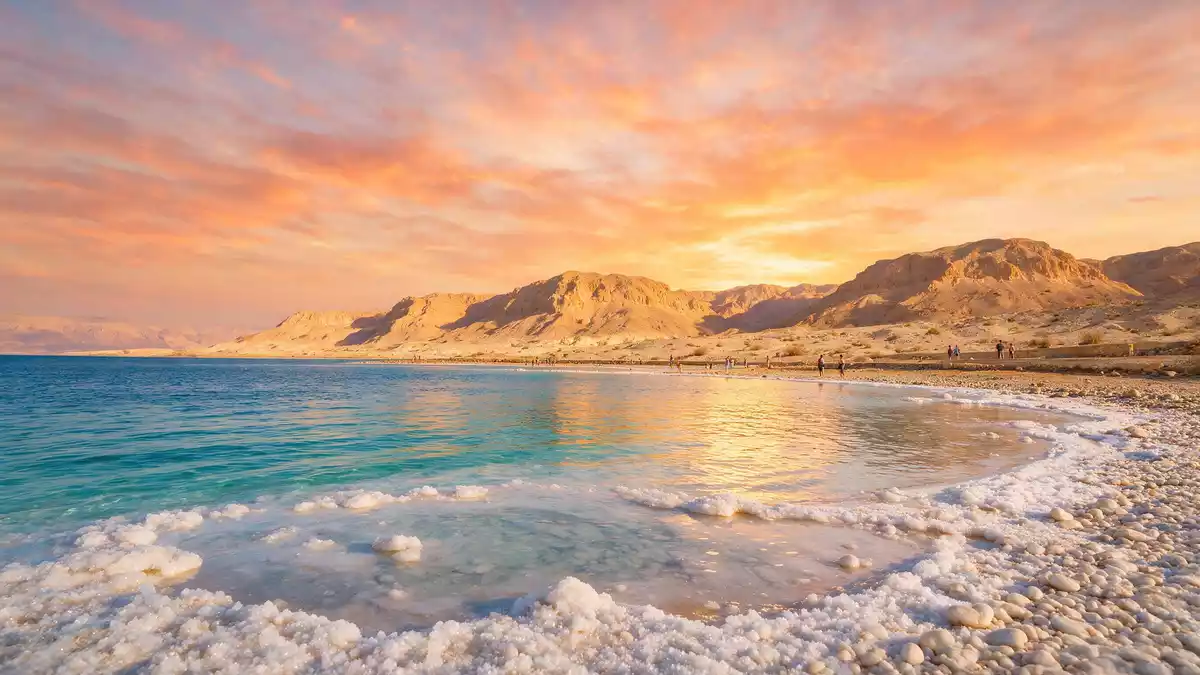
Yam HaMelach, the Hebrew name for the Dead Sea, reaches the Israeli shore at En Bokek in a striking meeting of dense salt water, resort buildings and desert cliffs in the Judean Desert. This landlocked salt lake occupies the Jordan Rift Valley between Israel, the West Bank and Jordan, and En Bokek forms a compact resort strip on its southwestern shore where the low-lying water and rising desert rock stand side by side.
Salt lake at the lowest edges of the Jordan Rift Valley
Yam HaMelach is a hypersaline lake set in the Jordan Rift Valley, bordered by Israel and the West Bank on the west and Jordan to the east, forming one of the most distinctive inland bodies of water in the region.landlocked salt lake The Hebrew term “Yam HaMelach” literally means “Salt Sea”, a name that reflects both biblical usage and the lake’s chemistry, where salinity far exceeds that of open oceans and normal aquatic life cannot survive.Salt Sea in Hebrew
In English this lake is widely known as the Dead Sea, and references in Hebrew literature also include names such as “Sea of Death”, yet the enduring term in Hebrew remains Yam HaMelach, the “Sea of Salt”.ancient Hebrew name The water surface lies at an elevation far below sea level, framed by dry desert slopes and cliffs that rise away from the shore, making the contrast between low water and higher rock a visible part of any visit along this stretch of the Jordan Rift Valley.Dead Sea description
En Bokek: resort strip between Yam HaMelach and the desert
En Bokek is a purpose-built Israeli resort district on the southern basin of Yam HaMelach, under the Tamar Regional Council, occupying a narrow band of land between the lake and the desert slopes of the Judean Desert in southern Israel.purpose-built resort strip Modern hotels form a row facing the lake, with spa facilities and beach infrastructure arranged along the shore so that the buildings stand directly opposite the broad pale water of the Dead Sea.Ein Bokek resort description
Behind this line of hotels, steep cliffs and desert hills rise, emphasising the vertical difference between the lower-than-sea-level lake surface and the higher rock faces that frame the resort district.desert cliffs behind En Bokek Public promenades and planted areas run between the buildings and the shore, creating a constructed beachfront where designated bathing areas give direct access to the shallow edge of Yam HaMelach and its mineral-rich waters.constructed beachfront at En Bokek
Salt, minerals and the sculpted shoreline
Along the shore near En Bokek the mineral content of Yam HaMelach becomes visible in pale bands of shallows and salt-encrusted edges, where crystallised deposits outline the waterline and give parts of the lake margin a textured, sculpted appearance.salt shoreline at En Bokek The southern basin of the Dead Sea, where En Bokek is located, has been heavily shaped by industrial evaporation, and large evaporation ponds connected to mineral works lie within view of the resort area, extending the geometric lines of water and salt beyond the immediate bathing beaches.evaporation ponds near En Bokek
The lake’s extreme salinity, expressed in its name as the “Salt Sea”, has long underpinned both its reputation and its practical uses, with mineral-rich mud, brine and salt harvested or used in spa treatments along this shore.Yam HaMelach definition At En Bokek these properties meet the built environment in a direct way, as hotels, promenades and public beach areas line a narrow strip between Route 90, the main Dead Sea highway, and the water, giving the resort district a clear orientation towards the lake and its salt-rich shoreline.resort between highway and lake
Visiting Yam HaMelach: what travellers from Western Europe should know
- Yam HaMelach and En Bokek lie in southern Israel’s Judean Desert on the southwestern shore of the Dead Sea, reached by road along Highway 90 from inland cities such as Jerusalem or Arad.
- The resort strip occupies a narrow band between the lake and steep desert slopes, so access from hotels to the public beaches and promenades is generally on level ground, while any approach towards the cliffs involves gradients and rocky terrain.
- The southern basin around En Bokek includes industrial evaporation ponds and mineral works areas beyond the main resort, so the immediate shoreline combines designated bathing beaches with visible infrastructure linked to Dead Sea mineral extraction.
- The official language is Hebrew and the currency is the Israeli new shekel.
- Entry requirements depend on your nationality; UK travellers can check the FCDO travel advice at gov.uk/foreign-travel-advice, Irish travellers the Department of Foreign Affairs at ireland.ie.
Searching for Yam HaMelach on social platforms
These links open searches for Yam HaMelach on each platform.
Frequently asked questions about Yam HaMelach
Where is Yam HaMelach in relation to En Bokek?
Yam HaMelach is the salt lake known as the Dead Sea, and En Bokek is a resort district on its southwestern Israeli shore in the Judean Desert.
What can visitors expect when they reach the shore at En Bokek?
Visitors encounter a constructed beachfront with hotels, promenades and designated bathing beaches along the lake, set between the pale salt water and rising desert cliffs.
What makes Yam HaMelach at En Bokek distinctive among desert landscapes?
The combination of hypersaline lake, visible mineral deposits, industrial evaporation ponds and a purpose-built resort strip pressed between water and desert rock gives this section of the Dead Sea a particularly stark character.


