
Yam HaMelach at En Bokek and the desert shore of the Dead Sea
Published on 09/14/2026 at 18:25 | Editorial responsibility: Rafael Müller, Editor-in-Chief AD HOC NEWS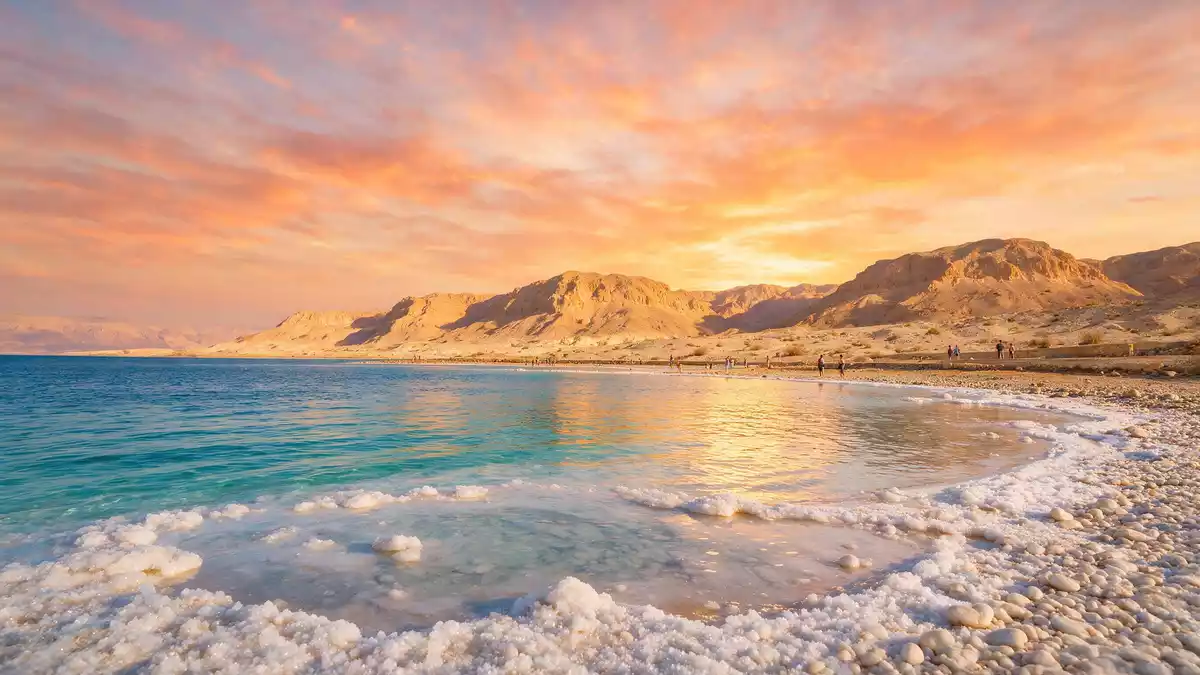
Yam HaMelach, the Hebrew name for the Dead Sea, reaches the Israeli shore at En Bokek in a striking meeting of dense salt water, resort buildings and desert rock. The lake forms the lowest large water body on land on Earth, set deep in the Jordan Rift Valley between Israel and Jordan. At En Bokek this unusual landscape is shaped into a resort strip where modern hotels line the shore and public beaches provide direct access to the mineral-rich water.
Yam HaMelach as Earth’s low salt lake
Yam HaMelach is a hypersaline lake lying in the Jordan Rift Valley, forming part of the boundary between Israel and Jordan and stretching along the Judean Desert. Its surface stands hundreds of metres below global sea level, making it one of the most extreme depressions on the planet and giving the surrounding cliffs a marked vertical contrast with the water.Dead Sea Israel The Hebrew name Yam HaMelach means “Salt Sea”, a direct reference to the lake’s exceptionally high salt content and the crystalline deposits that form along its shallow edges.Yam HaMelach (Dead Sea)
The water in Yam HaMelach contains dissolved minerals at concentrations far above those in ordinary seawater, creating a density that keeps bathers floating high on the surface. This mineral-rich composition has been used for industrial extraction of salts and for health-related products, and it underpins the long-established reputation of the area for spa and wellness facilities.commercial enterprises farming it for minerals Along many parts of the shore, white and pale grey salt formations outline the waterline, giving the lake a banded appearance where shallow mineral platforms reach under the surface.
En Bokek: resort strip on the southwestern shore
En Bokek is a purpose-built Israeli resort district on the southern basin of Yam HaMelach, in the Judean Desert region of southern Israel.Ein Bokek The settlement lies on the southwestern shore of the lake, under the Tamar Regional Council, occupying a narrow band between the water and the rising desert slopes.purpose-built hotel-and-tourism settlement Modern hotels form a row facing the Dead Sea, and a constructed beachfront with promenades and planted areas runs between these buildings and the shoreline.
The resort strip at En Bokek concentrates accommodation, spa complexes and public beaches in one walkable district along Route 90, also known as the Dead Sea Highway.Ein Bokek visitor guide Council-maintained sections such as the central public beach provide access to the lake, while hotel properties add pools, treatment centres and terraces that look across the salt water. Behind the resort, desert cliffs rise steeply, framing the linear strip of buildings and emphasising the difference between the low-lying lake surface and the higher plateau of the Judean Desert.salt water, resort hotels and desert cliffs
Water, salt and desert light at En Bokek
At En Bokek the shore of Yam HaMelach is shaped into a sequence of beaches, promenades and access points that bring visitors close to the water’s unusual properties. Sections of artificial sand are laid out near the water, and shaded structures mark areas for sitting and watching the lake, whose surface often appears glassy and pale against the stronger colours of the desert slopes.artificial sandy area with beach umbrellas In some places the shoreline shows clear mineral shelves and salt pans, adding texture to the transition between land and water.
The wider setting links En Bokek to other Dead Sea sites along the Israeli shore, including spa beaches and viewpoints, while still leaving it as a distinct resort strip with its own promenades and hotel cluster.beach at the Ein Bokek resort The combination of steep desert backdrop, extremely low elevation and visible salt formations makes Yam HaMelach at En Bokek a clear illustration of the geological setting of the Dead Sea basin as well as a developed tourism zone.
Visiting Yam HaMelach: what travellers from Western Europe should know
- Yam HaMelach and En Bokek lie in southern Israel’s Judean Desert on the southwestern shore of the Dead Sea, reached by road along Route 90, the main Dead Sea highway, from inland cities such as Jerusalem or Arad.
The resort strip forms part of the southern basin of the lake within the Tamar Regional Council area. - The terrain at En Bokek combines level promenades and beachfront areas with steep desert slopes rising immediately behind the hotels, so short walks can involve transitions from flat paved surfaces to rocky ground on nearby trails.
- En Bokek is near other Dead Sea sites including the archaeological plateau of Masada to the north and the smaller community of Neve Zohar along the same shoreline, making it a practical base for exploring this part of the Jordan Rift Valley.
- The official language is Hebrew and the currency is the Israeli new shekel.
- Entry requirements depend on your nationality; UK travellers can check the FCDO travel advice at gov.uk/foreign-travel-advice, Irish travellers the Department of Foreign Affairs at ireland.ie.
Searching for Yam HaMelach on social platforms
These links open searches for Yam HaMelach on each platform.Frequently asked questions about Yam HaMelach
Where is Yam HaMelach at En Bokek?
Yam HaMelach is the lake widely known as the Dead Sea, and En Bokek stands on its southwestern Israeli shore in the Judean Desert, on the southern basin of the lake.
What can visitors expect on a visit to En Bokek?
Visitors encounter a compact resort strip with modern hotels, promenades and public beaches giving direct access to the mineral-rich waters of Yam HaMelach, framed by steep desert cliffs.
What makes Yam HaMelach at En Bokek distinctive?
The combination of extremely low elevation, visible salt formations along the shore and the juxtaposition of dense salt water with a built resort district under desert rock makes this section of the Dead Sea unusual.


