
Xi Hu, the classical lake landscape of Hangzhou
Published on 09/18/2026 at 17:06 | Editorial responsibility: Rafael Müller, Editor-in-Chief AD HOC NEWS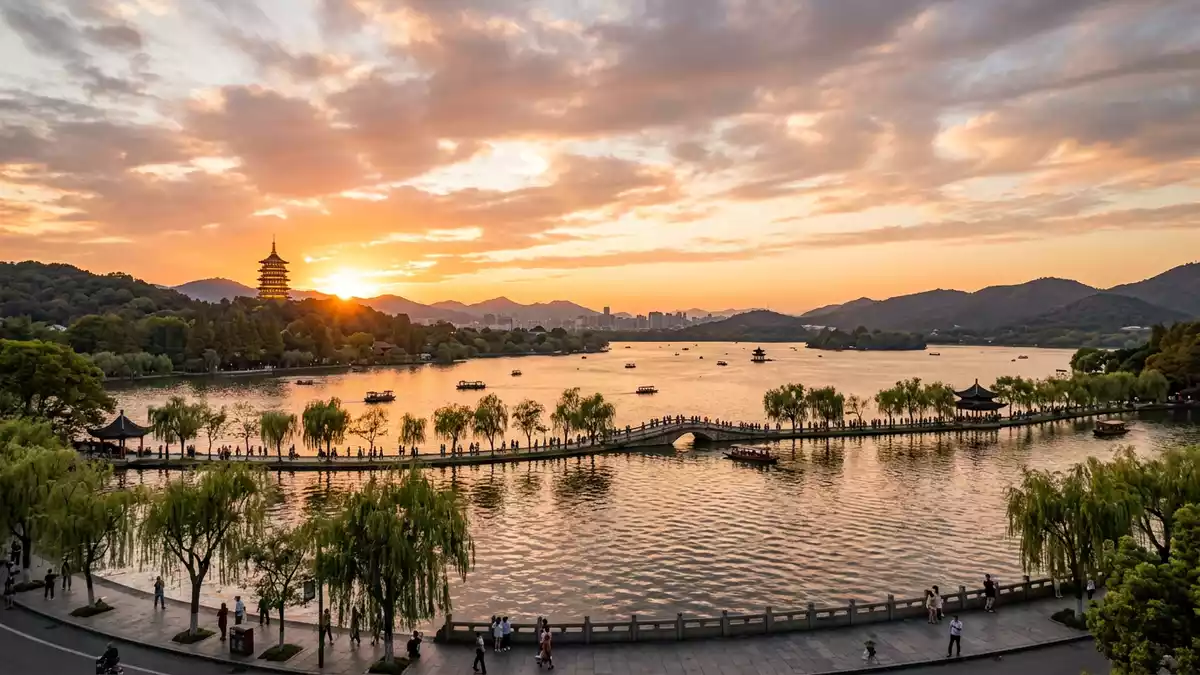
Xi Hu in Hangzhou, known in English as West Lake, is a broad freshwater lake framed by wooded hills on three sides and the urban fabric of Zhejiang’s provincial capital on the fourth. It has become a classical Chinese landscape in which water, gardens, temples and pavilions form a continuous scene rather than separate attractions, and the West Lake Cultural Landscape of Hangzhou is recognised as a World Heritage Site under UNESCO’s cultural landscape category after its inscription in 2011.
Water, hills and city in one composed landscape
Xi Hu lies in the Xihu District of Hangzhou in Zhejiang province in eastern China, immediately west of what was once the walled city, so the shoreline reads as an edge between open water and streets rather than a remote rural lake. The water surface extends across several square kilometres, with the lake stretching a few kilometres from north to south and a similar extent from east to west, giving enough scale for broad views while remaining intimate in comparison with major inland seas.freshwater lake in Hangzhou The wider West Lake Cultural Landscape comprises not only the lake but also the hills that surround it on three sides, creating a spatial relationship where peaks, slopes and waterfront sit within a single visual basin recognised in the UNESCO listing.West Lake Cultural Landscape of Hangzhou
The nominated World Heritage area covers more than 3,000 hectares, of which several hundred hectares are open water, and the rest are hillsides, gardens, causeways and islands woven together into one cultural landscape. Within this area, Xi Hu is divided into sections by broad causeways that carry paths, planting and small structures, so the experience of the lake is closely tied to crossings over the water as well as movements along the shore.nominated area and lake extent The hills that rise behind the lake are described in classical phrases as cloud-capped, and the city pressing against the remaining shore line gives Xi Hu an urban presence that has made it a reference point for garden making and landscape composition for centuries.surrounded on three sides by peaks
Causeways, islands and ten named views
Across Xi Hu, two main causeways and three artificial islands are key structural elements that organise both water and movement, and they were shaped over centuries through repeated dredging and landscape works between the ninth and twelfth centuries. The causeways divide the lake into distinct water bodies and carry avenues of trees, pavilions and viewing points, while the islands rise out of the surface as discrete garden spaces with their own compositions of buildings and planting.two causeways and three islands This pattern of causeways and islands gives the lake a sectional quality, where each reach of water and land edge can be explored from different angles.
By the thirteenth century, a set of “ten scenic views of West Lake” had been identified and named in poetic phrases that link specific locations with seasonal conditions, light and water. These views include places such as Su Causeway in the Morning of Spring, Autumn Moon over the Calm Lake and Three Pools Mirroring the Moon, each binding a shoreline, a structure or a reach of water to a particular time of year or day.ten poetically named scenic places Temples, pagodas, pavilions, gardens and ornamental trees are distributed around these scenes, so a visit to Xi Hu often becomes a sequence of short walks between named spots, each with its own framed outlook over water, hills or city.ten scenic views of West Lake
A World Heritage cultural landscape shaped over centuries
The West Lake Cultural Landscape of Hangzhou is inscribed on the UNESCO World Heritage List as a cultural property under criteria (ii), (iii) and (vi), recognising both its form and its influence on wider traditions of landscape design. The inscription records that the lake and its surroundings have inspired poets, scholars and artists since the ninth century, and that its composition of water, hills, built structures and planting has influenced garden design elsewhere in China as well as in Japan and Korea.inspired poets and scholars since the 9th century Xi Hu is therefore not only a local scenic site but also part of a lineage of designed landscapes that embody an idealised fusion of human intervention and natural forms.
The lake is described in UNESCO documentation as a cultural landscape in the sense defined by the World Heritage Convention, with the combination of causeways, islands, waterfront gardens and hillsides forming an intentional arrangement rather than a purely natural lake basin. Over the centuries, numerous temples, pagodas, halls and pavilions have been introduced around Xi Hu, along with characteristic flora, giving the shores a layered character in which religious sites, leisure gardens and working landscapes coexist.cultural landscape and World Heritage criteria In 2011 the West Lake Cultural Landscape of Hangzhou was formally inscribed on the World Heritage List, marking an international recognition of a landscape that had already held a significant place in Chinese cultural history for many centuries.inscribed on the UNESCO World Heritage List in 2011
Visiting Xi Hu: what travellers from Western Europe should know
- Xi Hu lies in Hangzhou in Zhejiang province in eastern China, with the lake reached through urban streets and waterfront promenades rather than a separate mountain access road.
- The lakeside paths and causeways involve extended walks on level ground with occasional sections of steps, while the surrounding hills rise steeply behind the shore where trails and temple approaches climb.
- The official language is Chinese and the currency is the renminbi yuan.
- Entry requirements depend on your nationality; UK travellers can check the FCDO travel advice at gov.uk/foreign-travel-advice, Irish travellers the Department of Foreign Affairs at ireland.ie.
Searching for Xi Hu on social platforms
These links open searches for Xi Hu on each platform.
Frequently asked questions about Xi Hu
Where is Xi Hu located?
Xi Hu is in the Xihu District of Hangzhou in Zhejiang province in eastern China, immediately west of the historic urban core along the city’s waterfront.
What should visitors expect when exploring Xi Hu?
Visitors encounter an extensive freshwater lake divided by causeways, with garden landscapes, temples, pagodas and pavilions distributed around the shore and the surrounding hills rising behind the water.
What makes Xi Hu distinctive among lakes?
Xi Hu forms the core of the West Lake Cultural Landscape of Hangzhou, a UNESCO World Heritage cultural landscape where water, hills, gardens and built structures have been composed together and celebrated since at least the ninth century.


