
Xi Hu and the layered landscape of Hangzhou
Published on 09/07/2026 at 10:35 | Editorial responsibility: Rafael Müller, Editor-in-Chief AD HOC NEWS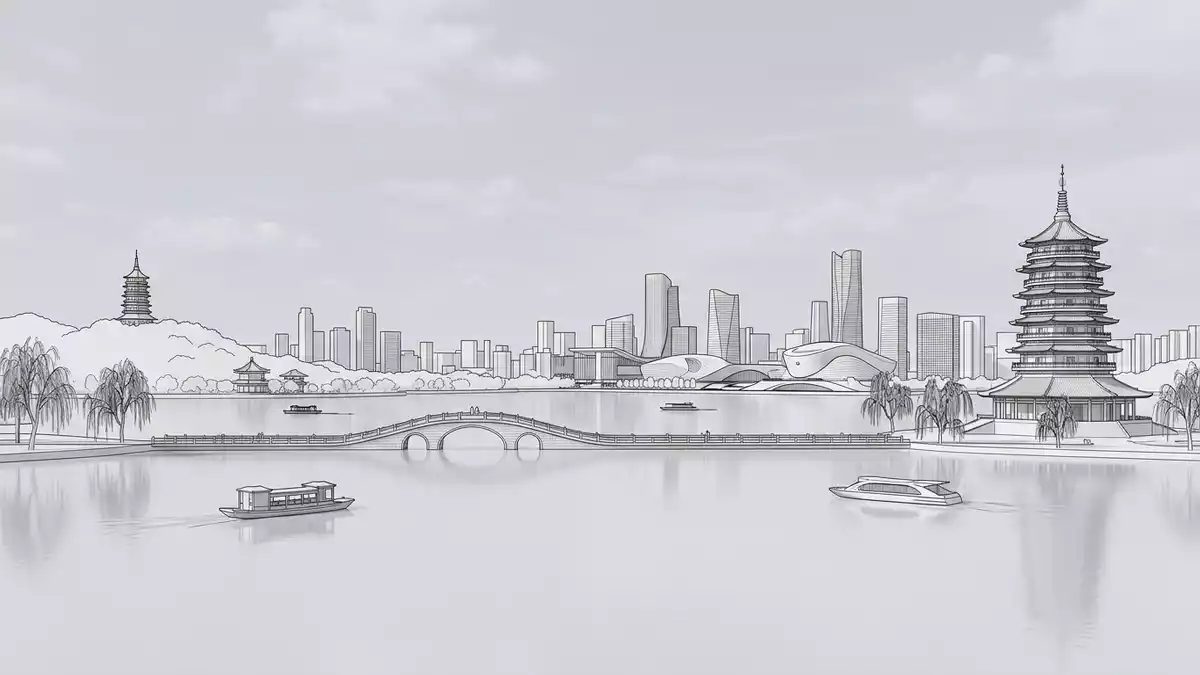
Xi Hu in Hangzhou is the lake known in English as West Lake, and it forms part of the West Lake Cultural Landscape of Hangzhou, inscribed on the UNESCO World Heritage List in 2011West Lake Cultural Landscape. The setting combines water, hills and built landscape in a composition that has shaped Hangzhou’s identity for centuriesshaped Hangzhou’s identity.
Lake, hills and causeways at Xi Hu
The place is read in layers: open water, wooded slopes and long lines of stone and earth across the surfaceopen water. West Lake is framed by hills on three sides, while the city lies along the remaining side, creating a clear edge between urban Hangzhou and the lake landscapeframed by hills.
The UNESCO description places Xi Hu within a broader cultural landscape, not as a single isolated lake. That wider designation includes temples, pavilions, gardens, pagodas, causeways and artificial islands, all part of the historical composition around the watercultural landscape.
Poetic places around the water
West Lake is associated with a long artistic tradition, and the UNESCO record notes that poets, scholars and artists have been inspired here since the ninth centurysince the ninth century. The lake also appears in a set of named scenic views that belong to Hangzhou’s cultural memory, including causeways, pagodas and water views with literary titlesnamed scenic views.
The landscape’s formal recognition rests on more than scenery alone. Its recorded area, 3,322.88 ha, underlines the scale of the protected composition around the lake, hills and historic features3,322.88 ha.
Xi Hu as a cultural landscape
Xi Hu is not a single monument but a stitched-together setting of water, land and structures. That combination is what gives the place its distinctive character in Hangzhou, where the lake, the hills and the built edges remain legible as separate parts of one landscapelake and the hills.
The historic weight of the place comes from this repeated relationship between nature and human work. Causeways, islands, pagodas and gardens sit within a lake setting that has been preserved as a cultural landscape rather than treated as scenery alonecultural landscape.
Visiting Xi Hu: what travellers from Western Europe should know
- Xi Hu lies in Hangzhou, Zhejiang, in eastern China. The lakeside landscape is reached through the city rather than by a separate rural access route.
- The terrain combines open water, causeways and wooded slopes. That mix gives the place long edges, broad views and multiple waterfront paths.
- The protected landscape includes temples, pagodas, gardens and artificial islands. Those elements are spread around the lake rather than gathered into one enclosed complex.
- Hangzhou is the city named in the UNESCO title for the site. The official language is Chinese and the currency is the Chinese yuan.
Searching for Xi Hu on social platforms
These links open searches for Xi Hu on each platform.
Frequently asked questions about Xi Hu
Where is Xi Hu?
Xi Hu is in Hangzhou, in Zhejiang, eastern China. It is the lake known in English as West Lake.
What does a visit involve?
The landscape combines water, causeways, hills and built features. The setting is spread around the lake, so it reads as a linked ensemble rather than a single object.
What makes Xi Hu distinctive?
The lake is part of a UNESCO cultural landscape, and the designation includes the surrounding hills and historic elements. The combination of water, architecture and planted scenery defines its character.


