
Xcaret’s rivers, ruins and coastline near Playa del Carmen
Published on 09/10/2026 at 06:28 | Editorial responsibility: Rafael Müller, Editor-in-Chief AD HOC NEWS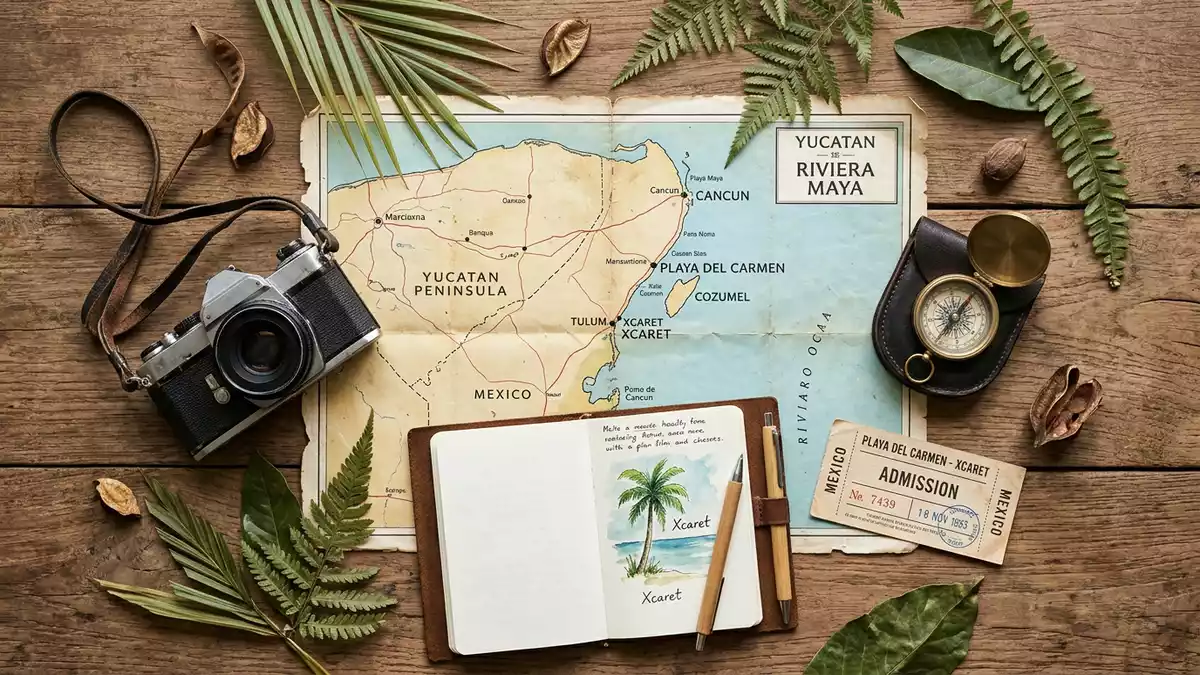
Xcaret on the Riviera Maya coast of eastern Mexico is an eco?archaeological park where underground rivers, traces of Maya settlement and Caribbean shoreline share the same stretch of limestone landscape. Set just south of Playa del Carmen in the state of Quintana Roo, the park in its present form dates back to December 1990, when architect Miguel Quintana Pali and the Constandse brothers opened the first phase to visitors.
Limestone coast shaped into an eco?archaeological park
Xcaret occupies a tract of coastal jungle, rock and inlet along the Caribbean shore of the Yucatán Peninsula. Much of the site sits on porous limestone, a rock that has allowed water to carve caves and channels which appear in the park as cenotes and underground rivers. Over time the property expanded to cover around 81 hectares (about 200 acres), creating a continuous parkland that links forest, shoreline and heritage structures along the Quintana Roo coast.covers about 81 hectares The coastal location places Xcaret within the tourism corridor between Cancún and Tulum, with the entrance reached along the Chetúmal–Puerto Juárez highway south of Playa del Carmen.south of Playa del Carmen along the Chetúmal–Puerto Juárez road
The modern park grew around an earlier Maya settlement known as Xcaret, a coastal site whose remains still stand within the grounds. Visitors walking the paths encounter low stone platforms and walls alongside more conspicuous modern structures, a reminder that pre?Columbian builders once occupied the same limestone ridge. The combination of archaeological remains and landscaped features led to Xcaret being described as an eco?archaeological park, a term that reflects its blend of nature trails, wildlife areas and preserved ruins.eco?archaeological park near Playa del Carmen
Underground rivers, inlets and wildlife exhibits
One of the defining experiences at Xcaret is the network of underground rivers that thread through the property. These watercourses are partly enclosed by rock and partly open to the sky, forming channels where visitors can float between limestone walls and vegetation. The rivers connect with an inlet on the Caribbean coast, a sheltered stretch of water where the sea meets the land and where swimming areas and viewpoints line the edge.built around a protected inlet on the Riviera Maya Inland, paths cross jungle clearings and lead to pavilions devoted to butterflies, sea turtles and other species native to Mexico’s varied ecosystems.aviary, coral?reef aquarium, butterfly pavilion and habitats for sea turtles and jaguars
The park’s layout mixes open trails with more enclosed spaces. There is an aviary where visitors move through tall mesh structures planted with trees, a coral?reef aquarium displaying marine life from the Caribbean, and areas dedicated to jaguars and other mammals. Elsewhere a small cemetery modelled on Mexican folk traditions rises in tiers, and a recreated Maya village combines traditional?style buildings with craft demonstrations. A rotating scenic tower offers an aerial view over the grounds, the forest canopy and the nearby coast, underlining the scale of the site and its position between jungle and sea.privately operated eco?archaeological park combining outdoor adventure, wildlife exhibits and preserved ruins
Maya remains and Mexican cultural performances
Xcaret is named after the nearby archaeological site, and portions of that pre?Hispanic settlement lie within the park’s boundaries. The ruins include platforms and walls built in stone, set among trees and modern paths. Their presence connects the contemporary attractions with Maya history on the Yucatán coast, where coastal settlements linked inland communities with maritime routes across the Caribbean.named after the archaeological site Xcaret Alongside the ruins, Xcaret contains a hacienda?style building and spaces that showcase Mexican crafts, food and regional traditions.
As daylight fades, attention centres on “Xcaret México Espectacular”, a large?scale evening performance in an arena within the park. The show brings together music, dance and costumed storytelling to trace episodes from Mexican history, from Indigenous cultures to more recent periods.large?scale evening show tracing Mexican music, dance and history The combination of archaeological remains, recreated village scenes and stage productions means a visit to Xcaret encompasses both quiet walks past stone structures and high?energy performances involving hundreds of artists.
Visiting Xcaret: what travellers from Western Europe should know
- Xcaret lies on the Riviera Maya coast of Quintana Roo, south of Playa del Carmen along the Chetúmal–Puerto Juárez highway in eastern Mexico. Road access is signposted near kilometre marker 282 on the route towards Tulum.
- Inside the park many paths are on uneven limestone and compacted earth, and several underground river routes involve walking along damp surfaces and using steps to reach entry and exit points.
- Xcaret is beside the Caribbean Sea, with swimming areas in the inlet and rivers; shore sections combine sandy patches with rocky edges rather than a continuous beach.
- The official language is Spanish and the currency is the Mexican peso. Entry requirements depend on your nationality; UK travellers can check the FCDO travel advice at gov.uk/foreign-travel-advice, Irish travellers the Department of Foreign Affairs at ireland.ie.
Searching for Xcaret on social platforms
These links open searches for Xcaret on each platform.Frequently asked questions about Xcaret
Where is Xcaret and how is it situated in relation to Playa del Carmen?
Xcaret is on the Riviera Maya coast in the Mexican state of Quintana Roo, a short distance south of Playa del Carmen along the Chetúmal–Puerto Juárez highway.
What should visitors expect during a day at Xcaret?
A visit to Xcaret involves walking through jungle paths and archaeological areas, swimming or floating in underground rivers and inlets, and attending Mexican cultural performances in the evening.
What makes Xcaret distinctive among coastal parks in Mexico?
Xcaret stands out for its combination of cenote?fed underground rivers, wildlife exhibits and preserved Maya remains within a single coastal park, alongside a large?scale Mexican history show.


