
Wuyi Shan’s red cliffs and tea valleys in Nanping
Published on 08/20/2026 at 19:39 | Editorial responsibility: Rafael Müller, Editor-in-Chief AD HOC NEWS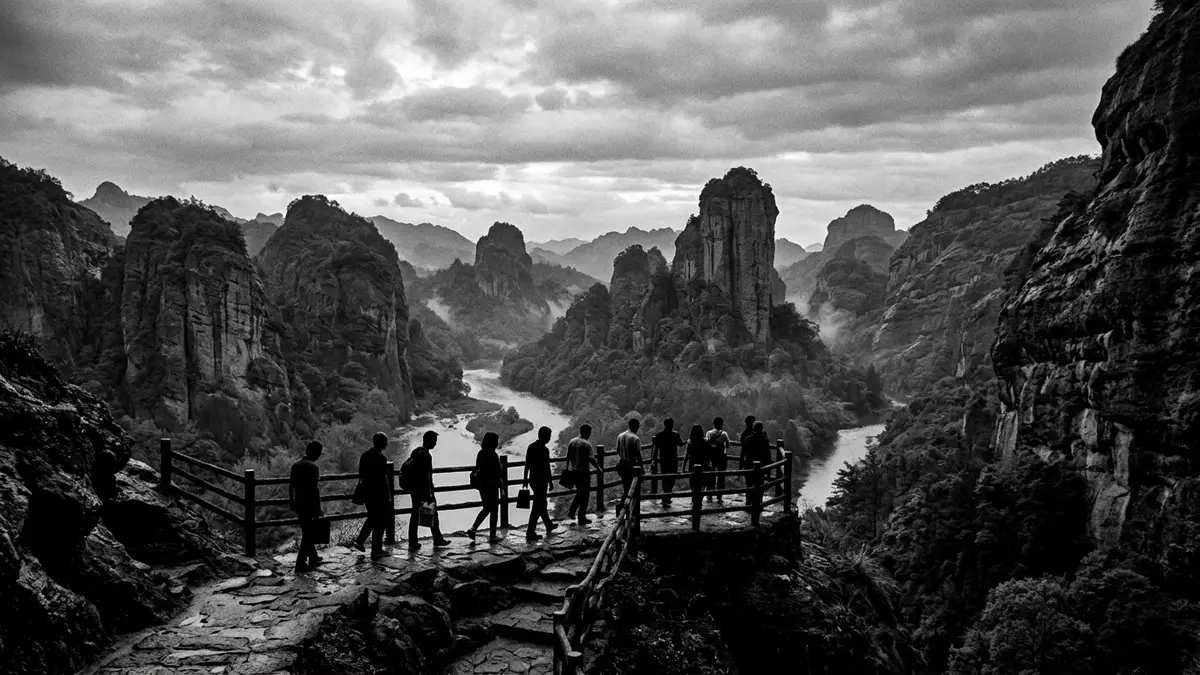
Seen from a bamboo raft or a cliff path, Wuyi Shan in Nanping is a mountain landscape of red sandstone walls, deep river bends and tea gardens tucked into narrow valleys. Set in northern Fujian in south-east China, it is recognised by UNESCO as a World Heritage site for its combined natural and cultural significance at the end of the twentieth century, anchoring both biodiversity conservation and long-established tea traditions in one protected area.
Danxia cliffs and the Nine Bend River
Wuyi Shan forms part of the Wuyi Mountains, a range of tilted sandstone and conglomerate rock that rises in northern Fujian near the border with Jiangxi. The terrain is marked by steep cliffs and gorges cut into the reddish rock, creating a classic Danxia landform with flat-topped heights and sheer faces above forested slopes and watercourses.Wuyi Mountains
Through the centre of this landscape runs the Nine Bend River, also known as Jiuqu Xi, a winding stream that threads between sandstone walls and low wooded hills. Its successive curves frame isolated peaks and promontories, so that each turn reveals another group of cliffs rising above the water. The ecological protection area around the Nine Bend River covers tens of thousands of hectares within the broader protected zone, combining river scenery with forest habitats and scattered cultural sites.Nine Bend Stream Ecological Protection Area
A dual World Heritage landscape
Mount Wuyi holds the unusual distinction of being inscribed on the UNESCO World Heritage List for both natural and cultural values in the same nomination. The listing, confirmed in 1999, recognises the area as a major refuge for species of the Chinese subtropical forest and South Chinese rainforest, with intact forest blocks and a high concentration of endemic plants.Mount Wuyi World Heritage listing
The designated World Heritage property extends over almost 100,000 ha, divided into several zones that reflect different emphases within the landscape. These include the Wuyi Shan National Nature Reserve to the east, focused on forest conservation; the Nine Bend River ecological zone; and a national scenic area to the west that brings together dramatic rock formations, river scenery and the most accessible tea cultivation territories near Wuyishan city.division into protection zones
Rock tea gardens and cultural layers
Along the cliffs and in narrow canyons carved by the Nine Bend River, Wuyi Shan is closely associated with Wuyi rock tea, known in Chinese as yan cha. The tea gardens occupy ledges, slopes and valley floors where mineral-rich rock and subtropical climate support oolong cultivars that have been cultivated and processed for generations.yan cha rock tea
Within the protected area, the traditional core cultivation zone for these teas is sometimes referred to as zhengyan or “original rocks”, corresponding closely to the national scenic area in the western part of the range. Here, shrubs of cultivars such as Shuixian and Rougui line terraces and pockets of soil between cliffs, forming a mosaic of tea plots under the surrounding walls. The wider World Heritage landscape also holds archaeological remains linked to the Han dynasty and early Confucian scholarship, adding historical depth to a terrain shaped by both ecology and long-running cultivation.origin of black and oolong teas
Visiting Wuyi Shan: what travellers from Western Europe should know
- Wuyi Shan lies in northern Fujian province in south-east China, within the prefecture-level city of Nanping. It is reached by transport links to Wuyishan city and onward access to the scenic and conservation areas.
- Within the protected landscape, approaches to viewpoints and cliff paths involve stairways, stone steps and uneven ground, and some sections follow narrow routes above the river.
- The broader area includes forested hills and river valleys, so weather conditions and visibility can change between lower paths along the water and higher vantage points on the sandstone heights.
- The official language is Chinese and the currency is the renminbi (yuan).
- Entry requirements depend on your nationality; UK travellers can check the FCDO travel advice at gov.uk/foreign-travel-advice, Irish travellers the Department of Foreign Affairs at ireland.ie.
Searching for Wuyi Shan on social platforms
These links open searches for Wuyi Shan on each platform.
Frequently asked questions about Wuyi Shan
Where is Wuyi Shan and what kind of place is it?
Wuyi Shan is a mountain range in the prefecture of Nanping in northern Fujian, south-east China, combining river gorges, forest and sandstone cliffs within a protected landscape.
What can visitors expect on a visit to Wuyi Shan?
Visitors encounter cliff-lined river bends, forested hills and tea gardens in narrow valleys, with paths and stairways leading to vantage points over the Danxia terrain.
What makes Wuyi Shan distinctive among China’s mountain landscapes?
Its combination of red sandstone cliffs, the winding Nine Bend River, extensive subtropical forest and long-established rock tea cultivation under a dual natural and cultural World Heritage listing gives Wuyi Shan a particular character.


