
Windsor Castle and its layered royal fortress townscape
Published on 09/01/2026 at 13:13 | Editorial responsibility: Rafael Müller, Editor-in-Chief AD HOC NEWS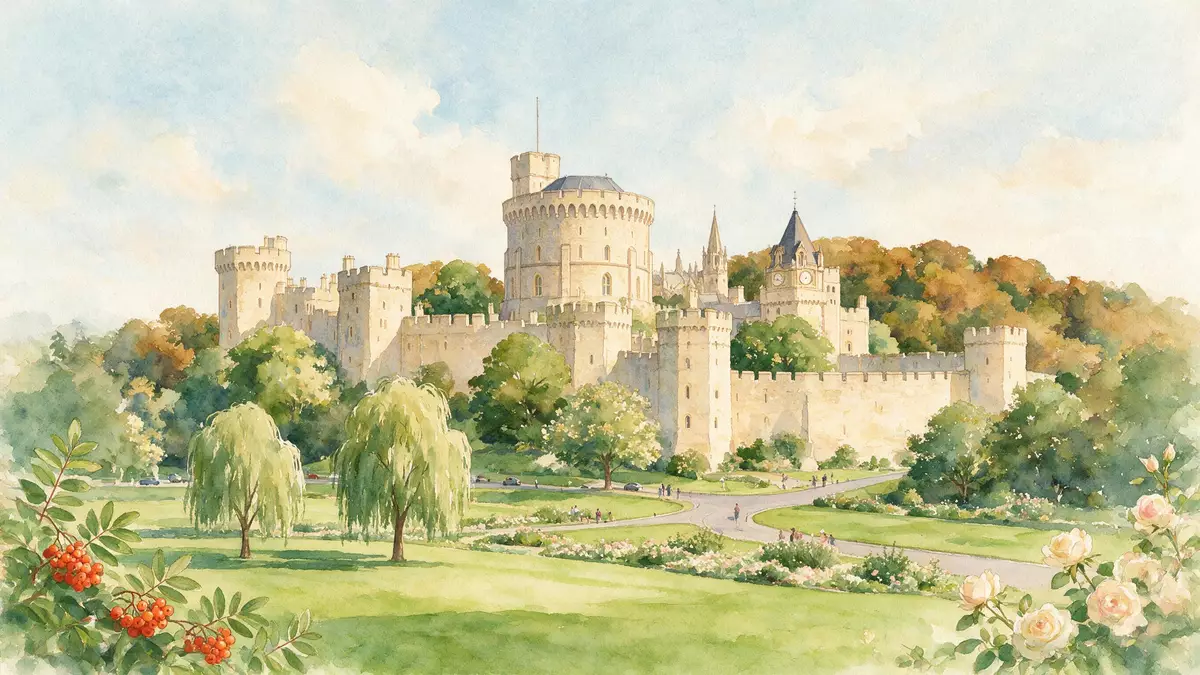
Windsor Castle dominates the skyline of Windsor in England, a fortified royal residence whose wards, towers and chapel together trace nearly a thousand years of architectural change.
A Norman stronghold above the Thames
The story of Windsor Castle begins in the eleventh century, when William the Conqueror established a motte-and-bailey fortress on a chalk promontory overlooking the River Thames west of London.William the Conqueror began building there around 1070 and the early castle took shape as a timber stockade around an artificial mound, with enclosed baileys spreading out across the hill.It was conceived as a mount and bailey castle of the first rank rather than a palace, guarding approaches to the capital and controlling the Thames Valley.
Over the twelfth century the timber fortifications gave way to stone, a transformation associated with Henry II, who rebuilt the keep and extended masonry walls around the wards.The motte-and-bailey layout evolved into a stone castle with a prominent Round Tower set on the central mound and outer curtain walls defining distinct upper and lower wards on the slopes below.By the thirteenth century chapels and additional towers had been added within these enclosures, turning a military stronghold into a complex of fortified courts and buildings.
From fortress to Gothic palace
In the fourteenth century Windsor Castle began to take on a more recognisably palatial character under Edward III, whose long reign saw extensive work on the upper ward and the royal apartments.Edward III is associated with the conversion of Windsor from fortification to Gothic palace, with stone chambers, halls and staircases replacing many of the earlier defensive structures around the keep.He also established the Order of the Garter at Windsor around 1348, embedding chivalric ritual into the fabric of the castle and tying its upper ward closely to court ceremony.
The spiritual and ceremonial centre of this palatial ensemble developed further in the late fifteenth and early sixteenth centuries with the construction of St George’s Chapel.A royal chapel at Windsor became the home of the Order of the Garter, and the stone vaulting and choir stalls added in the later fifteenth century created one of the most refined examples of Perpendicular Gothic architecture in England.The chapel later became the burial place of monarchs including Henry VIII and Elizabeth II, making the lower ward both a place of worship and a dynastic mausoleum.
A working palace shaped by later dynasties
Successive rulers continued to remodel Windsor Castle, overlaying medieval structures with Georgian and Victorian interpretations of grandeur while keeping its role as a royal residence intact.George IV heightened the Round Tower and added further masonry towers and battlements in the nineteenth century, giving the castle its familiar skyline above Windsor and reinforcing its image as a romanticised fortress.Over nearly 1,000 years the castle has been inhabited continuously and altered by monarchs, yet the basic division into upper, middle and lower wards still reflects its Norman origins.
These later dynasties also reshaped the interiors to suit court life and state occasions, rebuilding apartments for Charles II after the English Civil War and remodelling reception rooms in the Georgian period for formal visits and diplomatic hospitality.Residential suites in the upper ward were repeatedly reconstructed for monarchs and guests, while St George’s Hall in the lower ward provided a setting for Garter ceremonies that linked architecture, heraldry and spectacle.The castle has also served at times as a prison, wartime refuge and place of royal burial, reinforcing its status as a working palace woven into the institutional life of the monarchy.
Visiting Windsor Castle: what travellers from Western Europe should know
- Windsor Castle stands in Windsor in Berkshire, west of central London, and is reached from the town’s railway stations and local roads that climb towards the castle hill.
- Within the grounds, routes between the wards include gradients and flights of steps, and access to towers or viewing points involves staircases in historic masonry.
- The castle rises above the Thames and the urban streets of Windsor, so moving between the town and the entrances involves walking uphill and navigating cobbled or paved surfaces.
- English is the official language and the currency is the pound sterling.
Searching for Windsor Castle on social platforms
These links open searches for Windsor Castle on each platform.Frequently asked questions about Windsor Castle
Where is Windsor Castle?
Windsor Castle stands above the town of Windsor in Berkshire in southern England, on a hill rising from the north bank of the River Thames.
What should visitors expect inside the castle?
Visitors encounter a sequence of wards with stone walls, towers, royal apartments and St George’s Chapel, all arranged on sloping ground within a fortified perimeter.
What makes Windsor Castle distinctive among royal residences?
Its long history as an inhabited fortress, with a Norman motte, Gothic chapel and later Georgian and Victorian interventions on one hilltop site, gives the castle a layered character.


