
Windsor Castle and its layered royal fabric
Published on 08/21/2026 at 14:43 | Editorial responsibility: Rafael Müller, Editor-in-Chief AD HOC NEWS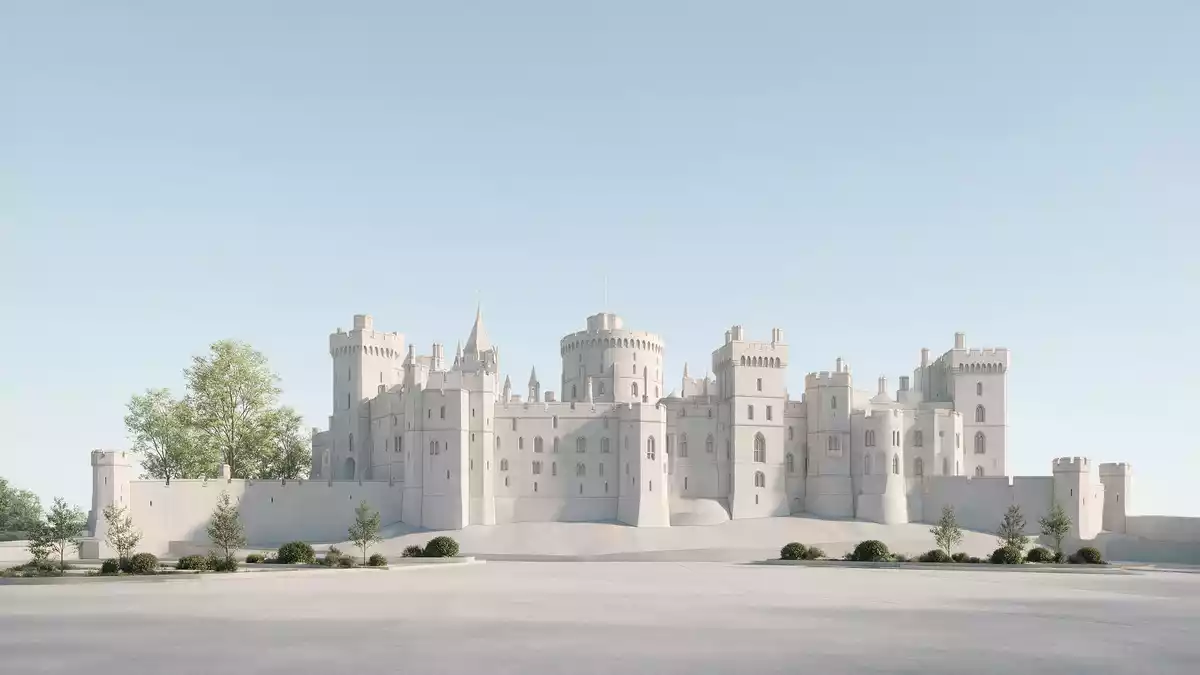
Windsor Castle in Windsor combines a Norman fortress with a royal residence, and the contrast is visible across its walls, towers and chapel buildings. Founded by William the Conqueror in the eleventh century, it remains one of Britain’s most familiar royal places and a building shaped by long use rather than one fixed form.
From William the Conqueror to the present royal residence
The castle’s origins lie in the reign of William I, who began work around 1070 on a defensive site above the Thames. The present complex grew through later centuries, but the earliest identity still reads in the scale of the mound, the stone outer lines and the concentration of buildings within the enclosure.William the Conqueror
That early foundation gives the place its historical depth, while later royal occupation gives it a different rhythm from an ordinary medieval fortification. The Royal Collection Trust describes it as a royal home and fortress of more than 900 years, and that pairing of household and stronghold remains the clearest way to read the site.royal home and fortress
St George’s Chapel inside the castle walls
Inside the castle stands St George’s Chapel, a major Gothic building linked to Edward III and the Order of the Garter. Its long stone body, vaulted interior and collegiate setting give the castle a religious dimension that sits beside its state rooms and military origins.St George’s Chapel
The chapel also changes the visitor’s sense of scale, because the castle is not just a residence or a fortification but a setting for ceremony, burial and dynastic memory. Edward III’s foundation in 1348 is a fixed anchor in the castle’s story, and the chapel’s later enlargement under Edward IV adds another clear historical layer.Edward III’s foundation
Stone, towers and the long royal footprint
The place is most striking for its mix of stone enclosure, raised approach, towers and sequential additions from different periods. That accumulated character makes the castle read as a working royal site that has absorbed medieval, later medieval and post-medieval layers without losing its fortress outline.
Because the site is spread across high ground and enclosed wards, the architecture is best understood as a sequence of spaces rather than a single façade. The effect is one of layered authority: defensive form on the outside, royal rooms and chapel spaces within, and a historical record visible in the masonry itself.stone Round Tower
Visiting Windsor Castle: what travellers from Western Europe should know
- The castle stands in Windsor, west of central London. Windsor & Eton Central and Windsor & Eton Riverside are the rail stations used for access to the town.
- The castle occupies raised ground above the Thames, and the approach includes slopes and enclosure walls. Parts of the visit involve paved surfaces and stairways.
- St George’s Chapel lies within the castle precincts. The castle, the chapel and the surrounding royal buildings form one historic complex.
- The site is in England, where English is the official language. The currency is the pound sterling.
Searching for Windsor Castle on social platforms
These links open searches for Windsor Castle on each platform.
Frequently asked questions about Windsor Castle
Where is Windsor Castle?
Windsor Castle stands in Windsor, in Berkshire, west of London. It overlooks the Thames from a raised site on the edge of the town.
What does a visit involve?
A visit brings together royal state rooms, the fortress setting and St George’s Chapel. The walk through the site moves between enclosed courtyards, stone buildings and chapel spaces.
What makes Windsor Castle distinctive?
Its distinction lies in the combination of medieval origin, continuous royal use and the presence of St George’s Chapel inside the castle. The result is a place that reads as both palace and fortress.


