
Whitehaven Beach and the cool white sands of the Whitsundays
Published on 09/01/2026 at 11:10 | Editorial responsibility: Rafael Müller, Editor-in-Chief AD HOC NEWS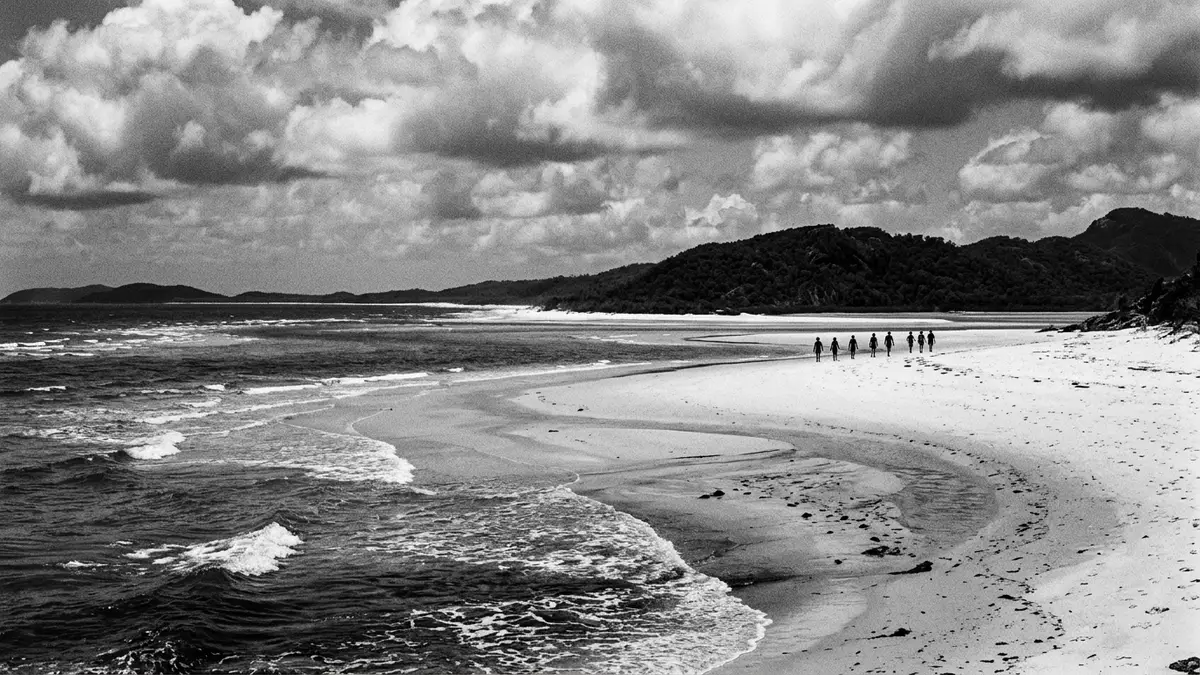
On the eastern shore of Whitsunday Island in Australia’s Whitsundays, Whitehaven Beach is a long sweep of pale sand and shallow sea where geology and seascape meet in a remarkably pure form. Its stretch of bright silica sand, protected within Whitsunday Islands National Park and the wider Great Barrier Reef Marine Park, has become a reference point for how a tropical beach can look when left largely to wind, tide and light.
A long arc of silica sand and shallow water
Whitehaven Beach runs for about seven kilometres (4.3 miles) along the south-eastern side of Whitsunday Island, facing the Coral Sea and the smaller Haslewood Island across the channel.This seven-kilometre length gives the beach an elongated, gentle curve rather than a compact bay, so the horizon opens out and the line of surf stays low and regular.
The sand here is remarkable for its composition: multiple geological and tourism sources describe it as being around 98–99% silica, a concentration far higher than at many other coastal sands in Queensland.The description of 98% pure silica sand appears repeatedly, while some technical notes put the figure slightly higher.One guide cites 98.9% silica as the share. This high silica content gives the beach its intense whiteness and a fine, almost powder-like grain.
National park protection on Whitsunday Island
Whitsunday Island is the largest of the roughly seventy-four islands in the Whitsundays off the central Queensland coast, and almost all of it forms part of Whitsunday Islands National Park.Whitehaven sits on the eastern shore of this island, and the beach itself lies inside both the national park and the Great Barrier Reef Marine Park. This dual status has practical consequences: permanent buildings are absent from the sand, and activities such as sand removal, littering and certain types of fishing are prohibited under marine park rules.Park regulations explicitly restrict sand removal and rubbish.
Because the beach lies offshore, about 25–30 km (15.5–18.6 miles) east of Airlie Beach on the mainland, there is no road access.Queensland Parks describes the day-use area as 25 km east of Airlie Beach within the national park. Travellers arrive by sea or air with operators running small motor vessels, larger day boats, sailing catamarans, seaplanes and helicopters from Airlie Beach and from resort islands such as Hamilton Island, Daydream Island and Hayman Island.
Textures, colours and nearby viewpoints
On the ground, Whitehaven Beach presents a series of bands. Closest to the tree line, the silica sand rises into low ridges and shallow swales where vegetation reaches towards the shore. Further down, the sand flattens and hardens near the tide mark, forming a firm walking surface broken by traces of each receding wave. In the shallows the water is clear, picking up pale blue and turquoise tones where the light reflects from the bright seabed described in travel accounts.Writers repeatedly refer to crystal-clear turquoise water along this beach.
At the northern end of Whitehaven Beach, tidal flows carve swirling patterns through an area known as Hill Inlet, where channels of deeper blue water snake between sandbars and shallows.Tourism Whitsundays identifies Hill Inlet as a key viewpoint overlooking these shifting forms. Several short walking tracks lead from landing points to lookouts above the inlet, giving a raised view of the beach’s northern curve and the contrast between bright sand and patterned sea.
Visiting Whitehaven Beach: what travellers from Western Europe should know
- Whitehaven Beach lies on the eastern side of Whitsunday Island in Queensland, reached mainly by boat, seaplane or helicopter from Airlie Beach and nearby resort islands.
- The beach consists of fine silica sand along a long, open shore, with access from small vessels onto the sand and short walking tracks rising into low forest and to Hill Inlet lookouts.
- The official language is English and the currency is the Australian dollar.
- Entry requirements depend on your nationality; UK travellers can check the FCDO travel advice at gov.uk/foreign-travel-advice, Irish travellers the Department of Foreign Affairs at ireland.ie.
Searching for Whitehaven Beach on social platforms
These links open searches for Whitehaven Beach on each platform.Frequently asked questions about Whitehaven Beach
Where is Whitehaven Beach?
Whitehaven Beach is on the south-eastern side of Whitsunday Island in Queensland, Australia, within Whitsunday Islands National Park offshore from Airlie Beach.
What can travellers expect on a visit?
Travellers step ashore onto fine white silica sand along a long, undeveloped shore, with shallow clear water and short walking tracks to forested areas and inlet lookouts.
What makes Whitehaven Beach distinctive?
The beach’s unusually pure silica sand, its seven-kilometre length on an island protected as national and marine park, and the tidal patterns of Hill Inlet combine into a distinctive coastal landscape.


