
Whitehaven Beach and its long arc of white silica sand
Published on 09/21/2026 at 23:16 | Editorial responsibility: Rafael Müller, Editor-in-Chief AD HOC NEWS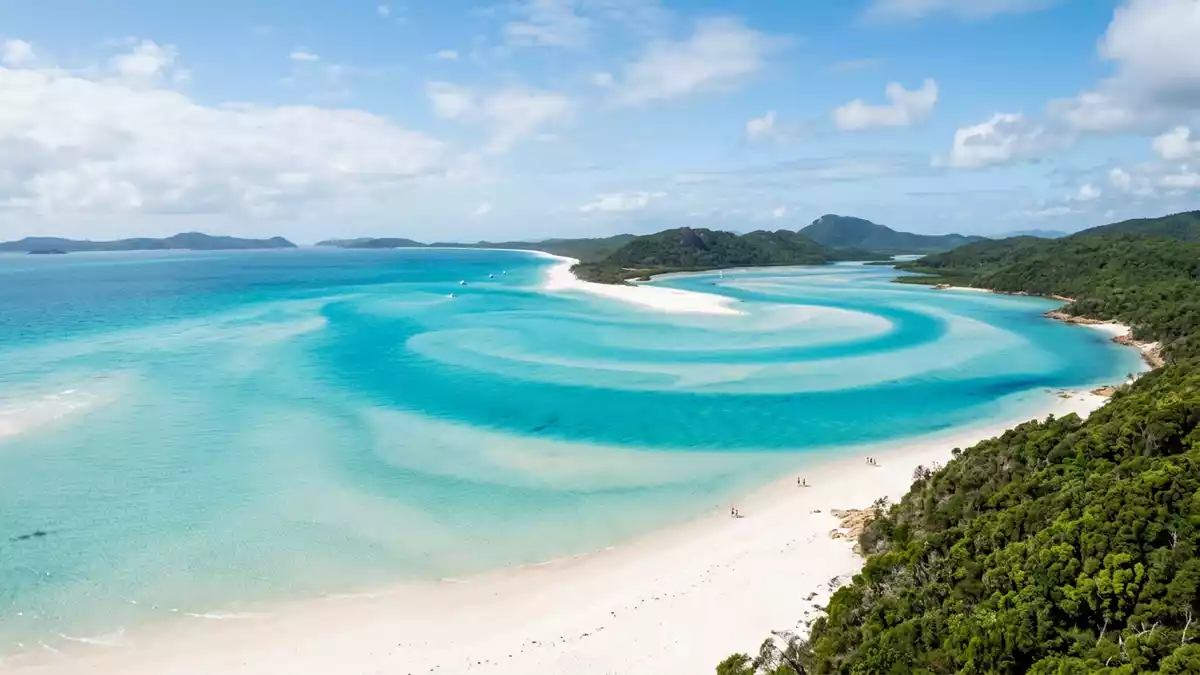
Whitehaven Beach on Whitsunday Island in the Whitsundays in Australia is a long, pale ribbon of sand between forested slopes and the Coral Sea, defined above all by its unusually pure silica grains and the way they shape the shoreline along the eastern side of the island.
An arc of almost pure silica sand
Seen from the water or from one of the island lookouts, Whitehaven Beach appears as a sweeping arc of pale sand running along the eastern shore of Whitsunday Island, backed by bush-covered ridges and opening towards the reef waters of the Coral Sea. The beach extends for about 7 km (4.3 miles), forming one continuous strip that follows the curve of the island rather than a series of separate coves, which gives it a strong visual presence against the darker land behind.Whitehaven Beach stretches over seven kilometres Along most of its length the surf breaks gently on a shallow foreshore, and at typical tides a broad strip of sand lies exposed between the waterline and the vegetation, creating space for walking and for small craft to land without any built structures intruding on the view.Seven kilometers of it stretches along the eastern side of Whitsunday Island
What distinguishes this arc from many other beaches in Queensland is the composition of its sand. Surveys of the material have repeatedly found that the grains at Whitehaven Beach are made up to around 98% of silica, a very high proportion compared with more typical coastal sands that mix quartz with shell fragments and other minerals.Surveys of the beach material place the silica content at around 98% That purity gives the beach its markedly light colour and a fine, powder-like texture underfoot, and it also means the sand behaves differently from many other beach sands because silica does not retain heat in the same way. Accounts of the beach consistently note that the silica grains at Whitehaven are extremely fine, so much so that they can work their way into mechanical and electronic equipment if handled without care.The beach is famous for its white silica sands
Whitsunday Island and the protected setting
Whitehaven Beach lies on Whitsunday Island, the largest of the Whitsunday group off the central Queensland coast, within both a national park and the wider Great Barrier Reef Marine Park. The island itself is a mix of forested slopes, rocky headlands and smaller bays, with Whitehaven occupying much of the eastern shoreline as a single long strand of sand. The beach sits on the south-eastern side of the island, facing out towards the reef lagoon and away from the mainland coast, and it is reached across open water rather than by road, which gives any visit a sense of crossing from the mainland to an offshore landscape.Whitehaven Beach is on Whitsunday Island in Whitsunday Islands National Park The protected status of both the island and the surrounding reef means the shoreline remains largely free of permanent buildings, with the transition from bush to sand and from sand to sea forming the main visual structure of the place.the Great Barrier Reef marine park and Whitsunday National Parks
Along the length of Whitehaven Beach, shallow clear water meets the high-silica sand, and in places walking tracks from the interior of Whitsunday Island reach the shoreline, linking the forested ridges with the open strand.Visitors encounter a long stretch of pale silica sand, shallow clear water, walking tracks to viewpoints Inland, the slopes above the beach carry vegetation typical of the Whitsundays, so the view from the sand includes both the pale foreground and the darker, tree-covered backdrop. Offshore, the Coral Sea extends towards the line of the Great Barrier Reef, and the colours of the water shift with depth and sand content, adding further contrast to the already marked difference between land and sea. The fact that the beach lies within the Great Barrier Reef Marine Park ties it to one of the most formally recognised marine environments in the world, and it also means that many visitors encounter Whitehaven Beach as part of a wider journey through reef and island landscapes.Whitehaven Beach & Hill Inlet | Great Barrier Reef
Sand, water and the experience of the shoreline
The physical properties of the silica sand are central to how a visit to Whitehaven Beach unfolds. Because the grains consist so largely of silica, the sand keeps a very light colour even when wet, and the fine texture creates a smooth surface that can be moulded easily by wind and water. Reports of the beach note that the high silica content means the sand does not hold heat in the same way as darker mineral mixes, so long stretches of the foreshore can remain comfortable to walk on in bare feet under strong sun.The defining feature of Whitehaven Beach is its 98% pure silica sand At the same time, the fineness of the grains means they are easily picked up by wind, waves and people; visitors are routinely advised that the sand can enter cameras, phones and other equipment because of its very small particle size.Whitehaven Beach’s sand is made from 98.9% pure silica
Along the beach the interaction between sand and water produces different patterns depending on tide and location. In some sections the shoreline forms a simple straight edge where small waves roll up and down a uniform slope, while in others the sand builds low banks and shallow lagoons that interrupt the run of the surf. At the northern end of Whitehaven Beach the tidal movements around Hill Inlet create swirling bands of sand and water that shift with the state of the tide, offering views of pale and deeper colours twisting together across the intertidal zone.Whitehaven Beach stretches 7km along the eastern side of Whitsunday Island Elsewhere on the strand the experience is simpler: a long, straight walk along fine pale sand with the sound of surf on one side and the rustle of bush on the other, with small boats anchored offshore and no permanent built frontage to interrupt the sequence of landforms along the sand.Beautiful 7km long beach as part of the Whitsundays island
Visiting Whitehaven Beach: what travellers from Western Europe should know
- Whitehaven Beach lies on the south-eastern side of Whitsunday Island in Queensland, reached by sea or air from the mainland coast around Airlie Beach rather than by road.
- The terrain at the beach itself is a broad, gently sloping strand of fine silica sand meeting shallow water, with bush-covered slopes rising behind and walking tracks linking the foreshore to island lookouts.
- Within the protected area of Whitsunday Islands National Park and the Great Barrier Reef Marine Park, the shoreline remains largely undeveloped, so any visit combines contact with the long silica beach and the surrounding island and reef landscape.
- The official language is English and the currency is the Australian dollar.
Searching for Whitehaven Beach on social platforms
These links open searches for Whitehaven Beach on each platform.
Frequently asked questions about Whitehaven Beach
Where is Whitehaven Beach and what kind of place is it?
Whitehaven Beach is a long silica sand beach on the eastern side of Whitsunday Island in Queensland, within Whitsunday Islands National Park and the Great Barrier Reef Marine Park.
What should travellers expect when visiting Whitehaven Beach?
Travellers encounter a broad arc of pale, fine-grained sand meeting shallow clear water, backed by bush-covered slopes, with access by sea or air from the mainland rather than by road.
What makes Whitehaven Beach distinctive among Australian beaches?
The beach is defined by its unusually pure silica sand, with surveys placing the silica content at around 98%, which gives it a very light colour, fine texture and different behaviour from typical coastal sands.


