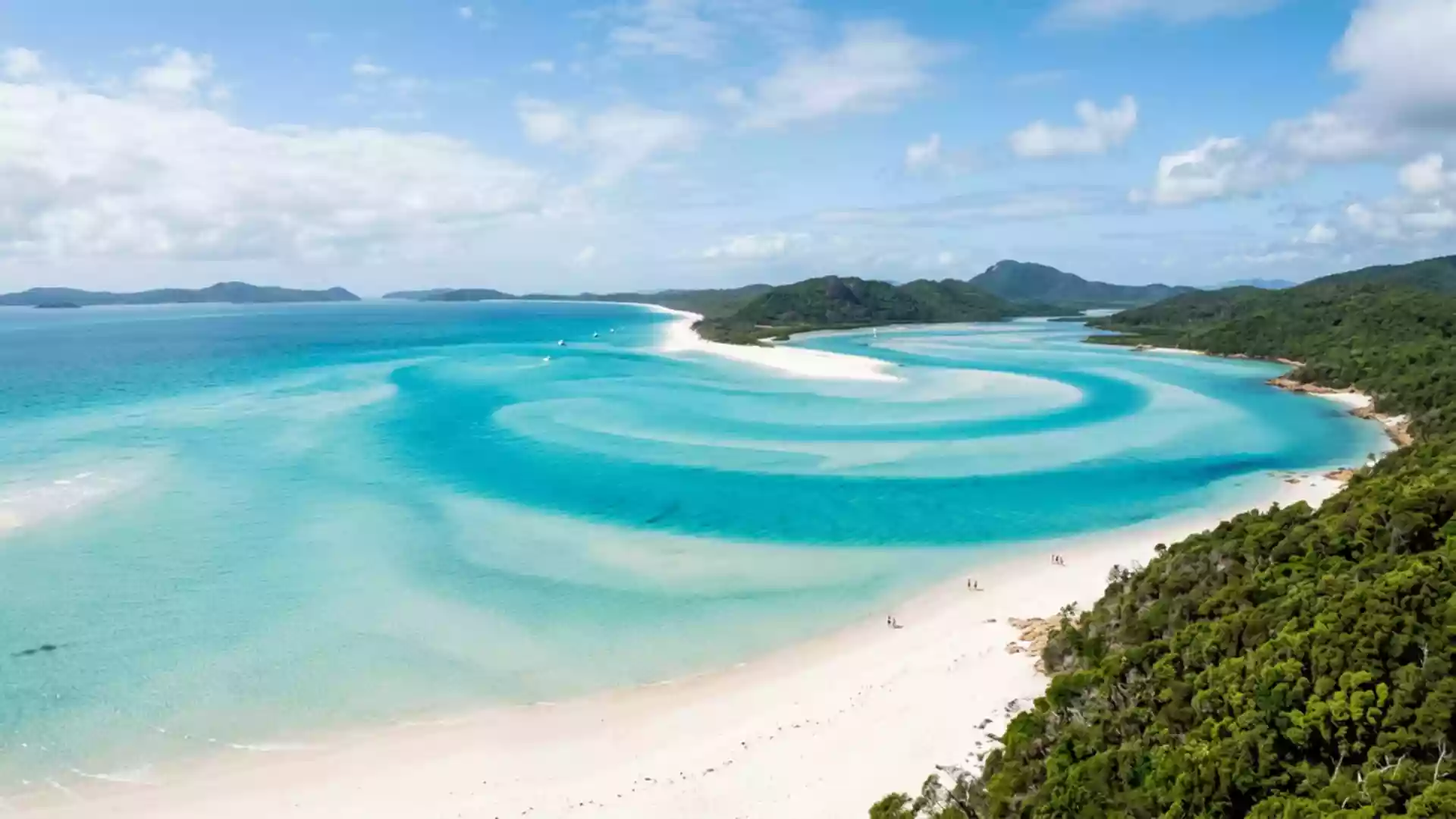
Whitehaven Beach and its long arc of silica sand
Published on 09/09/2026 at 16:05 | Editorial responsibility: Rafael Müller, Editor-in-Chief AD HOC NEWS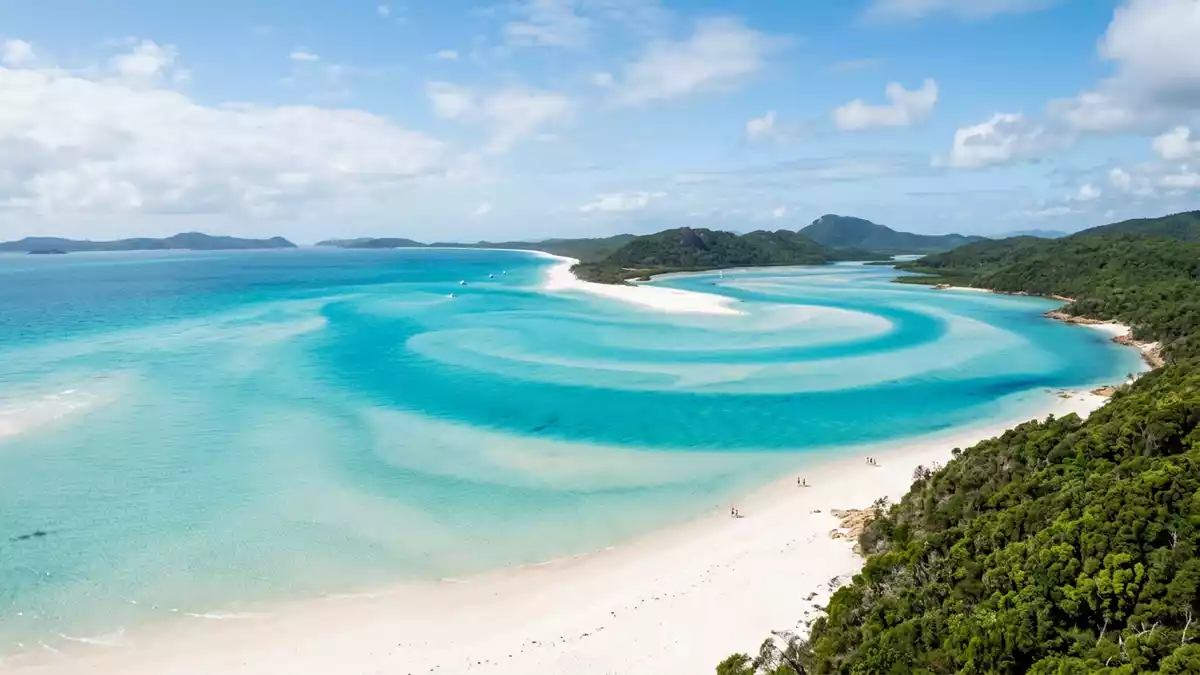
On the eastern side of Whitsunday Island in Queensland, Whitehaven Beach lays out a long arc of pale sand between green hills and the Coral Sea. This stretch of shoreline is part of the Whitsundays and sits within the wider Great Barrier Reef World Heritage Area, giving it a protected setting that shapes how the beach looks and feels over its full length.
An arc of silica sand on Whitsunday Island
Whitehaven Beach runs along the eastern shore of Whitsunday Island, one of the main islands in the Whitsundays off the coast of Queensland, Australia. The beach forms a curving ribbon facing the Coral Sea, backed by low forested slopes and pockets of tropical vegetation that reach down towards the sand. It sits within a national park on land and within the Great Barrier Reef Marine Park offshore, a protected arrangement that keeps the shoreline largely undeveloped and limits structures to simple facilities near established landing points.Whitehaven Beach stretches over seven kilometres along this side of the island, giving visitors a sense of scale that is clear as soon as boats anchor offshore or touch the sand.
The sand on Whitehaven Beach is known for its unusually high silica content, with surveys and descriptions placing the figure at around 98 per cent. This composition gives the sand a very light colour and a fine, almost powder-like texture underfoot, distinct from the coarser coral and shell fragments found on many other beaches in Queensland. The grains are derived from silica, a mineral linked to quartz, and they form a broad, continuous band along the shoreline with subtle variations in depth and slope as the beach rises and falls. The combination of bright white sand and shallow clear water creates strong contrasts in colour, especially where tidal patterns leave wet and dry areas side by side.The beach is seven kilometres in length and is famous for its white silica sands, a description that has become part of how the place is introduced in guides and official material.
Hill Inlet and the changing patterns of sand and sea
At the northern end of Whitehaven Beach, a shallow tidal estuary known as Hill Inlet cuts into the island and reshapes the contact between sand and sea. Here, pale silica banks and bars form broad sweeps and curves that shift with the tides, creating visible swirls of white and turquoise when viewed from the headlands and designated lookouts above. Boats tend to anchor offshore in defined zones, and walking tracks lead inland and upward to viewpoints that look across the inlet and the northern sections of the beach.Hill Inlet Lookout and South Whitehaven Lookout are named vantage points frequently used to frame the beach and inlet together in photographs.
The inlet’s relationship with the main beach gives Whitehaven a second layer of character beyond the long open arc of its central and southern sections. On the sand, the presence of the inlet is felt in the gentle gradients and shallow waters that change with the tide, exposing sandbars at low tide and covering them with clear water as the sea rises. From the hillside tracks, Hill Inlet appears as a broad basin with sinuous sand formations, illustrating how the high-silica sand is not only a static surface but a material moved and rearranged by tidal flows. These visual patterns are one of the reasons the northern end of Whitehaven Beach has become a focus for scenic access, with walking routes arranged to give views over both inlet and open coast.Whitehaven Beach stretches seven kilometres in length and is known for its unique white silica sand and the tidal patterns of Hill Inlet, tying the geometry of the inlet directly to the identity of the beach.
Within the Great Barrier Reef Marine Park
Whitehaven Beach lies within both a terrestrial national park on Whitsunday Island and the Great Barrier Reef Marine Park offshore, placing it in a network of protected areas along the central Queensland coast.The beach is part of the Great Barrier Reef Marine Park, and management rules cover activities on the sand and in the surrounding waters. These formal designations sit alongside the broader recognition of the Great Barrier Reef as a World Heritage Area, connecting Whitehaven Beach to one of the most documented marine environments on the planet.
The protected status has practical consequences for how the beach is experienced. The sand and shells are not removed, boats use set anchoring and mooring practices, and camping or extended stays on parts of Whitsunday Island require permits from the relevant park authorities. Offshore, fringing reefs and seagrass beds form habitats for marine life, and the clarity of the water close to the beach reflects both the sandy substrate and the managed marine environment around it. On land, basic walking tracks, lookouts and small infrastructure points are fitted into the forested slopes without large built-up strips or continuous rows of buildings. This combination of long silica beach, tidal inlet and protected land and sea gives Whitehaven Beach a character grounded in both geology and formal conservation.
Visiting Whitehaven Beach: what travellers from Western Europe should know
- Whitehaven Beach is on Whitsunday Island off the central Queensland coast in Australia and is reached by boats and organised trips departing from places such as Airlie Beach and Hamilton Island.
- The beach itself is a long, gently sloping strip of silica sand with shallow nearshore waters, so access from boats generally involves stepping straight onto the sand and walking across open shoreline.
- Walking tracks from designated landing areas lead into low forest and up to lookouts over Hill Inlet and the main beach, with gradients and stair sections that call for steady footwear rather than beach sandals.
- The official language is English and the currency is the Australian dollar.
- Entry requirements depend on your nationality; UK travellers can check the FCDO travel advice at gov.uk/foreign-travel-advice, Irish travellers the Department of Foreign Affairs at ireland.ie.
Searching for Whitehaven Beach on social platforms
These links open searches for Whitehaven Beach on each platform.Frequently asked questions about Whitehaven Beach
Where is Whitehaven Beach located?
Whitehaven Beach is on Whitsunday Island in Queensland, Australia, facing the Coral Sea within the Whitsundays and the Great Barrier Reef Marine Park.
What should visitors expect on a visit?
Visitors can expect a long arc of pale silica sand, shallow clear water, simple walking tracks to viewpoints and a largely undeveloped shoreline within national and marine parks.
What makes Whitehaven Beach distinctive?
The beach is distinctive for its high-silica white sand, its seven-kilometre length along Whitsunday Island and the shifting tidal patterns of Hill Inlet at its northern end.